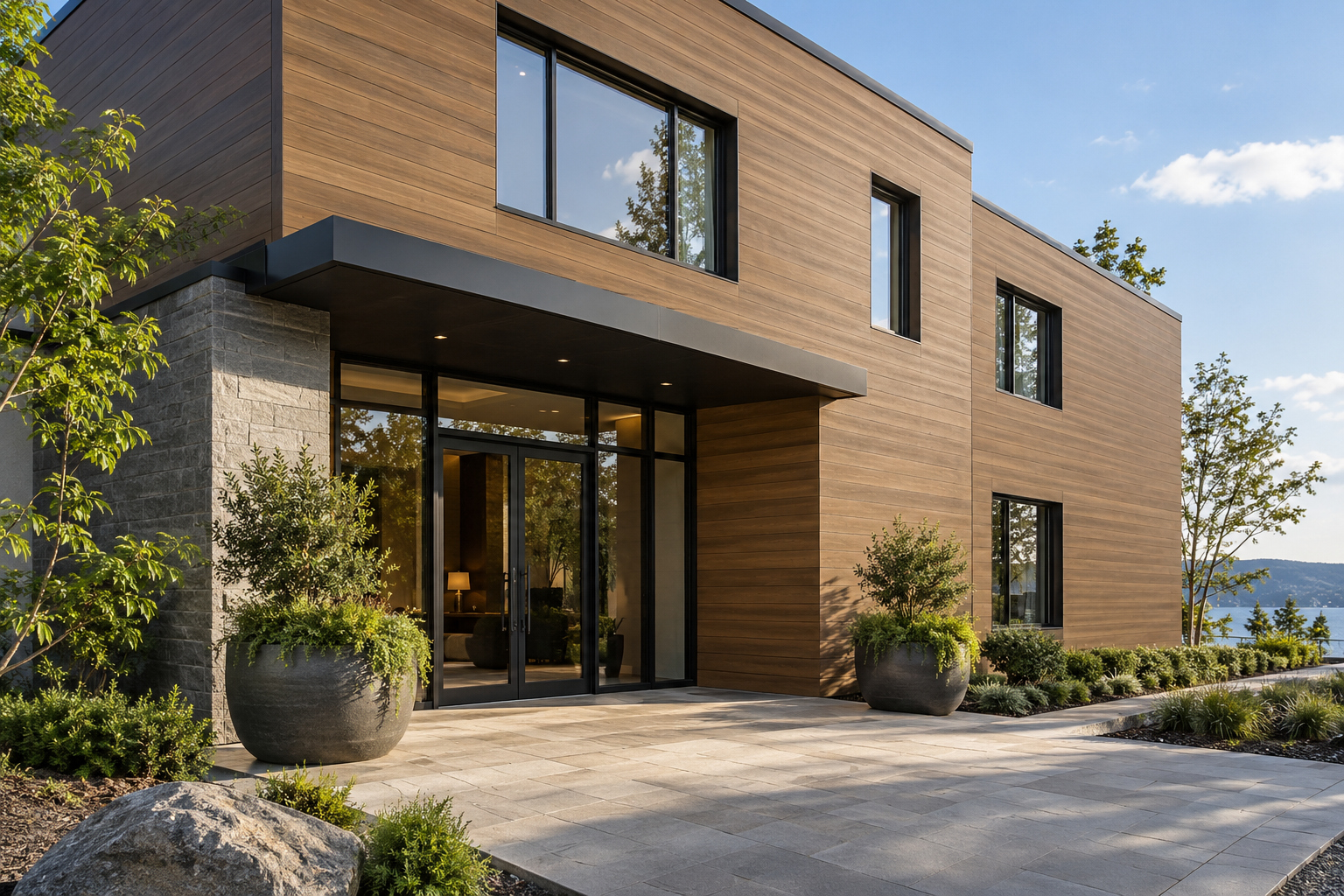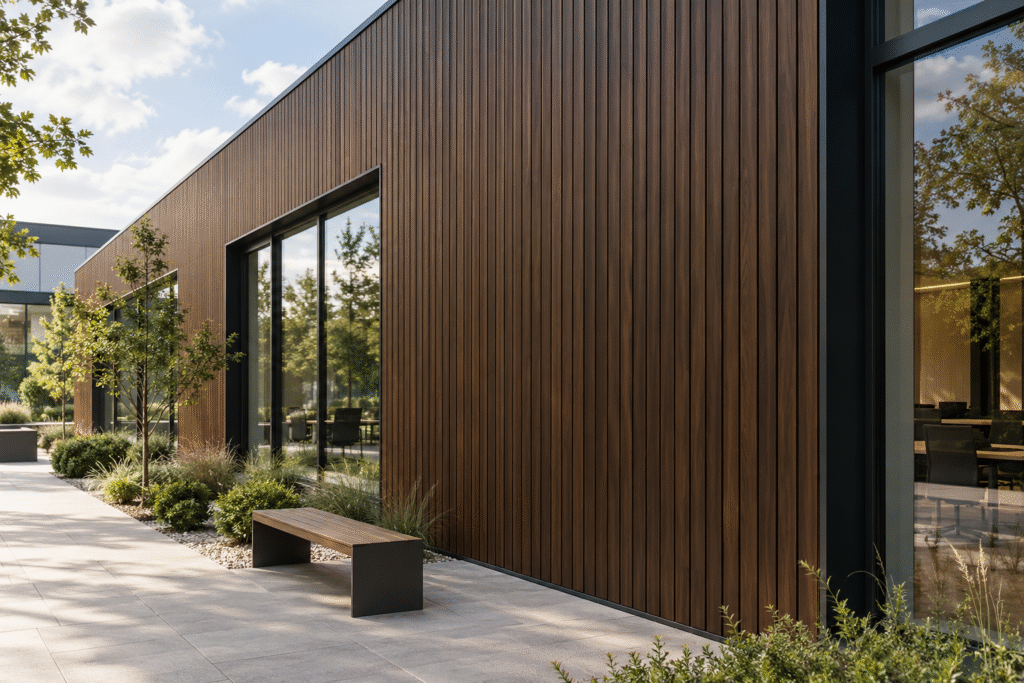
A completed hotel entrance may show a convincing wood-look facade, crisp corners and carefully finished window surrounds. However, its appearance does not identify the construction beneath the visible surface. An importer comparing outdoor WPC wall panels needs more than a photograph and a description such as premium composite. The purchasing decision should connect the offered profile, surface construction and supporting documents.
Outdoor WPC wall cladding names the same product category here. Keep it separate from indoor WPC wall panels, which serve a different application. Additionally, ask the supplier which exterior constructions it actually offers. This comparison does not assume that Witop Decor supplies every capped or uncapped option described in the market.
Quick Answer: Is Capped Cladding Always the Better Purchase?
The label alone cannot settle that decision. A capped profile includes a distinct outer layer; an uncapped profile lacks that separate cap. Compare the exact coverage, intended application, product evidence and care requirements. Then assess the complete offer against the project’s needs. Neither the word capped nor an attractive sample establishes a particular service life, fire classification or warranty outcome.
Identify the Surface Construction on the Offered Profile
Request a labeled cross-section that identifies the core and any separate surface layer. For a co-extruded product, ask the manufacturer to explain where the cap runs around the profile. Also, record the product code and document revision. A generic brochure diagram may describe a family of products without identifying the construction that the quotation includes.
For context, NewTechWood describes its UltraShield construction as a composite core with a polymer cap formed around four sides during extrusion. Its explanation distinguishes different cap-coverage arrangements. These descriptions concern that manufacturer’s products; they do not establish Witop specifications or guarantee the performance of another board. See NewTechWood’s UltraShield construction explanation.
Likewise, clarify what the supplier means by a coating, decorative film or embossed finish if those terms appear in the offer. Do not accept them as interchangeable descriptions of a co-extruded cap. Ask for the offered construction in plain language and connect the answer to a physical sample and its technical specifications.
Map Coverage Beyond the Front Face
During sample evaluation, ask the supplier to identify the visible face, reverse face, edges, grooves and end section. Then compare those locations with the drawing. A small face-only swatch can help a designer choose texture, but it cannot show how the surface layer continues around the full profile.
Also, distinguish coverage around a profile’s cross-section from the treatment of its lengthwise ends. Ask what the manufacturer requires at factory ends and any ends that the project will create. Do not infer an end treatment from a claim about four-sided coverage. Obtain the relevant detail rather than prescribing a universal coating or sealant.
| Comparison point | Question for a capped offer | Question for an uncapped offer |
|---|---|---|
| Construction | Where does the separate cap extend? | What forms the exposed surface? |
| Profile identification | Which code and drawing match the cap? | Which code and drawing match the material? |
| Ends and grooves | What coverage or treatment applies? | What finish or treatment applies? |
| Accessories | Do trims use the same construction? | Do trims use the same construction? |
| Care | Which methods suit the outer layer? | Which methods suit the exposed material? |
| Evidence | Which tests and warranty cover this SKU? | Which tests and warranty cover this SKU? |
Check Corners and Trims as Separate Supply Lines
A finished facade includes more than its main field boards. Therefore, review the proposed corners, end closures and window-surround profiles alongside them. Ask whether each accessory uses the same construction, another composite formulation or a different material. Similar surface appearance does not answer that question, and a panel specification should not silently become an accessory specification.
Next, identify every accessory by code on the elevation and quotation. For a hotel entrance, inspect the intended visible transitions in the design review. Confirm which edges the finished detail exposes and which profiles conceal them. Keep this appearance decision separate from approval of the complete exterior wall assembly and its required technical details.
Match Surface Care to the Building Operator’s Routine
Ask for the current care instructions for the exact proposed surface. Include permitted cleaning products and tools, any restrictions and the supplier’s response procedure for accidental marks. Meanwhile, ask the operator what cleaning routine it can realistically maintain. Do not turn a low-maintenance description into a promise that the facade will need no attention.
In particular, seek written guidance before including sanding, repainting or a repair compound in a maintenance plan. A technique suitable for one construction may not suit another. Request the manufacturer’s approved options without promising that every scratch permits an invisible local repair. Also, discuss how the contractor would access and replace an affected section if the approved remedy requires replacement.
Read the Warranty by Product and Application
Ask which warranty document applies to the offered main profile and each accessory. Check the named product, purchaser eligibility, project location and intended commercial use. Moreover, identify the relevant care obligations and claim evidence. A headline duration does not tell the buying team which conditions the supplier accepts or which remedy the document provides.
Fiberon’s public Wildwood warranty page explicitly identifies its cladding product and asks customers to retain proof of purchase for a claim. That product-specific example illustrates why procurement should preserve traceable records; it does not extend Fiberon’s terms to another supplier. See Fiberon’s Wildwood warranty information.
Finally, buyers should verify test reports, applicable VOC limits, fire-rating documents and warranty terms. Confirm the required fire rating for the actual application with the project team. Treat durability evidence and surface construction as related review items, while recognizing that a cap description cannot replace the required test documentation.
For example, when two offers cite stain resistance, ask which substance, exposure period and assessment method each report covers. Compare the specimen description with the offered surface before treating the results as equivalent. Likewise, keep a supplier’s marketing comparison separate from a report that identifies the exact product under review; send unresolved differences to the project’s technical reviewer.
Compare the Complete Commercial Offer
Ask the decorative building materials supplier to quote the identified boards and accessories against the same elevation. Compare installation cost with the building contractor and maintenance cost with the operator. Consequently, the team can evaluate the proposed scope without assuming that either construction always costs less over its service period.
Project procurement should retain the approved cross-section, sample reference, care guide and warranty revision with the order. Confirm MOQ, lead time and container loading for the final mix of products. Discuss custom colors and OEM/ODM cooperation before approval, and ask whether a proposed variation changes the documents on which the review relies.
B2B Buyer FAQ
Can a Photograph Identify a Capped Board?
No reliable purchasing conclusion follows from appearance alone. Request the manufacturer-identified cross-section, product code and construction description, then connect those records with the submitted sample.
Does Four-Sided Coverage Describe Every End Detail?
Ask the manufacturer to distinguish profile coverage from end treatment. Obtain the instructions for the exact product and planned detail rather than assuming the label answers both questions.
Should an Uncapped Offer Automatically Fail the Comparison?
Assess the actual product against the project’s requirements and evidence. A category name alone neither approves nor rejects an offer; document the reasons for the selection.
Can We Use the Panel Care Guide for Every Trim?
Check each accessory’s construction and applicable instructions. The supplier may specify a different material or surface, so confirm its care requirements within the same purchasing file.
What Should a Wholesale Distributor Include in an Inquiry?
Send Witop Decor the elevations, intended use, preferred appearance and quantities. In your bulk order inquiry, request samples, technical data sheets and a project quotation identifying the offered surface construction and accessories.

James is a content creator and decorator with five years of experience designing home decor. In his daily life, james is constantly on the lookout for the latest, great examples of house design and further optimizes his solutions. Additionally, he writes articles related to outdoor design, interior design, and architectural decorating materials to help brands build more engaging relationships with their audiences.