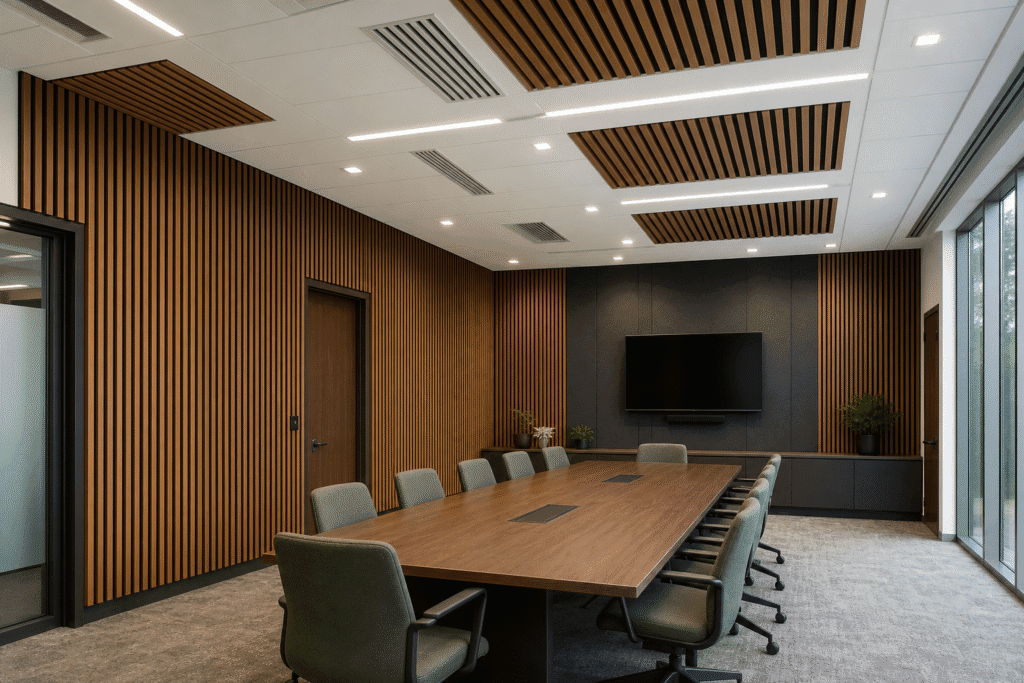
Direct Answer: B2B buyers should not select acoustic panels from an NRC number alone. They should review frequency-by-frequency absorption data, specimen construction, mounting method, air gap, panel thickness, room geometry, coverage, fire and VOC documents, durability, installation details, and supplier quality control. Therefore, a reliable procurement process connects laboratory evidence with the actual commercial room and complete installed assembly.
Start With the Room Problem, Not the Product Rating
Meeting rooms, restaurants, classrooms, hotel lobbies, offices, studios, and public halls create different acoustic problems. For example, a meeting room may need clearer speech, while a restaurant may need lower overall noise buildup. Consequently, buyers should define the room use, occupancy, volume, surface finishes, background noise, and communication goal before they compare acoustic panels.
An acoustic panel absorbs part of the sound energy that reaches it. However, panel performance depends on frequency, construction, mounting, placement, and total area. One single-number rating cannot describe every condition.
Therefore, developers, contractors, importers, distributors, interior designers, and acoustic consultants should translate the room problem into measurable requirements. They should also separate sound absorption inside a room from sound insulation between rooms. Acoustic wall panels may improve reverberation, yet they do not automatically stop speech or mechanical noise from passing through walls, doors, ceilings, or ducts.
Acoustic Procurement Evidence Matrix
| Specification dimension | Buyer question | Evidence to request | Risk if ignored |
|---|---|---|---|
| Absorption rating | How much sound does the tested specimen absorb? | NRC or other applicable rating plus full frequency data | A headline number hides weak performance at important frequencies |
| Mounting condition | How did the laboratory install the specimen? | Test setup, backing, air gap, frame, coverage, and specimen size | Site installation does not match the reported result |
| Room coverage | How much treated area does the room need? | Acoustic calculation, room model, or consultant recommendation | Too little material produces limited change |
| Fire and VOC | Can the exact assembly meet local requirements? | Current reports for panel, finish, backing, and mounting | Approval delay or specification rejection |
| Durability | Can the surface tolerate impact, dust, and cleaning? | Material data, cleaning guidance, sample tests, and warranty | Early visual damage or difficult maintenance |
| Factory consistency | Will bulk production match the approved sample? | Golden sample, tolerances, lot records, and inspection plan | Color, dimension, or fit variation across the project |
This matrix helps a procurement team request comparable quotations. Moreover, it moves the discussion from marketing claims to evidence. As a result, suppliers can quote the same panel construction, mounting method, accessories, and quantity basis.
Understand What NRC Can and Cannot Tell You
NRC gives buyers a convenient single-number summary of sound absorption across selected mid-frequency bands. Therefore, it can help with an initial product comparison when every report uses a recognized method and comparable specimen.
However, NRC does not show the complete absorption curve. Two products may display a similar NRC while performing differently at lower or higher frequencies. Consequently, buyers should request the full table or graph rather than rely on the headline number.
Additionally, an NRC value does not predict the final room result by itself. Room volume, existing finishes, panel area, location, ceiling height, occupancy, furniture, and background noise all influence perception. The acoustic consultant should connect product data to the actual space.
Read Frequency-by-Frequency Absorption Data
Speech, music, mechanical equipment, and crowd noise distribute energy across different frequencies. Therefore, the project should identify which frequency range creates the main problem. Meeting rooms often emphasize speech clarity, while entertainment spaces may need broader control.
Next, compare the absorption data at each reported frequency. A panel may absorb well in the middle and upper range but offer less help at lower frequencies. Moreover, a deeper assembly or air cavity may change that behavior.
Buyers should avoid turning laboratory data into unsupported guarantees. Instead, they should use it as an input to a room calculation or professional design. As a result, the project can choose panel thickness, mounting depth, and coverage for the actual acoustic target.
Match the Laboratory Mounting Method
Mounting conditions can change acoustic performance significantly. Therefore, buyers should check whether the laboratory placed the panel directly against a rigid surface, mounted it on battens, added an air gap, used insulation, or tested a complete slat-and-backing assembly.
Moreover, the specimen may include joints, frames, edge exposure, or a particular coverage area. If the site removes those elements, the published result may no longer represent the installation. The tender should name the tested construction and any approved variation.
An air cavity can influence absorption, especially at some lower frequencies. However, a deeper build-up affects door frames, electrical devices, skirting, room dimensions, and fire strategy. Consequently, the project team should coordinate acoustic depth with architectural interfaces before ordering material.
Calculate Coverage From Room Conditions
A fixed coverage percentage does not suit every room. Therefore, designers should consider room volume, shape, ceiling height, existing absorption, occupancy, target reverberation, and panel performance. A small carpeted meeting room needs a different strategy from a glazed double-height lobby.
Additionally, the location of the panels matters. Distributing treatment across useful wall and ceiling surfaces can control reflections more effectively than concentrating every panel in one decorative strip. Nevertheless, the final layout should follow the acoustic design and room constraints.
Project teams can start with a calculation, then verify through a mockup or completed pilot room where practical. Consequently, they gain evidence before repeating the same design across a hotel, office, school, restaurant chain, or residential development.
Separate Sound Absorption From Sound Insulation
Buyers often ask acoustic panels to solve a privacy problem between rooms. However, wall absorption and room-to-room sound insulation address different paths. Absorption reduces reflected sound inside a space, while insulation depends on partitions, doors, glazing, ceilings, floors, penetrations, and flanking routes.
Therefore, a meeting room with excessive echo may benefit from acoustic panels. In contrast, a meeting room that leaks confidential speech through an unsealed door needs enclosure improvements as well.
Mechanical systems also create background noise and transfer sound through ducts. Consequently, the consultant should review HVAC noise, return-air paths, ceiling plenums, and service penetrations. Decorative panels cannot compensate for every building-services issue.
Select the Right Panel Construction
Commercial acoustic panels can use PET fiber, fabric-wrapped absorbers, perforated boards, wood-slat surfaces with acoustic backing, or other constructions. Therefore, buyers should identify every layer: decorative face, core, felt or backing, frame, adhesive, finish, and mounting hardware.
Each construction creates different visual, acoustic, cleaning, impact, and installation characteristics. For example, a wood-slat panel can support a linear interior design, while a fabric-wrapped panel may offer another absorption profile and edge detail.
Moreover, material names do not guarantee performance. Buyers should compare exact thickness, density where relevant, dimensions, tolerance, edge quality, and test specimen. The purchase order should lock those attributes to the approved sample.
Coordinate Walls, Ceilings, Lighting, and MEP
Acoustic panels often meet doors, glazing, skirting, ceilings, sprinklers, detectors, speakers, diffusers, switches, screens, and artwork. Therefore, coordinated elevations should locate every device and define how the panel terminates around it.
Additionally, loaded equipment needs independent support. Installers should not rely on a decorative acoustic panel to carry televisions, shelves, handrails, or heavy signs unless the complete fixing detail has approval. Backing should connect to a suitable structure.
Ceiling installations require particular care. The project must coordinate suspension, access, seismic requirements where applicable, sprinkler coverage, lighting, and maintenance routes. Consequently, the installer needs reflected ceiling plans and service information before fabrication.
Verify Fire, Smoke, VOC, and Material Documents
Commercial projects may require fire, smoke, VOC, chemical, environmental, or hygiene documentation. Therefore, buyers should verify current test reports for the exact panel construction, surface finish, backing, thickness, adhesive, air gap, substrate, and mounting condition.
Moreover, a result for one component may not describe the complete installed assembly. Timber slats, PET felt, fabric, foam, adhesive, battens, cavities, and insulation can all affect assessment. The responsible fire consultant or local authority should review the proposed build-up.
Buyers should also check report dates, specimen identification, laboratory scope, and product traceability. They should verify fire-rating documents, VOC limits, warranty terms, and local acceptance before confirming a bulk order.
Plan Cleaning, Impact, and Replacement
Acoustic surfaces can collect dust or face contact from chairs, luggage, cleaning tools, and occupants. Therefore, the specification should match panel placement to the operating environment. High-contact lower walls may need a more durable finish or a separate protection zone.
Additionally, cleaning teams need approved vacuuming, brushing, spot-cleaning, or wiping guidance. A restaurant, classroom, hotel corridor, and executive meeting room will not use the same maintenance routine. Buyers should test cleaning methods on an approved sample.
Modular replacement can reduce lifecycle cost. Consequently, designers should use repeatable modules and accessible fixings where damage risk remains high. The owner should store matching panels, trims, clips, and lot references.
Control Color, Slat Rhythm, and Batch Variation
Acoustic panels often cover large visible areas. Therefore, small differences in woodgrain, fabric shade, felt color, gloss, slat spacing, or edge alignment can become obvious. Buyers should approve full-size panels under project lighting.
Moreover, linear slat systems need consistent rhythm across corners, doors, and service cutouts. Shop drawings should show module starts, end cuts, joint locations, and trim profiles. Installers should follow the same orientation throughout the elevation.
The factory should identify production lots and retain control samples. As a result, an importer can compare bulk production with the signed golden sample before shipment and manage reorders more accurately.
Compare Landed and Installed Cost
Panel price alone does not represent project cost. Therefore, buyers should include accessories, backing, battens, adhesives, fasteners, labor, access equipment, cutouts, waste, freight, duties, local transport, protection, cleaning, testing, and spare stock.
Additionally, a high-performing panel may need less coverage than a weaker product for the same design target, although only a proper calculation can confirm that outcome. Consequently, price per panel can mislead procurement teams.
Installation productivity also varies by module size and interface complexity. A pilot room can record crew hours, waste, cutting, alignment, and rework. This evidence helps contractors compare realistic installed cost and program impact.
Inspect Production and Packing Before Shipment
Acoustic panels can suffer crushed edges, surface marks, slat damage, bent profiles, or moisture exposure during transport. Therefore, packaging should protect faces, corners, long modules, and accessories. Buyers should confirm pallet size, gross weight, forklift access, stacking limits, and container bracing.
Moreover, pre-shipment inspection should review dimensions, thickness, squareness, slat spacing, backing adhesion, surface defects, color range, quantity, labels, and packaging. The inspector should compare representative units against the golden sample.
At Witop Decor, B2B customers can request acoustic panel samples, technical data sheets, color options, accessory information, packing details, and project quotations. However, the buyer should define the sampling plan and acceptable quality limits before production.
Approve a Pilot Room Before Repeating the Design
A pilot room connects laboratory data with architecture and installation. Therefore, it should include actual wall or ceiling build-up, panels, air gap, trims, lighting, doors, glazing, devices, and furniture where practical.
Next, the design team should inspect joint quality, color, alignment, edge details, device cutouts, and cleaning access. Additionally, the acoustic consultant can measure or assess the completed room against the project target.
Finally, the project should record approved construction, panel quantity, installation time, waste, and lessons learned. As a result, later rooms receive a clearer bill of materials and quality benchmark.
B2B Procurement Checklist
- Define room use, occupancy, volume, finishes, noise sources, and acoustic target.
- Separate reverberation control from room-to-room sound insulation.
- Request NRC or applicable ratings plus full frequency absorption data.
- Verify test specimen, mounting method, backing, air gap, and coverage.
- Use an acoustic calculation or consultant recommendation to set panel area.
- Coordinate doors, glazing, ceilings, lighting, sprinklers, HVAC, and loaded fixtures.
- Verify fire-rating documents, VOC limits, warranty terms, and local acceptance.
- Approve full-size color, slat rhythm, edges, trims, and cleaning method.
- Lock the golden sample, production tolerances, inspection plan, and lot records.
- Review packing, container loading, installation labor, waste, and spare modules.
Frequently Asked Questions
1. Does a higher NRC always mean a better acoustic panel?
No. A higher single-number rating may indicate more average absorption under the tested condition, but the project also needs suitable frequency performance, mounting, coverage, fire evidence, durability, and visual details.
2. How much wall coverage does a commercial room need?
No fixed percentage works for every room. Coverage depends on room volume, shape, existing finishes, occupancy, target reverberation, panel performance, and placement. Use a calculation or qualified acoustic recommendation.
3. Can acoustic wall panels provide speech privacy between offices?
They can reduce reflections inside a room, but they do not automatically stop sound transmission between rooms. The project should also review partitions, doors, glazing, ceilings, penetrations, HVAC paths, and background noise.
4. Does an air gap improve acoustic performance?
It can change absorption and may improve performance in some frequency ranges. However, buyers should verify the laboratory mounting condition and coordinate the added depth, fire strategy, interfaces, and installation method.
5. Which documents should an importer request?
Request technical data sheets, frequency absorption data, rating reports, specimen and mounting details, dimensions, installation guidance, cleaning instructions, packing data, warranty terms, and relevant fire and VOC documents.
Request an Acoustic Panel Project Package
A reliable acoustic panel package connects laboratory data with room use, mounting, coverage, interfaces, compliance, maintenance, and total installed cost. Therefore, share your floor plans, elevations, room dimensions, acoustic target, panel quantity, target finish, destination port, and installation schedule with Witop Decor. Our B2B team can discuss samples, technical data sheets, custom colors, OEM or ODM cooperation, wholesale pricing, packing, container loading, distributor support, and project quotations.

James is a content creator and decorator with five years of experience designing home decor. In his daily life, james is constantly on the lookout for the latest, great examples of house design and further optimizes his solutions. Additionally, he writes articles related to outdoor design, interior design, and architectural decorating materials to help brands build more engaging relationships with their audiences.