Quick Answer: Does a High NRC Prove Meeting Room Privacy?
No. The Noise Reduction Coefficient, or NRC, describes sound absorption; it does not rate how confidential a conversation remains outside a room. Acoustic panels can support the room’s absorption strategy, while sound isolation depends on the enclosing construction and its connections. Furthermore, speech privacy depends on listening conditions outside the room. Buyers should request separate evidence for the panels and a coordinated assessment of the complete meeting room.
For project procurement, this distinction prevents a costly mismatch. A buyer may order attractive wall panels with absorption data while expecting them to resolve an overhearing complaint from the corridor. Therefore, the quotation must identify which objective the panels address and who owns the other parts of the acoustic brief.
Keep Absorption and Transmission Evidence in Separate Columns
An absorption rating answers a different question from a transmission rating. Armstrong’s technical explanation distinguishes NRC from Ceiling Attenuation Class, or CAC, which addresses sound transmission through a shared ceiling plenum. This illustrates the broader purchasing principle: a material’s absorption evidence cannot substitute for evidence about a different transmission path. Armstrong NRC and CAC explanation.
Sound Transmission Class, or STC, describes sound insulation using transmission measurements and a defined rating method. ASTM E413 distinguishes laboratory ratings from field ratings and notes that flanking paths or construction differences can lower building performance. Consequently, a laboratory partition result does not establish the privacy of a completed room with different doors, junctions or services. ASTM E413 classification scope.
| Evidence | What buyers can use it to review | What it does not establish alone |
|---|---|---|
| Panel absorption report with NRC | Absorption performance of the tested product and mounting | Room-to-room isolation or confidentiality |
| Partition transmission report with STC | Performance of the tested partition construction | The result of every wall, door and service connection onsite |
| Ceiling system evidence with CAC | Transmission through the tested shared-plenum arrangement | Performance of unrelated wall or door paths |
| Completed-room assessment | The defined room, receiving positions and test conditions | Unlimited privacy under every future operating condition |
Also keep the actual report attached to the purchase record. Name each file by evidence type, product or assembly code, report reference and revision. A folder named only “acoustic certificate” encourages the wrong document to travel with a quotation. A number in a brochure also lacks the construction detail that allows a technical reviewer to judge applicability. Ask the reviewer to record the match and any exceptions before the buyer accepts a substitution.
Convert “Private Meeting Room” into an Assessable Brief
Start with the room’s use. A routine team discussion, a client negotiation and a personnel interview may demand different privacy expectations. Next, identify potential listeners: people in the neighboring meeting room, a corridor waiting area or an adjoining office. Record when those locations operate and which spaces the tenant controls.
Describe the concern clearly. Does the client want fewer distractions, less audible speech, or protection against understanding words? Avoid translating those different expectations into a single panel specification. Instead, appoint an acoustic specialist to define appropriate criteria and a verification approach for the actual project.
The National Research Council Canada’s meeting-room guidance considers transmitted speech alongside background sound at the listener’s position when assessing privacy. Therefore, the brief should document relevant operating conditions, rather than assuming that an empty room and a busy workday provide equivalent evidence. This is an assessment principle, not a recommendation to create excessive background noise. National Research Council Canada speech privacy guide.
Assign Responsibility for Every Room Boundary
Give the design team a room plan showing walls, doors, glazing, ceiling boundaries and service routes. Ask it to identify potential transmission paths and the party responsible for each detail. Additionally, include the junctions between trades. A wall contractor and a services contractor can each finish their own scope while leaving an unresolved interface.
The building contractor should coordinate the approved construction with door, glazing and mechanical suppliers. Meanwhile, the acoustic panel supplier should identify the offered product, facing, backing, thickness and mounting arrangement. Keep those responsibilities visible in the quotation so decorative absorption does not become an implied guarantee for the entire enclosure.
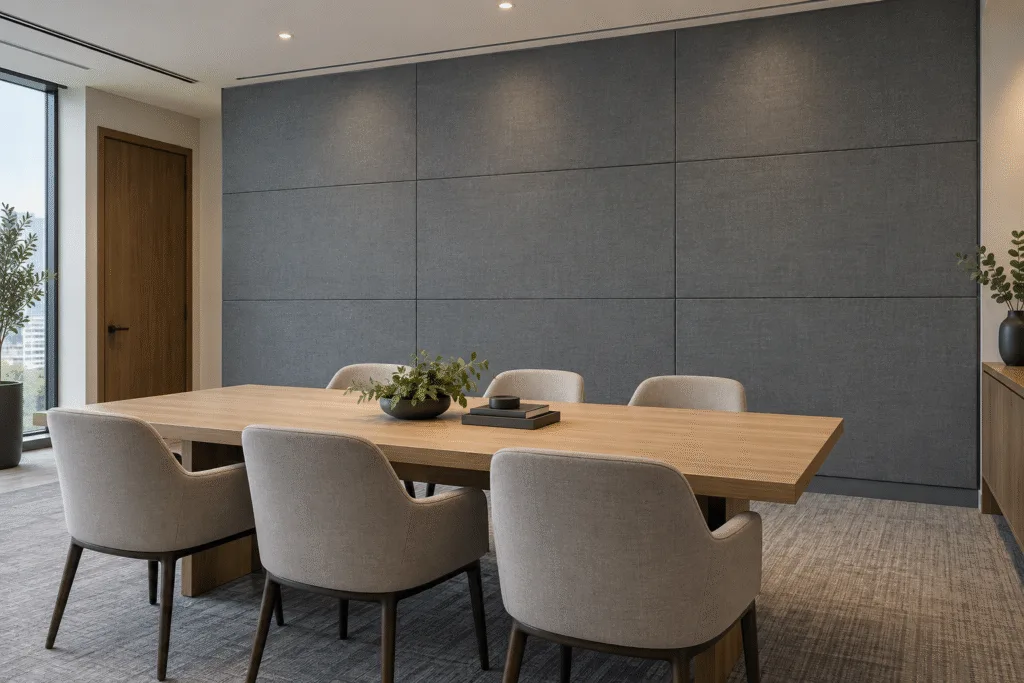
For example, a finished boardroom may have a fabric-faced panel wall, a closed door and a coordinated ceiling. The visual result does not reveal every hidden sound path. Therefore, include inspection and assessment milestones in the project plan, with access before finishes conceal critical details where the design team requires it.
Match the Delivered Panels to the Evidence
An importer should request technical specifications and the full relevant test report for the proposed panel assembly. Check the product identifier, facing, thickness, backing, mounting and laboratory information. Also ask which alternatives the evidence covers. A similar color or nominal thickness does not establish that two constructions share the same result.
During sample evaluation, assess texture, edges, color consistency and fixing compatibility separately from acoustic claims. A handclap or an informal conversation may flag an issue, but it does not replace the agreed assessment. Furthermore, buyers should verify test reports, VOC limits, fire-rating documents and warranty terms for the supplied product and destination requirements. A fire rating claim requires its own applicable evidence.
Record how finish changes, replacement facings and mounting substitutions will enter the approval process. This matters for a wholesale distributor because a standard sales description may reach many projects. Instead of promising “soundproof panels,” describe the documented product function and refer room performance questions to the coordinated project specification.
Compare the Cost of the Agreed Scope
Request separate prices for panels, mounting components, design coordination and any agreed verification work. Compare installation cost using the same approved scope. Otherwise, a cheaper quotation may simply omit an enclosure issue that another supplier has identified. Additionally, list unresolved assumptions beside the price so the buyer can obtain clarification before release.
Treat durability and maintenance cost as procurement questions too. Ask how staff clean the face, replace damaged modules and preserve the specified construction during maintenance. Confirm MOQ, lead time and availability of replacement finishes. Include packing dimensions and container loading in the bulk order review, especially when a project combines different panel sizes.
Before handover, collect the accepted drawings, product records, relevant reports and agreed room-assessment results. Also identify which later changes require review, such as a different door or a new service opening. This record helps the owner investigate a complaint without assuming that every acoustic issue originates in the decorative wall panels.
B2B Buyer FAQs
Can a high NRC compensate for a weak meeting room door?
Do not use NRC as evidence for the door’s transmission performance. Ask the project specialist to review the door assembly and its interfaces. Meanwhile, retain the panels’ separately defined absorption role.
Is STC a guaranteed confidentiality score?
No. It characterizes sound insulation under the relevant measurement framework. Privacy also depends on the complete room and listening conditions. Therefore, specify the project assessment instead of promising confidentiality from a partition number.
Can buyers compare NRC and STC numerically?
No. They describe different properties using different rating methods. Keep separate columns for the evidence type, tested construction and intended use. Also avoid ranking suppliers by whichever unrelated number appears larger.
What if the supplier provides absorption data only?
Evaluate that data for the absorption package. However, keep any room-isolation or privacy requirement unresolved until the responsible design team provides the appropriate specification and evidence. Do not quietly transfer that requirement to the panel order.
What should we send Witop Decor for an inquiry?
Send the room use, drawings, panel quantities, destination and the product evidence your project requires. Ask your decorative building materials supplier for samples and technical data sheets. For a bulk order inquiry to Witop Decor, include custom colors, OEM/ODM cooperation, delivery timing and packing needs so the project quotation reflects the defined panel scope.

James is a content creator and decorator with five years of experience designing home decor. In his daily life, james is constantly on the lookout for the latest, great examples of house design and further optimizes his solutions. Additionally, he writes articles related to outdoor design, interior design, and architectural decorating materials to help brands build more engaging relationships with their audiences.