Quick Answer: Why Does Pattern Repeat Matter in a Bulk Order?
A small WPC wall panel sample can show an appealing color while hiding how the same wood-grain features recur across a broad finished wall. Buyers should review several representative full-length faces together, identify distinctive repeated marks and approve their arrangement from normal viewing positions. Also confirm the decor code, face options and permitted installation direction. Do not assume a universal repeat length or an unlimited supply of unique patterns.
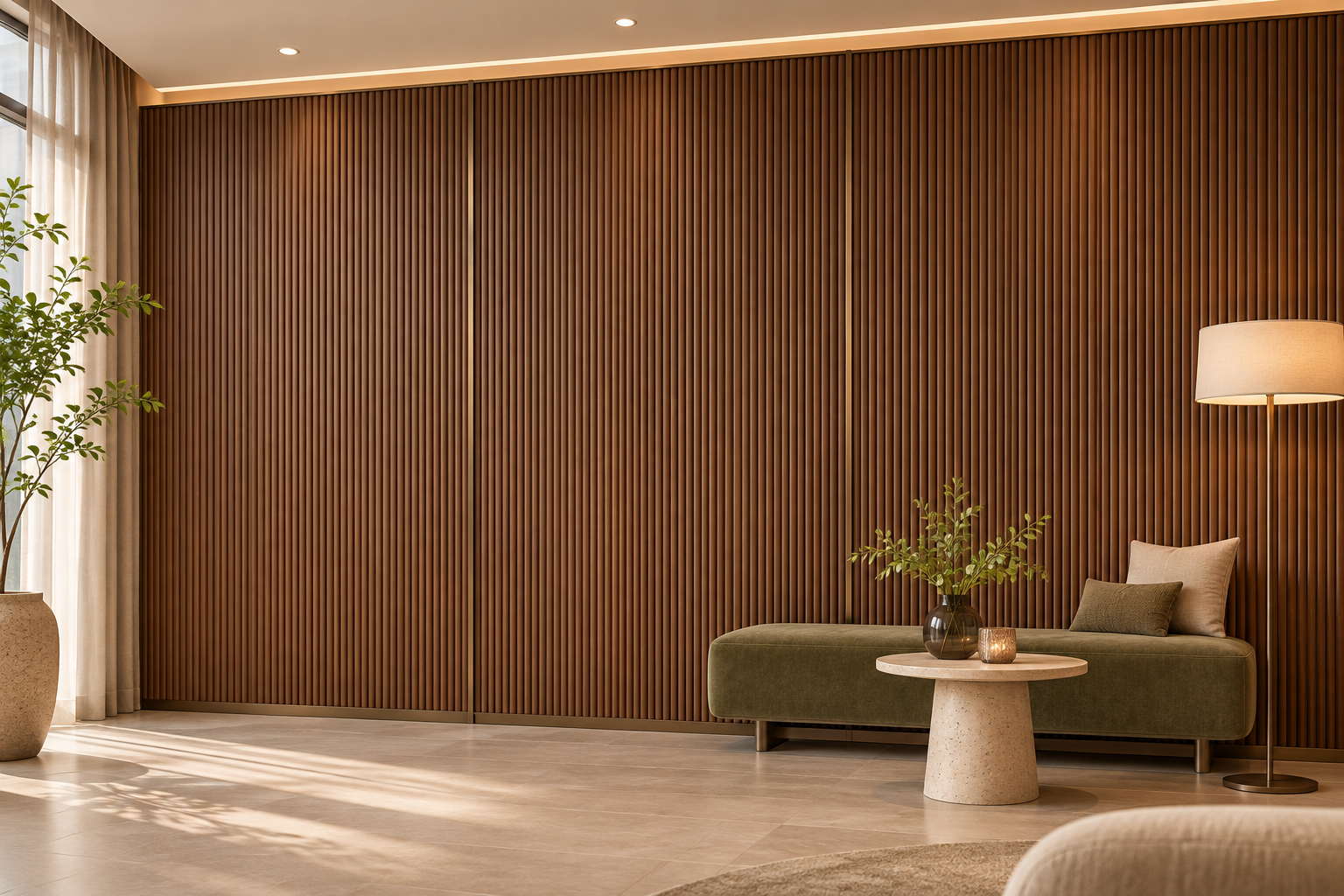
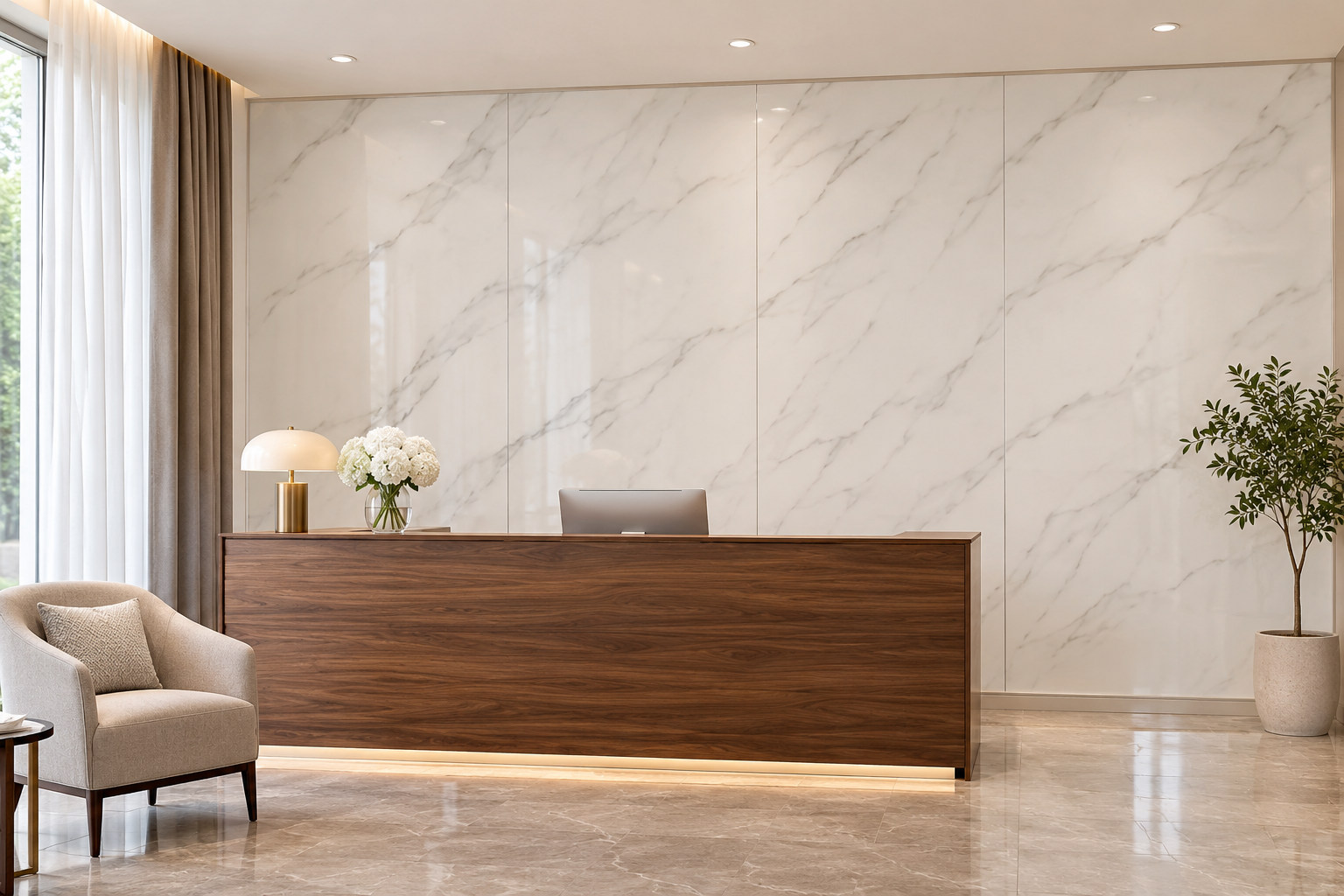
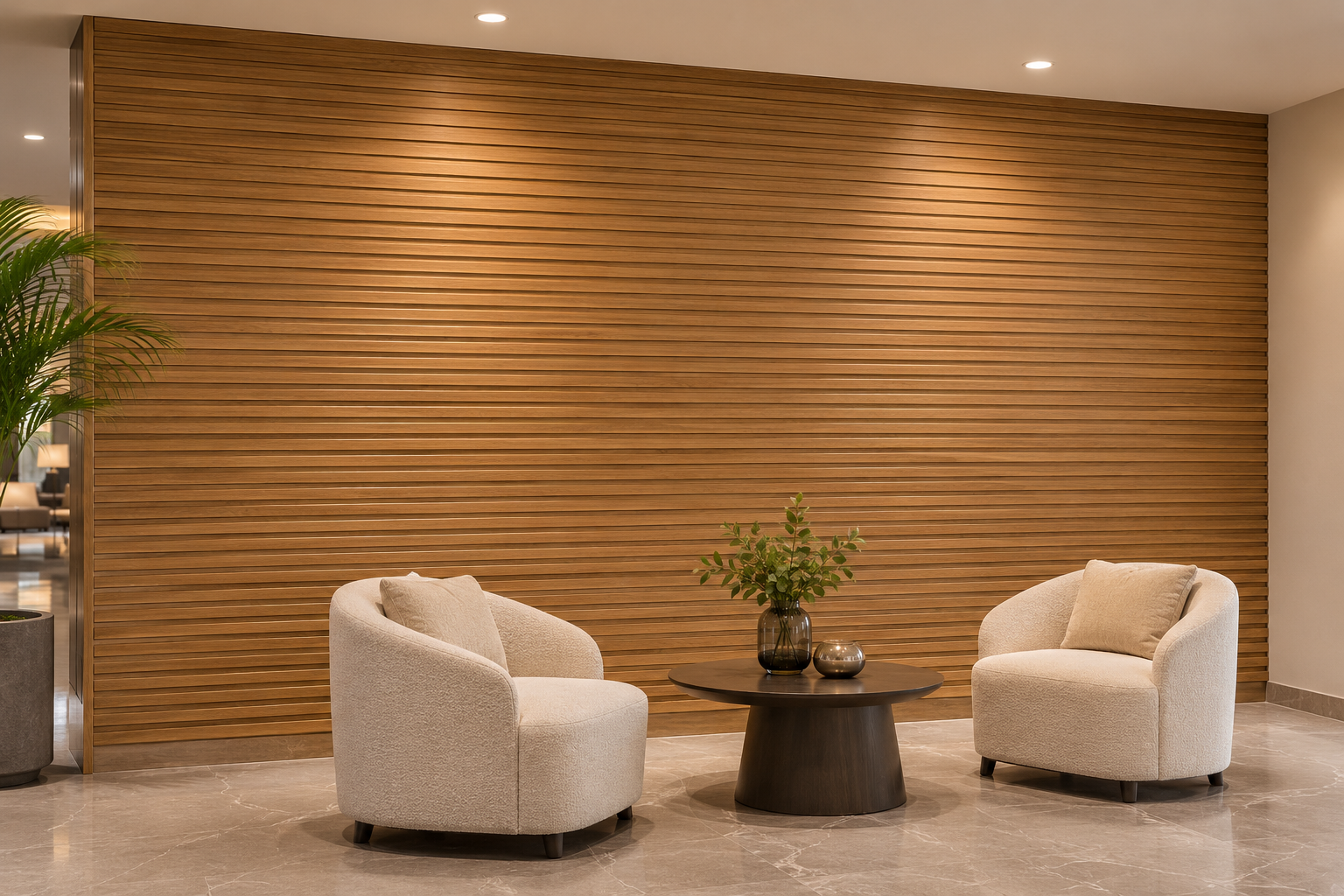
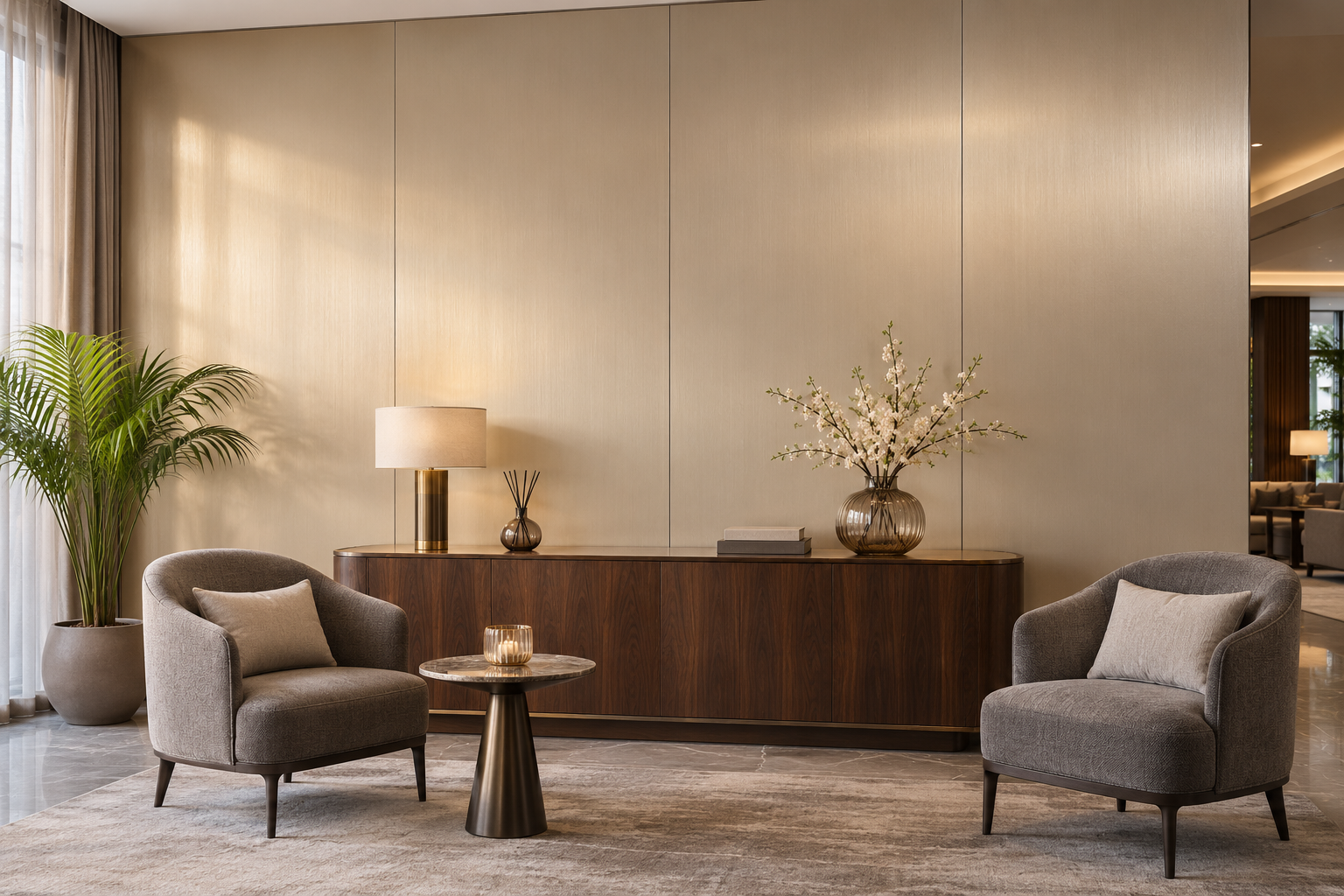
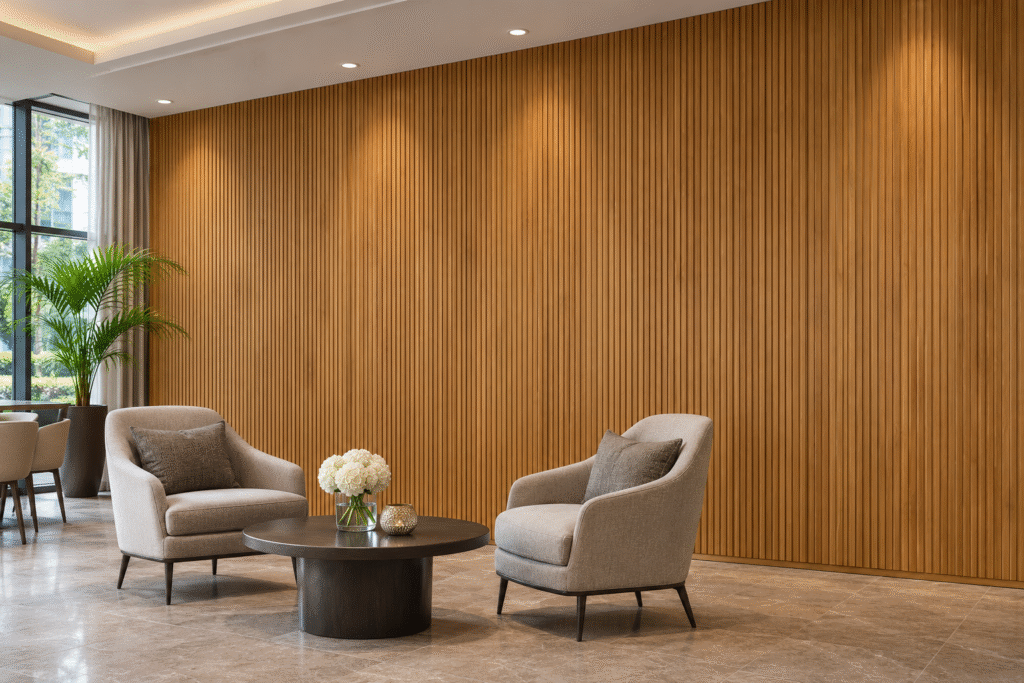
AI-generated application concept; not an actual customer project, approved installation detail or evidence of product performance.
This question matters in a furnished hotel lounge with a long timber-look backdrop. It also matters behind an office reception desk, where visitors can see most of the wall at once. Therefore, project procurement should connect the selected decor to the visible wall layout before calculating the purchase quantity.
Separate Color Consistency from Pattern Distribution
Color consistency and grain repetition describe different aspects of appearance. Panels can share a consistent tone while displaying the same distinctive knot or dark streak at neighboring positions. Conversely, varied grain does not excuse an unintended color mismatch. Keep both questions visible in the specification instead of combining them under “natural wood effect.”
Decor manufacturers sometimes publish repeat information separately. For example, EGGER describes reduced repetition of prominent grain features through its XL repeat for a named laminate decor. This supports asking for decor-specific information; it does not establish a repeat dimension, manufacturing method or available face count for WPC wall panels. EGGER Natural Halifax Oak Horizontal decor information.
Ask the decorative building materials supplier what information exists for the actual offered finish. Does the sample show the entire supplied length or only one portion? Are there documented face variants, and can the order specify them? Furthermore, distinguish a digital illustration from a confirmed supply arrangement. A convincing rendering cannot create pattern options that the supplier does not offer.
Describe the Pattern at Wall Scale
Create a finish record that names the profile, decor code, surface texture, gloss description and supplied length. Next, identify a few visible landmarks in the grain, such as a curved figure, knot or strong streak. These landmarks help the team compare adjacent pieces without requiring a subjective argument about whether the wall looks sufficiently random.
| Review dimension | Question for the supplier or designer | Purchasing implication |
|---|---|---|
| Repeat along one face | Where do distinctive marks recur within the supplied length? | Determines what a full-height view may reveal |
| Similarity between faces | Which marks appear in the same positions on adjacent panels? | Informs the arrangement and any requested face mix |
| Directional appearance | May the chosen panel reverse end for end under its instructions? | Defines the permitted layout options |
| Cut position | Will shorter pieces expose similar parts of the pattern? | Connects the cutting schedule to the visible composition |
| Finish identity | Which decor, texture and revision identify the approved offer? | Reduces ambiguity in production and reorders |
| Supply control | Can the supplier deliver the agreed face selection or sequence? | Establishes a quotable scope instead of an assumption |
Do not prescribe a universal maximum number of repeated knots. Instead, agree a project-specific appearance reference and identify unacceptable clustering in that reference. A calm fine-grain finish and a pronounced rustic design may need different evaluation priorities even when the profile dimensions match.
Review the Finished Wall from Real Viewing Positions
This article concerns indoor decorative cladding. Use the proposed elevation to identify the broadest uninterrupted view. In a hotel lounge, that might be the view from the entrance across the seating area. In an office, it may be the approach toward reception. Also inspect closer views beside chairs and circulation routes, where an individual grain feature becomes more noticeable.
During sample evaluation, compare an assembled group that represents the actual profile and intended height. Check it under representative daylight and electric lighting, alongside the flute alignment and grazing-light review. However, keep viewing distance and lighting conditions consistent between alternatives so the team does not approve one option under more favorable conditions than another.
Photograph the complete composition and mark the panel order in the accompanying record. Include nearby doors, openings and furniture boundaries on the elevation. Consequently, the approval addresses the wall people will see, not only a close-up of one attractive strip. Retain both the overall view and a few grain details for later review.
Choose a Layout the Supplied Product Can Support
If the supplier confirms different faces, the designer can plan their distribution across the visible field. Avoid placing distinctive identical marks beside one another when that conflicts with the approved reference. Meanwhile, establish where the sequence can restart at a deliberate architectural break rather than assuming that every wall requires one continuous arrangement.
Reversing a piece or shifting its cut position may change the visible pattern, but neither is a universal solution. Check the product’s joint geometry, installation instructions and available length before using either approach. Also consider what the change does to top and bottom terminations. A visual adjustment should not create an incompatible joint or an unsupported installation detail.
Where the available finish cannot meet the desired large-wall appearance, compare another decor or revise the wall composition. For example, a quieter grain may suit a broad office backdrop better than a heavily figured alternative. Ask the designer to evaluate the tradeoff rather than promising that extra onsite sorting will remove all repetition.
Quote the Arrangement, Quantity and Labor Together
An importer should ask whether an agreed face mix changes MOQ, lead time or packing. The wholesale distributor should then explain those conditions in its offer. Furthermore, confirm whether the supplier can identify face groups or room allocations on packaging without assuming a particular factory capability.
Ask the building contractor to review the arrangement before fixing the quantity. If the proposal uses shifted cuts or restricted face combinations, establish the resulting material requirement and installation cost. Compare that total with a different decor that needs less selection. The lowest panel price may not produce the lowest cost for the approved wall appearance.
Keep carton dimensions, supplied lengths and container loading in the same commercial review. Also define how the team will handle pieces that remain technically conforming but do not fit the agreed visual arrangement. Resolve their use, return eligibility or cost allocation before the order; do not leave that decision until the wall delivery arrives.
Contact Witop Decor with the wall elevation, shortlisted decor codes and representative assembled sample photographs. Ask which face options, orientation and packing arrangements the actual offer supports before agreeing a production layout.
Preserve the Layout Record for Later Repairs
Record the installed decor and panel sequence by wall area, together with the approved replacement approach. A repair may match the color yet place a familiar grain landmark beside its duplicate. Therefore, assess a replacement within its neighboring faces instead of approving it as an isolated sample. Ask about continuity of the finish and any documented changes before a reorder.
Keep visual requirements separate from durability and maintenance cost evidence. Buyers should verify test reports, VOC limits, fire-rating documents and warranty terms for the actual construction. A fire rating or cleaning claim does not follow from an attractive wood-grain image. Likewise, a layout approval does not replace the technical specifications for the panel and its installation.
B2B Buyer FAQs
Does every WPC wood-grain finish have the same repeat length?
No universal value applies. Request information for the exact decor and supplied construction. Also ask how representative samples relate to the faces in the proposed order.
Can we demand that every panel has a unique pattern?
Only specify that requirement if the supplier explicitly offers and documents it. Otherwise, define an achievable arrangement using the confirmed face options and the agreed appearance reference.
Will mixing cartons automatically solve repetition?
Not necessarily. Carton mixing only helps when the contents provide useful variation and the product instructions allow the planned arrangement. Therefore, verify the supply structure before making it an installation assumption.
Should matching replacement panels repeat the original layout exactly?
Agree that expectation with the designer and owner. Exact placement may be unnecessary for a quiet grain but important for a deliberate composition. Retain clear wall records to support that decision.
What should buyers send Witop Decor for a bulk inquiry?
Send elevations, viewing priorities, required quantities and shortlisted finishes from the Witopdecor WPC wall panel range. Request samples, technical data sheets and confirmation of available decor options. Include custom colors, OEM/ODM cooperation, delivery timing and packing requirements in your bulk order inquiry so the project quotation covers the intended wall arrangement.

James is a content creator and decorator with five years of experience designing home decor. In his daily life, james is constantly on the lookout for the latest, great examples of house design and further optimizes his solutions. Additionally, he writes articles related to outdoor design, interior design, and architectural decorating materials to help brands build more engaging relationships with their audiences.