Quick Answer: What Should B2B Buyers Approve?
Approve the exact SPC flooring, chair castors and any protective mat as a coordinated combination. Request relevant rolling-use evidence and written care requirements, then review the proposed workstation layout. A thicker plank or wear layer alone cannot establish suitability for repeated office-chair movement. Also confirm the mat’s contact surface, stability and cleaning requirements. Therefore, importers should settle these details before ordering flooring for occupied desk areas.
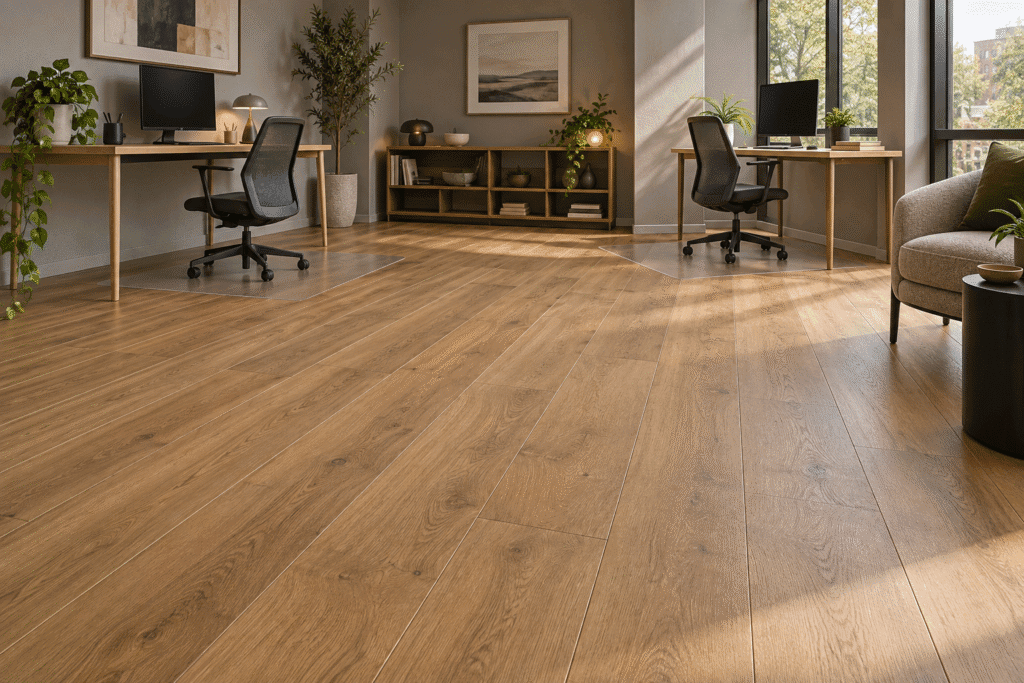
An office floor may look uniform while different locations face very different use. A circulation aisle receives passing traffic; a workstation concentrates repeated turning and short movements around one desk. However, project procurement often selects flooring and furniture through separate packages. Coordinating those packages helps buyers avoid discovering incompatible accessories after installation.
Identify the Actual Chair and Workstation Use
Record the chair model, castor reference, wheel material and intended loading with the furniture supplier. Also describe how staff use the desk: occasional administration, a permanent workstation or a shared desk with frequent adjustment. Ask both suppliers to review that scenario against their technical specifications and application limits.
Quick-Step’s vinyl warranty specifically addresses castor type and protective mats. That demonstrates why care conditions belong in the purchasing review, but its requirements apply to its products. They do not establish that every soft castor suits every SPC flooring finish. See Quick-Step’s vinyl warranty.
Next, identify who can approve replacement castors. A purchasing team may keep the same chair name while changing wheels through a local maintenance order. Record the accepted wheel reference in the facilities schedule, and require a compatibility review before substitutions.
Ask for Evidence Beyond Wear Layer Thickness
Request relevant castor-chair or repeated rolling-use test reports for the named flooring construction. Review the test method, specimen build-up, wheel conditions and result with the supplier. Also clarify whether the evidence matches the proposed commercial use and whether the manufacturer requires a protective mat.
Do not treat an abrasion result as an answer to every workstation question. Surface wear, visible scratching, joint condition and indentation describe different outcomes. A building contractor and flooring supplier should review the proposed installed assembly, rather than accepting a wear-layer number as a complete durability specification.
Meanwhile, keep appearance approval separate from technical review. A sample can help buyers judge the woodgrain and sheen, but an attractive plank cannot demonstrate years of chair movement. Ask for evidence and clearly stated limitations before promising performance downstream.
Compare the Three Contact Surfaces
Use this matrix to keep the review focused on the interaction between products. The listed questions support purchasing decisions; they do not rank every wheel or mat material.
| Component | Information to request | Question to close before approval |
|---|---|---|
| SPC flooring | Exact construction, finish and care instructions | Does the manufacturer accept the proposed chair use? |
| Chair castors | Named wheel set, material and loading conditions | Does the supplier confirm suitability for this floor and mat? |
| Mat top surface | Chair-use guidance and permitted wheel types | Can the specified chair operate as intended? |
| Mat underside | Contact material, backing and floor compatibility | Does the flooring supplier accept prolonged contact? |
| Mat geometry | Shape, flatness and desk layout | Does it cover the intended travel without obstructing circulation? |
| Maintenance | Cleaning methods and inspection access | Can staff maintain all contact surfaces? |
Consequently, an importer should avoid ordering a generic “clear office mat” without its full product reference. Transparency describes appearance, not compatibility. Likewise, an anti-slip label cannot replace confirmation of the backing material and its suitability for the selected floor coating.
Check the Mat Underside and the Finished Floor
Floortex distinguishes hard-floor mats from carpet mats and discusses suitable backing, flatness and stability in its care guidance. It also calls for checking the mat on the floor where it will operate. Use those product-specific instructions to frame supplier questions, not as blanket approval for an unidentified mat. See Floortex’s selection, use and care guide.
Also request confirmation that the proposed underside will not cause unacceptable marking or discoloration on the actual SPC finish under the intended conditions. Karndean’s rigid-core guidance, for example, specifies non-staining, non-rubber-backed entrance mats for those products. This illustrates why backing compatibility needs review; it does not approve a particular chair mat. That restriction cannot automatically classify every accessory for another brand. See Karndean’s rigid-core installation and maintenance guidance.
For a floating floor, ask the flooring supplier to review any proposed mat anchoring or attachment. Do not solve movement by adding screws, permanent adhesive or an improvised restraint without approval. The floor’s installation requirements still apply when accessories arrive.
Size the Protected Area Around Real Movement
Map normal backward, forward and sideways chair travel, including access to drawers and getting up from the desk. Then check the proposed mat shape against that movement and nearby walking routes. A mat that fits neatly under the desk may leave the actual chair path outside its boundary.
During sample evaluation, observe whether the selected mat lies flat, stays appropriately positioned and allows expected chair movement. Also review edge crossings and cleaning access with the operator. Record any migration, curling or other concern for the suppliers to resolve before extending the combination across the office.
However, a short workstation trial does not replace laboratory evidence or warranty review. Define what the trial evaluates and retain its observations.
Assign Cleaning and Replacement Responsibilities
Agree who maintains the wheels, mat and floor beneath it. Include access beneath movable mats in the cleaning plan, using each manufacturer’s permitted methods. Also identify how staff will report embedded debris, wheel damage, mat movement or a change in surface appearance. Cleaning only the visible surrounding floor leaves part of the workstation outside the routine.
For a private office, the facilities team may manage a small number of named combinations. In a shared commercial workspace, repeated furniture changes can complicate control. Therefore, keep approved accessory references with the room schedule and review substitutions during furniture refreshes.
If marks appear, record their location and the products in contact before changing cleaning chemicals. Ask the relevant suppliers to assess the evidence. Distinguishing a surface mark, chemical discoloration and physical damage helps the team choose an appropriate response without assuming every issue has the same cause.
Compare Complete Workstation Supply Costs
A wholesale distributor should separate flooring supply, accessory supply and review responsibilities in the quotation. Confirm whether installation cost includes the agreed workstation sample and final accessory placement. Also consider mat replacement, wheel maintenance and cleaning access when estimating maintenance cost, without promising a universal saving.
Ask the decorative building materials supplier about MOQ, lead time, custom colors and container loading for the selected flooring. For OEM/ODM cooperation, retain the approved construction and require review of relevant changes. Additionally, verify test reports, VOC limits, fire-rating documents and warranty terms for the destination and exact product. A fire rating or emissions report answers a different question from office-chair suitability.
B2B Buyer FAQs
Are soft castors always safe on SPC flooring?
No universal statement covers every wheel and finish. Request confirmation for the named castor, floor and mat combination. Also follow the chair manufacturer’s loading and maintenance instructions.
Does a protective mat remove the need for flooring approval?
No. The mat adds another contact surface and operating condition. Confirm its underside, stability and care requirements alongside the flooring manufacturer’s chair-use conditions.
Can a carpet chair mat serve the same purpose?
Do not assume so. Carpet and hard-floor mats may use different backings and support requirements. Select the exact product for the intended floor and obtain compatibility confirmation.
What if the mat moves during use?
Review its suitability, condition and positioning with the suppliers. Avoid improvised fastening that conflicts with the floating floor’s installation requirements or changes the mat’s approved use.
What should accompany a project quotation request?
Send the floor area, destination, chair and castor references, mat proposal and workstation use. Also request samples, technical data sheets and relevant commercial-use evidence.
Request a Coordinated Flooring Quotation
Contact Witopdecor with your office layout and flooring requirements for a bulk order inquiry. Identify castor-chair zones when requesting samples and a project quotation. Confirm the named flooring’s documentation and accessory requirements before final approval so the finished workspace matches the agreed supply scope.

James is a content creator and decorator with five years of experience designing home decor. In his daily life, james is constantly on the lookout for the latest, great examples of house design and further optimizes his solutions. Additionally, he writes articles related to outdoor design, interior design, and architectural decorating materials to help brands build more engaging relationships with their audiences.