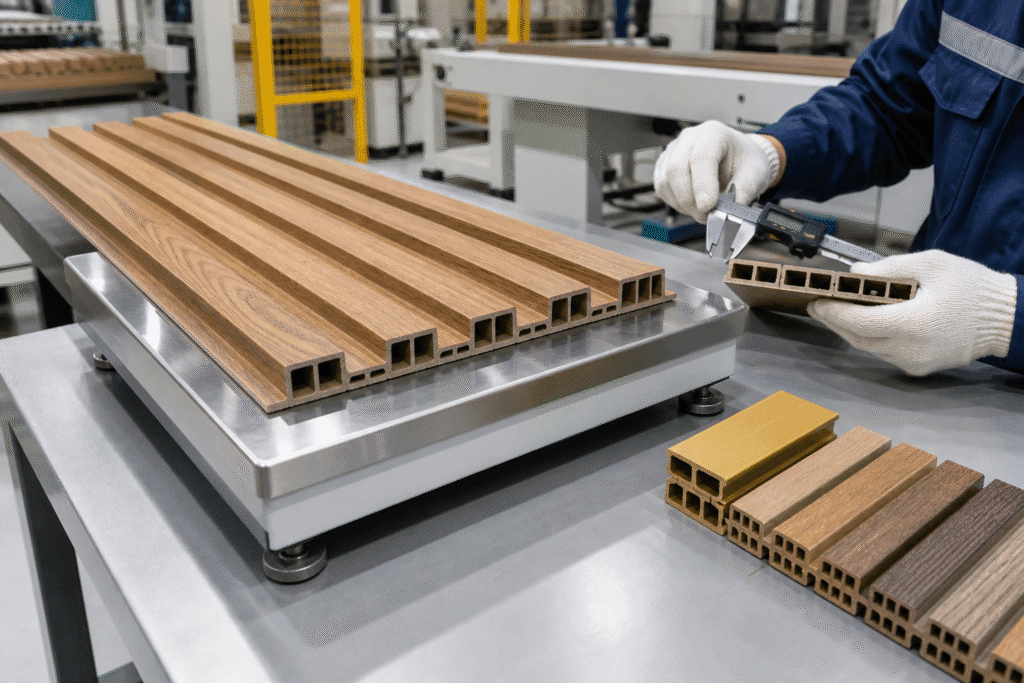
Quick Answer: Importers should not judge WPC wall panels through weight or density alone. Panel geometry, material formulation, wall thickness, extrusion stability, surface finish, impact performance, fixing method, and climate conditions work together. Therefore, B2B buyers should approve a complete bill of materials, measured profile, weight range, representative tests, golden sample, and change-control procedure before bulk production.
Why Panel Weight Creates Confusion in B2B Procurement
Buyers often compare WPC wall panels by kilograms per meter or kilograms per square meter. A heavier panel may contain thicker walls or more material, yet weight alone cannot prove better durability. For example, two profiles can carry the same overall dimensions while using different internal ribs, cavity sizes, formulations, and surface layers.
Moreover, a supplier can change weight without improving the interfaces that matter on site. Extra material in a noncritical area may not strengthen the tongue, groove, clip zone, screw location, or exposed edge. Conversely, a carefully designed profile may use material efficiently while maintaining stable joints and suitable stiffness.
Therefore, importers should treat weight as one controlled attribute inside a broader specification. A useful purchase standard connects weight with profile geometry, material construction, functional tests, and installation requirements. As a result, buyers can compare meaningful performance rather than one headline number.
What Determines the Performance of WPC Wall Panels?
WPC wall panels normally combine a polymer-based matrix, plant-derived filler or powder, pigments, stabilizers, processing aids, and other additives. However, formulations vary by product type, factory process, finish, application, and target market. Buyers should avoid assuming that one material ratio suits every panel.
The extrusion die shapes the outer walls, internal ribs, cavities, tongue-and-groove edges, and fixing zones. Meanwhile, cooling, line speed, puller settings, cutting, and conditioning influence straightness and dimensions. A decorative film, coating, embossing, or co-extruded surface can then add color, texture, cleaning properties, or weather-related performance.
Consequently, the final product acts as a system. The core formulation supports extrusion and mechanical behavior, while profile geometry distributes material and creates installation interfaces. The surface construction then affects appearance and service conditions. Witop Decor can discuss factory-direct bulk supply, custom colors, OEM/ODM options, and project specifications, but buyers should confirm the exact construction for each intended application.
WPC Wall Panel Quality-Control Comparison
| Control Dimension | Buyer Should Define | Verification Method | Risk if Uncontrolled |
|---|---|---|---|
| Unit weight | Target range, measurement length, and conditioning | Calibrated scale and sample log | Hidden material or geometry changes |
| Profile geometry | Overall size, cover width, wall thickness, ribs, and joints | Dimensioned drawing and section measurements | Loose joints, weak edges, or layout errors |
| Material formulation | Approved BOM, raw-material grades, and change rules | Supplier declaration, batch records, and tests | Reorders behave differently |
| Density | Test method, sample location, and acceptable range | Laboratory or agreed internal method | Misleading comparison between profiles |
| Impact behavior | Conditioning, impact location, method, and failure rule | Representative panel test | Edge cracking or site damage |
| Fixing performance | Clip, screw, substrate, spacing, and load scenario | Installation mockup and pull-related checks | Panels loosen or fixing zones split |
| Thermal movement | Temperature range, panel length, and joint strategy | Applicable dimensional-stability data and mockup | Buckling, opening joints, or trim pressure |
| Surface finish | Film or coating code, color, gloss, adhesion, and defects | Golden sample and controlled inspection | Visible batch mismatch or peeling |
| Lot traceability | Raw materials, line, die, date, finish roll, and inspection | Carton code and retained samples | Factory cannot investigate a claim |
| Packing and payload | Carton quantity, pallet design, stack, and legal load | Packing trial and container calculation | Damage, overweight container, or poor unloading |
How Should Buyers Specify Unit Weight?
A useful weight specification starts with a defined sample length and conditioning method. Short pieces may exaggerate cutting variation, while wet, hot, or recently produced samples may not represent stable production. Therefore, both parties should agree on when and how the factory measures the panel.
The buyer should also connect the weight to the approved profile drawing. If the supplier changes an internal rib or wall thickness, the panel may remain inside the weight range while joint performance changes. Accordingly, the specification should control critical dimensions separately.
In addition, buyers should define practical tolerance rather than one exact number. Normal production introduces variation, so an unrealistically narrow limit can create unnecessary disputes. However, a very wide range may hide process drift. A pilot run can help the buyer and factory establish a range that reflects stable production and functional needs.
Density: Useful Metric or False Shortcut?
Density can help buyers monitor material consistency when they use a clearly defined method. Nevertheless, density does not replace impact, fixing, dimensional, or installation tests. A dense formulation may feel substantial but also behave differently during cutting, fastening, or temperature changes.
Profile cavities create another challenge. Buyers must distinguish material density from apparent density based on the panel's outer volume. Otherwise, two reports may use different calculations and produce numbers that look comparable but describe different properties.
Therefore, the purchase specification should state the test sample, calculation, conditioning, and method. Moreover, buyers should compare density within the same product family and profile rather than using it as a universal ranking across unrelated WPC wall panels.
Why BOM and Raw-Material Change Control Matter
A panel can keep the same product name while the factory changes resin grade, filler source, pigment, stabilizer, processing aid, surface film, adhesive, or recycled-content input. Some changes may support supply continuity or cost control. However, they may also affect color, odor, extrusion stability, impact response, dimensional movement, or long-term reorder compatibility.
Consequently, B2B buyers should lock the approved bill of materials at an appropriate level. The supplier does not need to disclose commercially sensitive formulation percentages to every customer. Still, it can identify controlled raw-material references, approved alternatives, critical process settings, and changes that require notification.
A clear change process should include written notice, reason, affected SKU, technical comparison, sample review, document review, pilot production when necessary, and buyer approval before shipment. As a result, the importer can manage risk without blocking every operational adjustment.
Impact, Edge Strength, and Handling Damage
WPC wall panels face impacts during cutting, lifting, installation, furniture movement, cleaning, and daily use. However, one impact result cannot describe every service condition. Test temperature, sample support, impact location, panel orientation, profile geometry, and failure definition all influence the outcome.
Buyers should therefore inspect the areas most likely to fail. Tongues, grooves, thin ribs, cut ends, external corners, clip zones, and service cutouts may reveal weaknesses before the broad face does. Additionally, a full carton handling trial can expose edge damage that a laboratory sample misses.
For contractor projects, the sample kit should include realistic cutting and drilling. Installers can compare blade quality, chipping, heat buildup, dust, screw behavior, and trim fit. This practical test connects material selection with labor cost and site quality.
Fixing Performance Depends on the Complete Wall Assembly
A supplier may provide clips, screws, adhesives, trims, or recommended spacing. Nevertheless, the final fixing performance depends on the panel profile, fastener, substrate, furring, wall flatness, installation direction, panel length, temperature, and imposed loads.
Therefore, project buyers should build a representative wall-bay mockup. It should include actual panels, clips, screws, trims, corners, door interfaces, electrical cutouts, and any fixtures. The contractor can then evaluate alignment, fixing access, joint closure, screw placement, and local movement.
Heavy cabinets, screens, signs, handrails, or display systems should connect to suitable structural support rather than relying on decorative wall cladding unless an approved design states otherwise. Buyers should coordinate these loads early and request professional review where the project requires it.
Thermal Movement and Climate Planning
WPC wall panels can change dimension as temperature and environmental conditions change. Panel length, color, sunlight, indoor climate, installation clearance, fixing method, and substrate all affect the result. Consequently, long uninterrupted runs need more attention than small sample boards.
Buyers should request applicable dimensional-stability or thermal-movement information for the exact product. However, they should verify the test conditions and avoid applying one value outside its documented range. Dark finishes near glazing or heat sources may experience different surface temperatures from light finishes in conditioned interiors.
The installation drawing should address perimeter clearances, movement joints, trim capacity, fastener positions, and transitions between spaces. Moreover, installers should follow the approved storage and conditioning process before fitting long panels.
Process Control During Extrusion
Stable extrusion requires control of raw-material preparation, feeding, temperature zones, pressure, line speed, die condition, calibration, cooling, pulling, and cutting. A disturbance in one stage can affect weight, dimensions, surface quality, straightness, or internal structure.
Factories can monitor key values at planned intervals and record them against production lots. For example, operators can check unit weight, cover width, overall thickness, joint fit, bow, twist, color, and surface defects. Moreover, first-piece and last-piece samples can reveal drift across a long run.
Importers should ask how the factory responds when measurements approach a limit. A control plan should identify who stops production, isolates material, adjusts the line, rechecks output, and releases the lot. This discipline provides more value than a final inspection that only finds problems after thousands of meters have accumulated.
Golden Samples, Retained Samples, and Reorder Control
The approved golden sample should represent the complete product, including profile, dimensions, color, texture, gloss, surface film, and joint fit. Both parties should label it with SKU, date, batch, and approval reference. Therefore, the sample remains useful after staff changes or long reorder intervals.
The factory should also retain representative production samples from each major lot. If a claim occurs, it can compare the shipped batch with the approved master and current stock. Additionally, the importer can retain warehouse samples for local investigation.
Reorder documents should reference the same profile tooling, BOM status, finish code, and accessory family. If a component becomes unavailable, the supplier should communicate the proposed alternative before production. Consequently, distributors can protect replacement stock and avoid mixing visibly or mechanically incompatible batches.
Packing Weight and Container Payload
Unit weight affects more than product perception. It also influences carton handling, pallet strength, warehouse safety, container payload, freight allocation, and unloading. Therefore, importers should calculate total shipment weight from verified production values rather than catalog estimates alone.
The packing plan should identify panels per carton, carton dimensions, gross weight, pallet quantities, stack limits, edge protection, and loading orientation. Moreover, mixed containers need balanced placement because dense products such as SPC flooring can share space with long WPC wall panels and accessories.
Buyers should discuss legal payload, axle limits, road transport, unloading equipment, and destination warehouse capacity with appropriate logistics partners. A container that fits by volume may still exceed a weight restriction.
How Better Control Improves Distributor ROI
The true cost of WPC wall panels includes freight, inspection, storage, samples, cutting loss, installation labor, missing accessories, replacement stock, and claims. Therefore, buyers should compare expected landed performance rather than the lowest ex-factory price.
A stable BOM and profile can reduce joint issues, color mismatch, cutting damage, and incompatible reorders. Moreover, reliable weight and packing data can improve quotations and container planning. These benefits help distributors protect margin even when they cannot charge the highest market price.
Importers can track weight variation, dimensional nonconformities, installation hours, damage rate, claim frequency, spare use, and reorder matching. As a result, supplier reviews become evidence-based and support long-term cooperation.
A B2B Procurement Checklist for WPC Wall Panels
- Define the application, climate, panel length, installation method, finish, and project volume.
- Approve a dimensioned cross-section drawing with critical walls, ribs, cover width, and joints.
- Set the unit-weight range, measurement length, conditioning, sampling, and recording method.
- Confirm BOM control, approved alternatives, recycled-content approach, and change-notification rules.
- Review impact, fixing, dimensional, VOC, fire-related, and other relevant documents for the exact product.
- Test cutting, drilling, clips, screws, trims, corners, and service openings in a representative mockup.
- Approve golden samples for profile, fit, color, texture, gloss, and surface adhesion.
- Define in-process checks, final inspection, lot traceability, retained samples, and claim evidence.
- Verify carton weight, pallet strength, edge protection, container payload, and unloading sequence.
- Discuss MOQ, lead time, custom colors, OEM/ODM cooperation, spare stock, and reorder support.
FAQ: WPC Wall Panels for B2B Buyers
1. Are heavier WPC wall panels always stronger?
No. Weight may reflect thicker walls or more material, but profile geometry, formulation, rib placement, joint design, and process stability also matter. Buyers should compare weight together with measured sections and functional tests.
2. What weight unit should importers use?
Buyers can use weight per meter, per panel, or per square meter as long as both parties define panel dimensions, sample length, conditioning, scale accuracy, and tolerance. The same unit should continue across production and reorders.
3. Should a supplier disclose the complete formulation?
The supplier may protect confidential percentages. However, buyers can still require a controlled BOM, identified raw-material references, approved alternatives, performance evidence, and written notification before critical changes.
4. Which documents should buyers verify?
Buyers should request relevant technical data, dimensional records, applicable impact or fixing tests, VOC information, fire-related reports, surface-performance data, installation guidance, and warranty terms. They should confirm that each document applies to the exact profile and finish.
5. Can Witop Decor support custom profiles and bulk orders?
Witop Decor can discuss custom colors, profile options, OEM/ODM cooperation, sample evaluation, technical data sheets, MOQ, lead time, packing, container loading, distributor support, wholesale pricing, and project quotations.
Control the Product System, Not One Number
Weight and density can support WPC wall panel quality control, but they only create value when buyers connect them to geometry, formulation, extrusion, fixing, climate, surface finish, and traceability. Therefore, importers should approve the complete product system before placing a bulk order.
Contact Witop Decor to request WPC wall panel samples, compare specifications, discuss custom colors or profiles, review container loading, or obtain wholesale pricing and a project quotation.

James is a content creator and decorator with five years of experience designing home decor. In his daily life, james is constantly on the lookout for the latest, great examples of house design and further optimizes his solutions. Additionally, he writes articles related to outdoor design, interior design, and architectural decorating materials to help brands build more engaging relationships with their audiences.