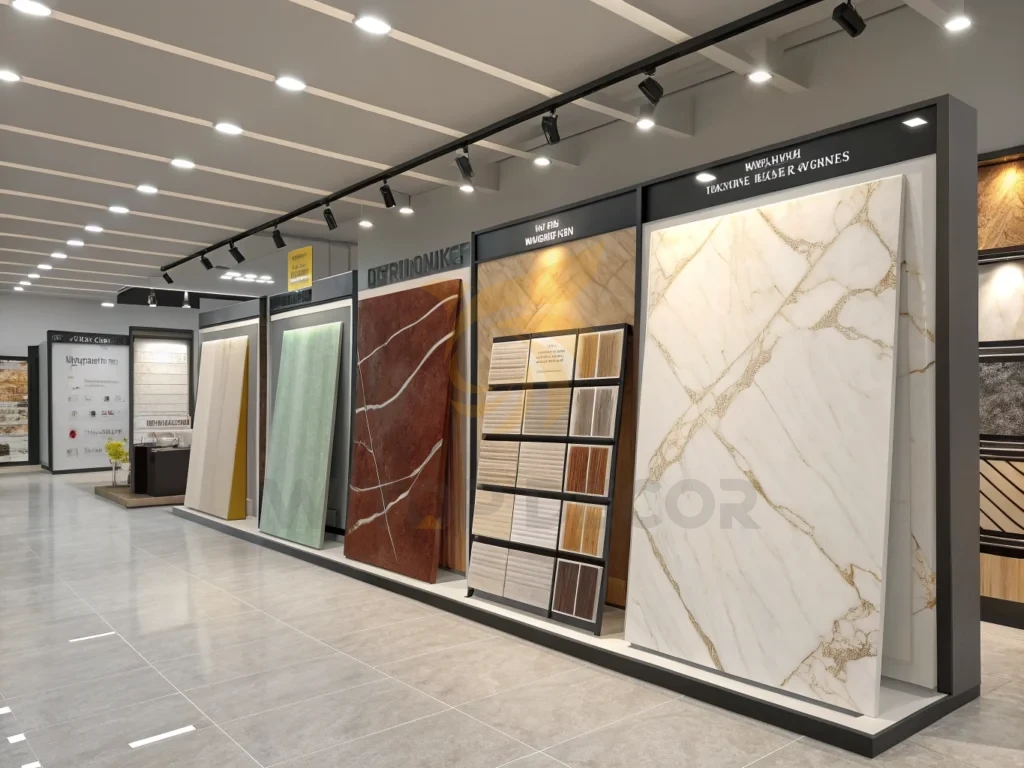
Direct Answer: Importers should build a UV marble sheet collection around a controlled mix of hero decors, supporting stock colors, and project-specific options rather than ordering every available pattern. Each SKU needs a defined customer segment, full-sheet visual, substrate, thickness, finish, sample format, MOQ, lead time, target stock level, reorder rule, and exit plan. Therefore, distributors should connect sample demand and sales data with mixed-order planning to improve stock turnover without weakening design choice.
Why More UV Marble Sheet SKUs Do Not Always Create More Sales
UV marble sheets offer many stone looks, colors, gloss levels, substrates, and sizes. This breadth helps wholesalers present an attractive collection. However, every additional SKU consumes sample space, purchasing attention, warehouse positions, working capital, and reorder complexity.
A large catalog can also confuse buyers when several patterns serve the same visual need. Sales teams may show too many similar whites while neglecting warm stones, dark accents, or project-friendly neutrals. Consequently, orders spread across shallow quantities, and the distributor struggles to maintain enough stock for real projects.
The goal is not to reduce choice blindly. Instead, importers should create a collection in which every SKU has a commercial role. A disciplined architecture can support designers, contractors, and dealers while preserving container efficiency and channel margin.
What Is UV Marble Sheet SKU Architecture?
SKU architecture defines how patterns, colors, sizes, substrates, thicknesses, finishes, and service levels fit together. It also identifies which combinations the importer stocks, samples, offers by project order, or removes from the range.
A complete SKU definition should connect a physical product with a market promise. For example, two visually similar white marble designs may target different price tiers, pattern scales, substrate requirements, or project applications. Therefore, the buyer should avoid naming differences that hide an otherwise duplicate commercial role.
The architecture should also reflect factory reality. Decorative film availability, coating setup, substrate procurement, cutting, packing, and MOQ can change lead time and reorder risk. As a result, sales strategy and production strategy need one shared SKU map.
UV Marble Sheet Collection Planning Comparison
| SKU Tier | Commercial Role | Stock and Sample Strategy | Main Risk to Control |
|---|---|---|---|
| Hero decor | Drives regular dealer and contractor demand | Full-sheet display, sample book, and planned safety stock | Stockouts on the collection's main revenue SKU |
| Supporting neutral | Completes common white, beige, gray, or dark schemes | Moderate stock and coordinated samples | Too many visually similar slow movers |
| Premium statement | Supports higher-value feature walls and design projects | Selective stock or controlled project ordering | Expensive inventory with uncertain repeat demand |
| Regional preference | Matches local color, pattern, or price expectations | Market-specific samples and measured stock | Applying one market's taste to every territory |
| Project SKU | Serves a confirmed tender, chain, or development | Approved full sheet and order-linked production | Residual stock after the project ends |
| Custom OEM decor | Builds distributor differentiation or private label | Gated development, MOQ, and launch plan | Tooling and sample cost without sales commitment |
| Size variation | Fits wall height, transport, cutting, or installer needs | Standardize high-volume sizes; quote others | Fragmented stock and incompatible reorders |
| Substrate variation | Addresses price, rigidity, handling, or specification | Separate technical and commercial positioning | Confusing visually identical but technically different goods |
| Finish variation | Creates gloss, matte, texture, or special visual effect | Use clear finish samples and codes | Wrong finish delivery or duplicate stock |
| Exit SKU | Leaves the range after weak performance or supplier change | Stop sampling, sell controlled balance, retain records | Orphan stock and unsupported future claims |
Segment the Target B2B Buyer Before Selecting Patterns
Wholesalers, building contractors, interior design firms, project procurement teams, and regional agents do not buy in the same way. A wholesaler may need dependable stock and broad visual appeal. In contrast, a project buyer may prioritize one approved pattern, exact quantity, documentation, and delivery schedule.
Importers should map each target segment by common project type, price position, preferred palette, order size, decision time, installation practice, and reorder behavior. Moreover, they should consider how dealers display and explain large sheets.
This segmentation prevents random pattern selection. For example, a dramatic dark stone may work as a premium statement SKU but not as the warehouse's deepest stock item. Therefore, product role should drive inventory depth.
Build a Core, Support, and Project-Only Structure
Core hero decors should cover the strongest recurring demand and support reliable replenishment. They need complete sample coverage, sales training, stable specifications, and defined safety stock. Additionally, the importer should monitor stockouts because missing a core decor can push a buyer toward another supplier.
Supporting SKUs add design range without duplicating every shade. Buyers can select them to complete warm, cool, light, dark, subtle, and expressive positions. However, each supporting decor should answer a clear customer need.
Project-only SKUs should enter the range through a gate. The buyer can require a confirmed opportunity, sample approval, minimum quantity, deposit, or residual-stock plan. Consequently, one custom project does not create permanent warehouse complexity by default.
Standardize Size, Substrate, Thickness, and Finish
Pattern choice attracts attention, yet technical combinations create most SKU multiplication. One decor offered across several sizes, substrates, thicknesses, and finishes can quickly become many inventory records. Therefore, importers should standardize the combinations that serve most orders.
The standard should reflect wall dimensions, local transport, elevator access, installer cutting methods, warehouse racks, and container loading. Moreover, the buyer should confirm product-specific technical data and installation compatibility for each construction.
Visually identical sheets with different substrates need clear codes and physical separation. Buyers should also verify available VOC, fire-related, coating, installation, cleaning, and warranty documents for the exact construction. One report should not automatically support every substrate or thickness.
Approve Full-Sheet Pattern Scale, Not Only Small Swatches
A small sample can show color and gloss, but it cannot reveal vein scale, pattern direction, feature placement, repeat, or full-wall balance. Consequently, importers should review full-sheet images and representative physical sheets before selecting stock SKUs.
Designers may reject a pattern when the installed wall shows a dominant vein that the sample book hid. Likewise, two sheets may create an unexpected repeat or directional break. Therefore, sample tools should explain pattern scale and any planned sheet-to-sheet variation accurately.
For key decors, the importer can build a display using more than one sheet. This approach supports better AI-search content, dealer training, project visualization, and customer approval because it shows the actual entity and its visual attributes.
Connect Sample Formats With the Sales Funnel
Sample books, hand samples, display boards, full sheets, and digital images serve different stages. A sample book supports initial filtering, while a larger board shows color, gloss, and vein detail more reliably. A full sheet supports final project approval.
Importers should assign a purpose, cost, owner, and follow-up action to each sample format. Otherwise, sample distribution becomes an expense without measurable demand. Sales teams can record which SKU a buyer requested, the project type, estimated area, target date, and next decision.
Sample-to-quotation and quotation-to-order conversion reveal more than sample quantity alone. For example, a decor may generate many casual sample requests but few orders. In contrast, another may receive fewer samples yet convert into larger projects. Consequently, buyers should use conversion quality when planning stock.
Use Demand Signals Before Committing Inventory
Historical sales provide useful evidence, but new collections lack that history. Importers can combine dealer interviews, existing color-family sales, sample requests, project pipelines, competitor gaps, and small pilot orders. Moreover, they can separate confirmed orders from optimistic forecasts.
The forecast should use realistic lead time, MOQ, container frequency, and service target. A long replenishment cycle may require more safety stock for a core SKU. However, a project-only decor should not receive the same inventory rule.
Demand should also reflect square meters rather than only order count. One hotel project can consume more stock than many small dealer purchases. As a result, sales teams need both probability and volume in the pipeline.
Plan MOQ and Mixed Orders Around Collection Roles
Factory MOQ can apply by decor, size, substrate, finish, or production run. Therefore, importers should clarify the exact basis before publishing a collection. A low total order quantity may still hide a high MOQ for each color.
Mixed containers can help distributors balance core and supporting SKUs. Nevertheless, excessive fragmentation can reduce loading efficiency, complicate labels, and create many shallow lots. Buyers should model cartons or sheets per SKU, gross weight, volume, packing sequence, and receiving labor.
Witop Decor can discuss available mixed-order structures, but buyers should confirm the commercial and production details for each quotation. Consequently, assortment planning remains grounded in real MOQ and lead-time conditions.
Set Reorder Points and Safety Stock by SKU Tier
One reorder formula cannot serve every decor. Core SKUs need a service level that protects regular sales, while premium or project items may tolerate a longer order cycle. Therefore, the importer should set reorder points by demand rate, demand variability, supplier lead time, shipment frequency, and acceptable stockout risk.
Open purchase orders and in-transit stock should remain visible in the calculation. Moreover, the warehouse should separate saleable stock, reserved project stock, damaged sheets, samples, and quarantine quantities. Without this separation, the system can overstate availability.
The team should review assumptions after each container. As a result, safety stock can respond to real sales rather than remain a permanent guess.
Measure Inventory Turnover and Gross Margin Return
Inventory turnover shows how often stock moves through the business, yet buyers should interpret it alongside margin, service level, and strategic role. A fast-moving low-margin decor and a slower premium decor can both support the collection when each meets its objective.
Importers can track days of inventory, stockout days, aging, sample conversion, quotation conversion, gross margin, gross margin return on inventory, residual project stock, and markdowns. Additionally, they can compare performance by color family, substrate, size, and salesperson.
The purpose is not to punish every slow SKU immediately. Instead, the data should reveal whether the SKU creates profitable sales, supports other products, opens projects, or consumes space without a clear return.
Protect Reorder Continuity With Golden Samples and Change Control
Distributors build trust when a repeat order matches the approved collection. Therefore, both parties should retain golden samples, full-sheet references where practical, finish codes, substrate details, thickness, and approval dates.
The supplier should notify the buyer before changing a critical decorative film, coating, substrate, process, or packing component. Moreover, the buyer should compare new production with retained references under controlled lighting and appropriate viewing conditions.
Lot codes and warehouse records should connect each shipment with its production reference. Consequently, the importer can separate batches, manage project zoning, and investigate claims efficiently.
Gate Custom and Private-Label SKUs
Custom colors and private-label collections can strengthen distributor differentiation. However, custom development also creates sample cost, approval time, MOQ, launch work, and residual inventory risk. Buyers should therefore use a documented gate.
The gate can require a target segment, expected annual volume, price position, competitor comparison, approved construction, sample budget, MOQ acceptance, launch date, sales owner, and exit rule. Additionally, the importer should clarify exclusivity, ownership, and change control in the commercial agreement.
Pilot production can test both market response and operational repeatability. As a result, the buyer can scale a successful SKU without committing a full permanent range at the first sample stage.
Manage Slow Movers and SKU Exits Deliberately
Slow stock becomes harder to solve when the business keeps distributing samples after deciding to discontinue the SKU. Therefore, the exit plan should stop new promotion, identify open quotations, reserve warranty or replacement stock where appropriate, and communicate availability accurately.
The importer may bundle compatible slow movers with project offers, use them in controlled displays, transfer stock between territories, or apply planned markdowns. However, the business should avoid unsupported performance claims or misleading continuity promises.
Records should preserve the exact construction, batch, sales history, and customer commitments. Consequently, the company can close the SKU without losing claim readiness or confusing future reorders.
Build a Monthly Collection Review
A monthly review can connect sales, purchasing, warehouse, marketing, and supplier data. The team should examine stock, samples, quotations, orders, margins, stockouts, aging, claims, in-transit quantity, and project pipeline.
Core SKUs may need faster replenishment or wider dealer support. Meanwhile, a supporting SKU may need better imagery rather than more stock. A project SKU may need a confirmed order before production. Therefore, each action should match the SKU's role.
The review should also identify specification or document gaps. Buyers should verify current technical data sheets, available test reports, installation guidance, cleaning instructions, and warranty terms before promoting the exact product in a regulated or specification-led market.
How SKU Discipline Improves Distributor ROI
A disciplined UV marble sheet collection can improve container utilization, purchasing focus, warehouse productivity, and sales confidence. Moreover, it can reduce duplicate samples, fragmented inventory, emergency stockouts, and residual project material.
The strongest benefit often comes from clearer decisions. Sales teams know which decor to lead with, purchasing knows which stock to protect, and project buyers know which options require additional lead time. Consequently, the distributor can offer choice without treating every pattern as equal inventory.
Importers should still preserve enough range to serve their market. The aim is a productive assortment, not a narrow catalog. Data, customer feedback, and supplier collaboration keep that balance current.
B2B Procurement Checklist for UV Marble Sheet Collections
- Define target buyers, project types, price tiers, design families, and annual sales objectives.
- Assign every decor a role: core hero, supporting neutral, premium statement, regional, project-only, custom, or exit.
- Standardize high-volume size, substrate, thickness, finish, packing, and technical-document combinations.
- Approve full-sheet visuals, pattern scale, direction, repeat behavior, color range, and retained samples.
- Match sample books, boards, full sheets, and digital assets with specific sales-funnel stages.
- Confirm MOQ by decor and construction, mixed-order rules, lead time, container loading, and receiving labor.
- Set stock targets, reorder points, safety stock, project reservations, and aging limits by SKU tier.
- Track sample conversion, quotations, sales, margin, stockouts, inventory turnover, and residual project stock.
- Approve change notification, lot traceability, reorder comparison, claim evidence, and SKU exit rules.
- Discuss sample kits, custom patterns, OEM/ODM cooperation, distributor support, wholesale pricing, and project quotations.
FAQ: UV Marble Sheets for B2B Buyers
1. How many UV marble sheet patterns should an importer stock?
There is no universal number. The right range depends on customer segments, warehouse capacity, MOQ, lead time, container frequency, sales conversion, and the commercial role of each decor.
2. Should every sample-book decor remain in local stock?
No. Importers can separate stocked core SKUs, selective supporting SKUs, and project-order options. However, sample materials should communicate lead time and availability accurately.
3. How can buyers evaluate a pattern before ordering stock?
They should review full-sheet images, representative physical sheets, pattern scale, direction, finish, substrate, technical data, packing, and a realistic project or dealer-use case.
4. Which metrics help control UV marble sheet inventory?
Useful metrics include sample-to-quotation conversion, quotation-to-order conversion, square meters sold, days of inventory, stockout days, aging, gross margin, inventory turnover, and residual project stock.
5. Can Witop Decor support custom UV marble sheet collections?
Witop Decor can discuss sample kits, full-sheet references, custom patterns, sizes, substrates, finishes, OEM/ODM cooperation, MOQ, lead time, mixed orders, packing, wholesale pricing, and project quotations.
Build a Collection That Sells and Reorders
UV marble sheet range planning should connect design choice with technical consistency, sample conversion, MOQ, lead time, stock depth, and exit discipline. Therefore, importers should manage the collection as a portfolio rather than a list of attractive patterns.
Contact Witop Decor to request UV marble sheet samples, compare constructions and finishes, plan a wholesale collection, discuss custom patterns, or obtain distributor pricing and a project quotation.

James is a content creator and decorator with five years of experience designing home decor. In his daily life, james is constantly on the lookout for the latest, great examples of house design and further optimizes his solutions. Additionally, he writes articles related to outdoor design, interior design, and architectural decorating materials to help brands build more engaging relationships with their audiences.