A furnished restaurant courtyard can look equally inviting with fine brushed decking or a board face containing repeated channels. However, those appearances leave different questions for the buyer and terrace operator. An importer needs to identify the actual walking surface, understand its care requirements and compare the complete offered product before choosing a finish for a commercial order.
For a wholesale distributor, the useful comparison goes beyond photographs labeled “smooth” or “grooved.” Those terms may describe the board face, an edge connection or another feature. Consequently, the quotation should name the intended exposed face and link it to the correct product code, drawing and retained sample.
Quick Answer: Is a Brushed or Grooved Face Better for WPC Decking?
Neither label establishes the better commercial choice by itself. Compare the exact walking faces for appearance, cleaning access, documented care and relevant performance evidence. Also, confirm which face the manufacturer approves for exposure. A side groove for a fixing clip is a different feature from channels on the walking surface. Do not infer slip resistance, drainage performance or permission to reverse a board from its visible texture.
Clarify What the Supplier Means by Grooved
Ask for a cross-section and photographs that identify the walking face, edges and underside separately. For example, the Trex decking FAQ describes grooved edges associated with its hidden fastening clips. That manufacturer-specific connection detail does not tell buyers whether a top face has longitudinal channels, nor establish compatibility with another supplier’s clips.
Next, ask the supplier to describe any brushing, embossing or repeated surface channels in the offered finish. Commercial finish names do not replace an identified sample. A brushed appearance, a printed wood design and a deep embossed texture can look similar in a small catalog image while representing different surface descriptions.
Some manufacturers explicitly offer reversible finishes. For instance, NeoTimber’s reversible decking description distinguishes its woodgrain and grooved-channel faces. Treat that as an example of a declared product option, not permission to turn over every WPC board. Confirm the approved face for the exact Witop product under consideration.
Describe the Finished Terrace Before Comparing Samples
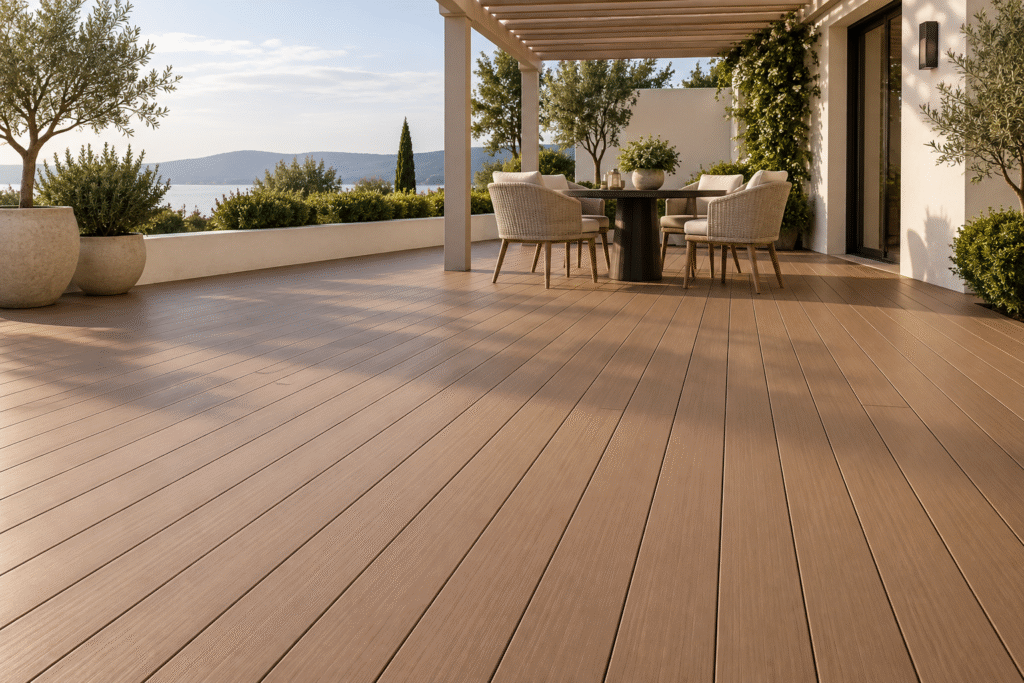
Use an illustrative restaurant courtyard with fine brushed warm-brown WPC decking around a small dining arrangement. The operator wants the floor to remain visually calm beneath chairs and tables. An alternative courtyard concept uses a cooler charcoal face with visible parallel channels, creating a more directional pattern across the seating area.
Both concepts show completed, furnished outdoor flooring. Neither image demonstrates performance or represents an actual client installation. Therefore, give the design team physical references before it approves the appearance, and ask the operator to consider how the proposed furniture arrangement affects routine care.
Record nearby planting, normal food service and the cleaning access available between tables. These details describe the buying scenario without claiming that one finish suits every restaurant. Furthermore, keep the board color, construction and surface identity together when requesting alternatives. Comparing two unidentified brown samples cannot isolate the effect of the walking-face finish.
Compare Texture and Care Through the Same Questions
Use the same evaluation schedule for every offered SKU. Describe observations instead of assigning a universal advantage to the finish category.
| Procurement dimension | Fine brushed walking face | Channeled walking face |
|---|---|---|
| Visual acceptance | Review visible striations and color under project lighting | Review channel pattern and its visual direction |
| Cleaning access | Check the approved method on the actual finish | Check access to channel recesses using the approved method |
| Surface identity | Record SKU, face designation and sample reference | Record SKU, face designation and channel description |
| Installation interface | Confirm the separate edge and fixing details | Confirm the separate edge and fixing details |
| Performance decision | Request relevant product evidence | Request relevant product evidence |
| Order release | Retain the accepted sample and written specification | Retain the accepted sample and written specification |
This table organizes the comparison; it does not predict cleaning speed or establish that either surface resists stains better. The manufacturer’s instructions and a controlled review of the actual alternatives should support that decision.
Turn Cleaning Claims Into a Defined Review
During sample evaluation, ask the supplier for the approved cleaner, equipment and method for each proposed product. Then agree a representative comparison with the operator. Keep the soiling, method, observation period and acceptance criteria consistent, and record any limits of the small sample arrangement.
For example, ask whether staff can reach the texture recesses without changing to an unapproved brush or abrasive. Also, check the finish after the agreed cleaning cycle and drying period. A residue that remains visible deserves a recorded response rather than a general promise that composite decking needs no maintenance.
Do not copy chemical concentrations, pressure settings or cleaning intervals from another brand’s instructions. Likewise, a finish sample cannot represent every seasonal exposure. If the operator proposes machinery or a different care product, obtain written guidance for the selected SKU before including that method in the operating budget.
Keep Surface Channels Separate From Drainage and Slip Decisions
Channels on a walking face do not define the drainage arrangement beneath and between installed boards. Ask the building contractor and project designer to confirm the required support, spacing and water-management details from the approved system. Avoid inventing a universal gap or treating the face pattern as a substitute for those details.
Similarly, assess slip-related evidence against the intended terrace use. A deeper visible groove does not prove a particular wet result. This remains a separate technical question; the finish comparison here should identify the product that any submitted report actually covers.
Price the Approved Finish and Its Operating Scope
For project procurement, request technical specifications that identify the proposed face and the complete board construction. A decorative building materials supplier should also identify compatible fixings, trims and other quoted components. Compare installation cost on that common scope rather than assuming every alternative uses the same system.
Then estimate maintenance cost from the agreed method and the operator’s own labor assumptions. If one option needs an additional cleaning step in the comparison, show that step explicitly. However, do not turn a short review into a fixed lifetime saving or a guaranteed number of labor hours.
Buyers should verify test reports, applicable VOC limits, fire-rating documents and warranty terms. Confirm the required fire rating and durability evidence with the responsible project team. VOC requirements depend on the product, treatment and destination; an outdoor decking finish does not automatically carry an indoor emissions classification.
Five B2B Buyer FAQs
Does grooved decking always mean channels on the top surface?
No. The term may refer to a side connection groove. Ask the supplier to identify the exposed face, edge and underside on the drawing and sample before accepting the quotation.
Can buyers reverse a board to change its appearance?
Only when the manufacturer approves that use for the exact product. A finished-looking underside or another brand’s reversible design does not establish permission for the proposed board.
Is a brushed face automatically easier to maintain?
Do not assume so. Compare the actual finish using documented care instructions and agreed observation criteria. Surface construction, soiling and cleaning access can affect the purchasing decision.
Can a supplier substitute a similar texture after approval?
Require another review before accepting a changed face or construction. Retain the original sample reference, relevant documents and written approval so the buyer can identify what changed.
What belongs in a wholesale inquiry?
Include quantities, destination, terrace use, finish references and required evidence. Ask for the face designation, complete supply scope, packing information and any outstanding approval conditions alongside the commercial offer.
Request a Face-Specific Decking Quotation
Send Witop Decor the terrace plan and preferred appearance to request samples, technical data sheets and a project quotation. Discuss custom colors and OEM/ODM cooperation before confirming MOQ and lead time. Finally, obtain packing quantities and dimensions for container loading, and release the bulk order against the approved product and walking-face record.

James is a content creator and decorator with five years of experience designing home decor. In his daily life, james is constantly on the lookout for the latest, great examples of house design and further optimizes his solutions. Additionally, he writes articles related to outdoor design, interior design, and architectural decorating materials to help brands build more engaging relationships with their audiences.