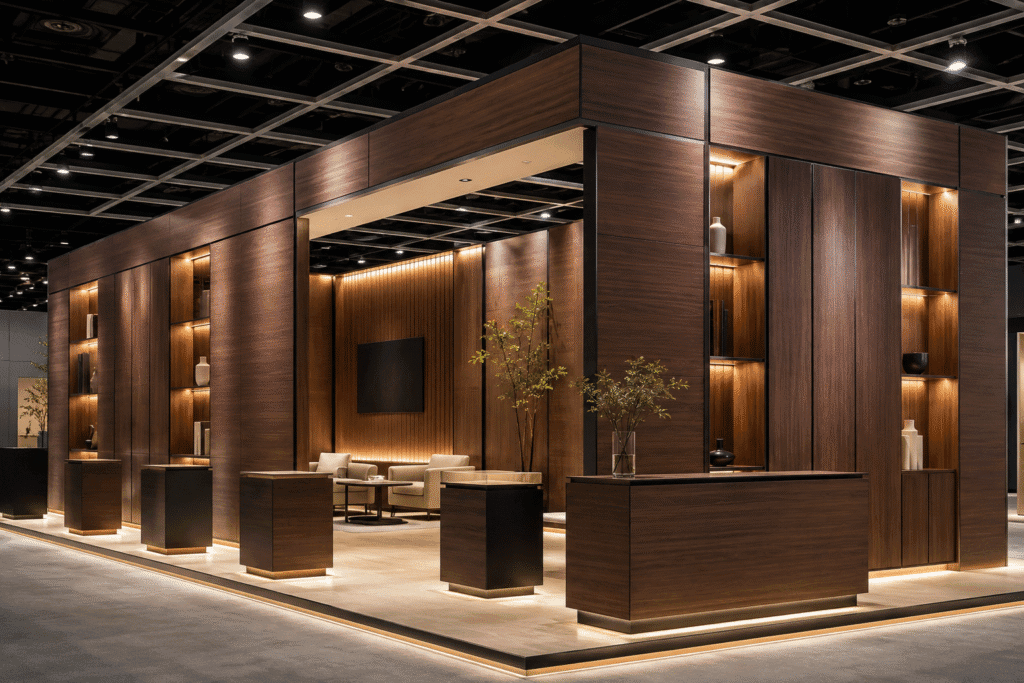
Direct Answer: Buyers can use bamboo charcoal panels in exhibition and showroom systems when they coordinate panel size, substrate, fixing, edges, lighting, graphics, transport protection, replacement modules, and compliance documents from the start. Therefore, the best B2B specification treats the decorative panel as part of a reusable kit rather than a one-event surface. Moreover, a trial assembly and packing test can reveal hidden labor, damage, and reconfiguration costs before a larger rollout.
Why Reusable Exhibition Systems Need a Different Buying Model
A permanent wall and a reusable exhibition module follow different operating cycles. Teams assemble, illuminate, photograph, dismantle, pack, move, store, and rebuild an exhibition system. Consequently, the finish must support repeated handling as well as the final visual result.
Therefore, buyers should compare bamboo charcoal panels through lifecycle tasks. These include cutting, mounting, edge protection, fixture coordination, cleaning, repair, labeling, packing, storage, and design changes. In contrast, a purchase decision based only on the first booth rendering may hide most of the commercial risk.
Moreover, exhibition companies, distributors, brand agencies, and showroom contractors often manage several clients or cities. A standardized module can support faster quoting and inventory reuse. However, uncontrolled colors, sizes, and fixings can create fragmented stock that loses value after one event.
Exhibition System Decision Matrix
| System Element | Main Requirement | Buyer Should Define | Commercial Risk |
|---|---|---|---|
| Main feature wall | Strong visual finish and repeated assembly | Panel module, joint rhythm, backing, and light direction | Visible damage or inconsistent alignment |
| Product display bay | Shelves, screens, and concentrated loads | Structural support, cutouts, cable routes, and replaceable faces | Decorative panel carries unsupported loads |
| Reception counter | Touch, luggage, cleaning, and corners | Edge profile, kick zone, access, and repair module | High-wear damage at the most visible element |
| Graphic zone | Changing campaigns and signs | Graphic fixing, removable layer, and opening locations | Surface damage during every update |
| Storage and transit | Repeated packing and movement | Crate layout, separators, labels, and moisture control | Scratches, crushed edges, or missing parts |
| Rebuild kit | Fast identification and predictable assembly | Module codes, hardware sets, drawings, and spare stock | Labor delay and incorrect component use |
Design Modules Around Reuse, Not Only Appearance
The module size should connect design intent with transport, labor, storage, and replacement. A very large face can reduce joints and create a premium appearance. However, it may require more handlers, larger crates, wider access routes, and a costly replacement after local damage.
Smaller modules can improve handling and repair, yet they add joints and labels. Therefore, the project team should compare several module grids against common booth dimensions, vehicle or container limits, venue access, and crew capability.
Additionally, the visible joint should support the design. A shadow line, metal trim, frame, shelf, or lighting feature can create logical module boundaries. As a result, crews can replace one face without making the booth look patched.
Designers should also define orientation. Wood-look or directional finishes need clear top, bottom, left, and right references. Consequently, every panel and drawing should use the same module code and orientation mark on a concealed surface.
Separate Decorative Faces From Structural Loads
Bamboo charcoal panels can provide a decorative face, but shelves, televisions, products, signs, and lighting equipment need suitable structural support. Therefore, the system designer should transfer loads into the frame or approved backing rather than assume the finish panel carries them.
Moreover, cutouts can reduce local strength or create vulnerable corners. The drawings should identify screen recesses, cable openings, sockets, shelf brackets, ventilation, and access doors before production. As a result, the workshop can standardize reinforcement and reduce uncontrolled site cutting.
A sample display bay should include realistic loads and cables. However, the test should follow the actual frame, backing, fixings, and opening sizes. A panel sample alone cannot validate the complete exhibition structure.
Choose Fixings for Assembly and Clean Removal
Reusable systems need a fixing method that balances security, speed, alignment, and removal. Options may include concealed mechanical fixings, approved clips, hook systems, frame retainers, or other supported details. Therefore, the buyer should review the exact combination with the system engineer and panel supplier.
Permanent adhesive may simplify the first build, yet it can limit face replacement or reuse. In contrast, removable mechanical systems may add hardware and workshop preparation. Consequently, the lifecycle comparison should include assembly minutes, removal damage, hardware loss, and repair labor.
Furthermore, fixings should remain accessible without exposing distracting hardware. The trial build should record the correct sequence and tools. As a result, new crews can follow a repeatable method in another city.
Protect Edges and Corners Through Multiple Cycles
Edges often experience more damage than the broad panel face. Reception counters, door openings, storage racks, and crate handling create repeated contact. Therefore, buyers should select edge details early and test them through assembly, dismantling, and packing.
The system may use matching trims, metal profiles, controlled returns, framed modules, or protected shadow lines. Moreover, the detail should account for panel thickness, core color, surface film, and dimensional tolerance. A visually thin edge can still need a durable hidden support.
External corners deserve replaceable parts where practical. For example, a separate corner post can protect adjacent face modules. Consequently, a damaged corner may require one small component instead of two large decorative panels.
Plan Lighting With the Finish and Module Grid
Exhibition lighting can intensify color, texture, gloss, and joint visibility. Therefore, teams should review bamboo charcoal panels under the actual color temperature, beam angle, distance, and dimming level. A sample under office lighting may look different on the exhibition floor.
Moreover, grazing light can reveal substrate waves or steps between modules. Designers can reduce risk by aligning fixtures with the module grid and controlling the mounting plane. As a result, the lighting supports the finish instead of exposing avoidable inconsistencies.
Color-critical brands should approve several production-representative panels together. Additionally, they should photograph the mockup with the cameras and screens used for event content. This review helps teams judge how the finish appears both in person and in marketing images.
Coordinate Graphics and Changing Brand Content
Exhibition walls often carry logos, product signs, campaign graphics, and screens. However, brand content changes more frequently than the base wall system. Therefore, the design should separate replaceable graphics from reusable bamboo charcoal panel faces whenever possible.
For example, a dedicated graphic rail, magnetic layer, framed insert, or replaceable sign zone can reduce repeated drilling. The responsible specialist should confirm compatibility and fixing loads. Moreover, the drawings should preserve cable access and avoid blocking module removal.
When the campaign changes, teams should update only the content layer. As a result, the base finish can continue across several event cycles and protect the original material investment.
Build a Transport and Storage Plan
Reusable panels require purpose-designed packing. Therefore, the project team should define crate size, stacking orientation, separators, corner protection, face protection, moisture control, labels, and maximum pack weight. General packaging for one-way delivery may not support repeated event handling.
Moreover, each crate should match the installation sequence. If crews need the rear modules first, those components should remain accessible without unloading every front piece. As a result, packing design can reduce venue labor and handling damage.
The buyer should run a packing trial with the finished modules. Additionally, the team should photograph each layer and record the packing list. A return checklist can identify missing hardware or damaged components before the next shipment.
Storage conditions also matter. Panels and finished modules need protection from unsuitable moisture, heat, pressure, dirt, and impact according to supplier guidance. Consequently, the lifecycle plan should include warehouse racks, crate inspection, and inventory ownership.
Control Colors, Batches, and Replacement Stock
Reusable exhibition systems may expand over time. Therefore, buyers should keep product codes, decor codes, batch records, signed samples, module drawings, and event history. A descriptive color name alone cannot support a precise reorder.
Whenever practical, produce visible modules for one system in one controlled batch. Moreover, allocate spare faces at the same time as the main order. This approach can reduce visual differences during an urgent repair.
Spare quantities should reflect exposure and replacement size. Reception counters and external corners may need more support than protected upper-wall modules. As a result, the spare plan should follow risk rather than apply one percentage to every component.
Verify Fire, VOC, and Venue Requirements
Exhibition requirements vary by country, venue, event organizer, booth height, occupancy, substrate, and installation method. Therefore, buyers should request technical data sheets, available fire information, VOC information, installation guidance, care instructions, and warranty terms for the exact bamboo charcoal panel construction.
Moreover, the team should compare the documented product and assembly with the proposed frame, backing, fixing, joints, and coatings. A report for a different construction may not support the final booth system.
Buyers should verify test reports, VOC limits, fire-rating documents, warranty terms, venue rules, and local acceptance with qualified professionals. Additionally, exhibition organizers may request documents before move-in, so procurement should build approval time into the schedule.
Calculate Lifecycle Return Across Event Cycles
The first-order material price does not define the value of a reusable system. Buyers should include design, workshop labor, hardware, finishing, packing, freight, drayage, venue labor, storage, repairs, graphics changes, missing parts, and disposal.
Therefore, calculate cost per event or cost per usable cycle. For example, a more organized module kit may cost more initially but reduce assembly hours and damage. Likewise, replaceable face panels can preserve the frame after a campaign change. In contrast, a one-piece wall may create a lower first quote but little reuse value.
Distributors and exhibition contractors can protect margin by offering complete kits. Moreover, they can add sample approval, module drawings, coded packing, spare parts, technical files, and reorder management. As a result, the buyer receives operational value rather than only decorative sheets.
Recommended B2B Procurement Workflow
- Define target event count, booth sizes, transport routes, storage, and reconfiguration needs.
- Select a module grid that balances appearance, handling, repair, and crate efficiency.
- Separate structural loads, graphics, cables, and services from the decorative face.
- Approve fixings, edges, corners, lighting, and removable access through a trial assembly.
- Conduct dismantling and packing trials with realistic crew actions.
- Verify available technical, fire, VOC, care, installation, and warranty documents.
- Confirm MOQ, lead time, batch allocation, labels, packing, container loading, and delivery.
- Establish spare modules, inventory records, return inspection, and reorder procedures.
Questions to Include in a Supplier RFQ
The request should state panel dimensions, module quantities, finish, edge details, backing, cutouts, target event count, destination, packing constraints, technical document needs, delivery date, and expected order volume. Additionally, buyers should ask about MOQ, lead time, custom colors, surface options, tolerances, pieces per pack, weight, container loading, sample support, and repeat-order records.
Witop Decor can discuss sample kits, custom finishes, OEM or ODM cooperation, technical data sheets, packing concepts, container loading, and wholesale project quotations for bamboo charcoal panels. However, detailed module drawings and event requirements help the factory quote the relevant product and service scope.
FAQ for Bamboo Charcoal Panel Buyers
Can bamboo charcoal panels support shelves or televisions?
The decorative panel should not carry loads without a suitable engineered support system. Therefore, designers should transfer loads into the frame or approved backing and coordinate all openings.
What module size works best for reusable exhibition walls?
No universal size works for every system. Buyers should compare booth dimensions, access routes, crew capacity, crate size, joint appearance, and replacement cost.
How can teams reduce damage during repeated transport?
Use purpose-designed crates, face separators, corner protection, controlled stacking, clear labels, packing photos, and return inspections. Moreover, test the complete packing process before the first event.
How should importers manage future color matching?
Keep signed samples, decor codes, batch records, module allocations, photos, and spare faces. Additionally, include high-risk spare modules in the original batch whenever practical.
What does Witop Decor need for a bulk project quotation?
Provide module drawings, quantities, panel sizes, finish, edges, cutouts, backing details, packing limits, destination, event schedule, document needs, and target order date. Consequently, the proposal can address both material and project logistics.
Turn a Decorative Finish Into a Reusable Asset
Bamboo charcoal panels can support distinctive exhibition and showroom environments. However, repeatable value comes from module discipline, protected edges, coordinated lighting, transport planning, documented spares, and realistic lifecycle costing. Therefore, B2B buyers should test the whole kit before scaling the system.
Contact Witop Decor to request samples, compare bamboo charcoal panel finishes, discuss custom colors and OEM or ODM options, review available documents, plan packing and container loading, or obtain a wholesale project quotation.

James is a content creator and decorator with five years of experience designing home decor. In his daily life, james is constantly on the lookout for the latest, great examples of house design and further optimizes his solutions. Additionally, he writes articles related to outdoor design, interior design, and architectural decorating materials to help brands build more engaging relationships with their audiences.