A curved lobby wall can carry a convincing wood-look rhythm while creating a difficult purchasing question: how will the selected profiles connect as the wall changes direction? A straight-wall sample answers only part of that question. Therefore, an importer should establish the permitted connection geometry before accepting a curved-wall quotation.
This guide concerns indoor WPC wall panels. It does not extend an interior profile’s approval to outdoor WPC wall cladding. For a wholesale distributor, the key distinction is between a profile or connection designed for a particular curve and an ordinary product that merely looks similar in a rendering.
Quick Answer: Can Standard WPC Wall Panels Follow Any Curved Wall?
Do not assume that they can. Confirm the exact profile, connection and approved change of direction for the proposed convex or concave wall. A visible flute pattern does not establish joint articulation, backing support or permission to bend the material. Review any expressly approved flexible or curved system separately from an arrangement of flat sections. Then obtain the supplier’s written application limits before confirming the order.
Identify What Actually Creates the Curve
A specification should explain whether the proposed system bends an approved component, changes angle at an approved connection, or follows several flat backing sections. These approaches create different supply and appearance questions. Consequently, the phrase “flexible WPC” needs an identified product and installation detail behind it.
For example, COOWIN’s curved-panel product page identifies CWN-08 and CWN-09 as particular WPC profiles and describes adjustable inner and outer arcs. This illustrates a model-specific product offering. It does not establish a radius or curved-use approval for another supplier’s wall panels, including an unconfirmed Witop SKU.
Ask the decorative building materials supplier to identify the offered mechanism directly. Avoid treating a photograph of a curve as evidence that a standard extrusion can reproduce it. Equally, a separate flexible backing does not by itself establish that the decorative face or its connections permit the proposed movement.
Distinguish Convex and Concave Joint Conditions
On a convex wall, the decorative face follows the outside of the curve. On a concave wall, the face follows the inside. Describe that orientation on the inquiry drawing instead of relying on the word “rounded.”
Next, ask how adjacent profiles engage in that orientation. Request a section showing the connection at the proposed change of direction, including the visible face and rear contact. The supplier should identify any permitted opening, overlap or special connector for the selected system. Buyers should not invent acceptable joint clearances from a catalog photograph.
Also, ask whether the proposed connection remains engaged along the full profile length. A favorable appearance at the middle of a short sample does not settle the conditions at its ends or beside a return. Keep this question separate from the decorative color approval.
Compare the Three Proposed Supply Routes
Use the table to clarify a supplier’s proposal. It describes purchasing routes for review rather than interchangeable installation instructions.
| Proposed route | Confirmation to request | Appearance issue to approve |
|---|---|---|
| Specifically approved curved or flexible product | Exact SKU, orientation, limits and complete installation method | Face shape and connection appearance on the actual curve |
| Approved profiles meeting at changing angles | Permitted articulation and continued connection engagement | Repeating joint rhythm and any visible opening |
| Approved flat sections around a faceted wall | Backing geometry and approved transitions between sections | Deliberate changes in plane rather than a perfectly smooth arc |
If the supplier cannot approve the requested route, ask the designer to revise the geometry or specify another suitable system. Do not solve the uncertainty by proposing unapproved heating, cutting slots or forcing connections together.
Coordinate the Connection With Its Backing
Show the relationship between the decorative profile, its fixing zone and the supporting surface. Ask the responsible reviewer how each component maintains the intended contact and support as the wall turns. A connection drawing and a backing drawing should describe the same assembly.
Then confirm who supplies any special rails, connectors or transitions that the proposal requires. A building contractor may otherwise price an ordinary flat-wall fixing package while purchasing assumes the curve includes a dedicated support system. Identify those boundaries before comparing installation cost.
In addition, distinguish decorative cladding from support for mirrors, signage or other fixtures. Request the relevant fixture support detail independently. A curved decorative wall does not establish that the profile or its connection can carry an additional fitting.
Review the Straight-to-Curve Transition
A long wall may begin straight, turn through a convex section and meet a different finish. Therefore, include the transition in the submitted detail. Ask how the first angled connection relates to the last straight profile and how the wall terminates at the far end.
Also, show door returns and adjacent joinery. The selected curve may change the available space for a trim or service opening. Request an approved solution for those locations rather than assuming that a standard end profile fits every changing angle.
For repeated hotel locations, identify which wall details share the same geometry and which require separate review. A supplier’s approval for one convex arrangement should not silently become approval for a tighter curve or an inward-facing return elsewhere.
Approve the Visible Result as a Separate Decision
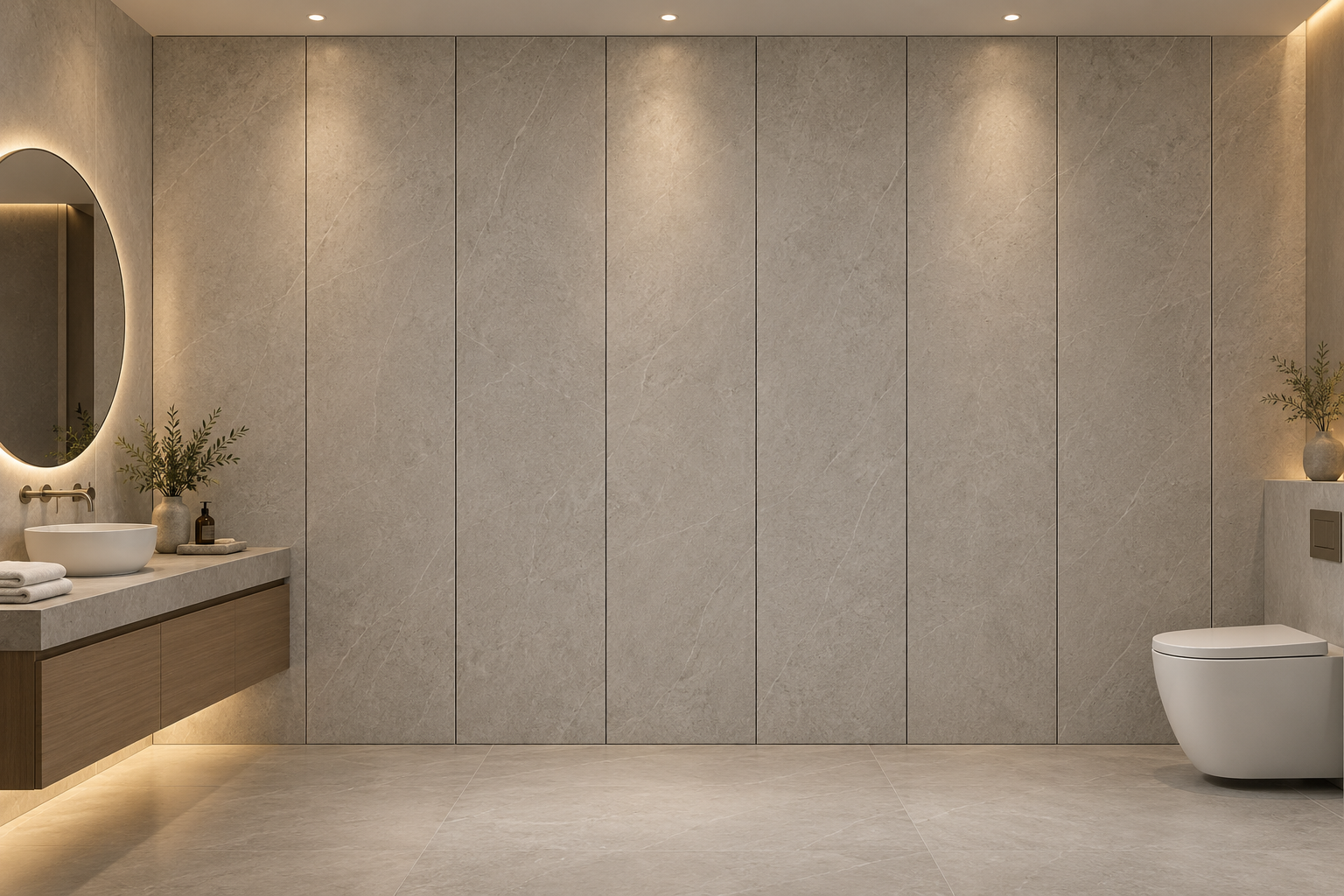
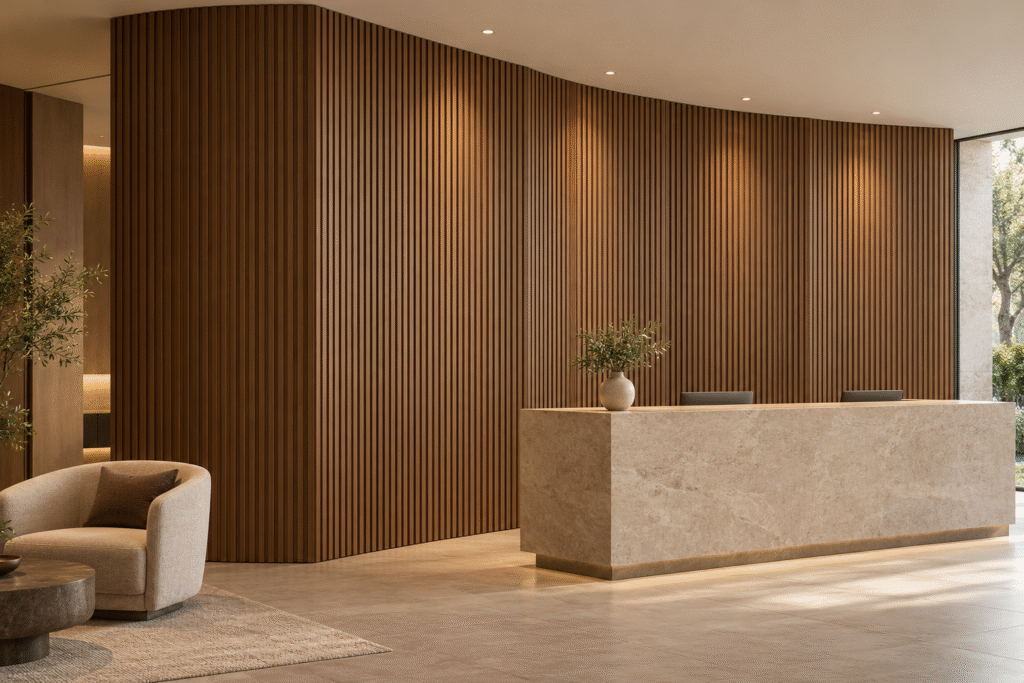
An illustrative furnished reception can use a warm walnut-look wall arranged in several deliberate flat sections that create a gentle convex sweep. A second completed lounge concept can use pale oak-look profiles on a gently faceted concave wall behind seating. Neither concept establishes the availability or approval of a specific curved Witop system.
During sample evaluation, review the proposed joint rhythm from normal approach routes and alongside the selected furniture. Check the accepted section at a change of direction as well as a straight portion. However, keep decorative acceptance separate from the supplier’s technical approval of the connection and support.
Record the chosen profile, finish and detail revision together. If the team changes the profile width or connector after approval, return the affected geometry to the responsible reviewer. Similar wood grain does not establish equivalent connection behavior.
Price the Approved Package and Handover Scope
For project procurement, request a quotation covering the approved profiles, matching transitions, required accessories and agreed supporting components. Confirm MOQ, lead time and container loading against that schedule. Do not turn an attractive curved rendering into a purchase list of standard straight-wall panels alone.
Furthermore, ask how the accepted system permits inspection or replacement if necessary. Include any access limitations in the handover information. This helps the operator evaluate maintenance cost without assuming that an articulated or flexible appearance guarantees easy removal.
Buyers should verify test reports, VOC limits, fire rating documents and warranty terms for the exact product and intended assembly. Confirm whether the evidence covers the proposed construction. A curved appearance does not establish durability or compliance, and the technical specifications should state the applicable limits clearly.
B2B Buyer FAQs
Can a supplier approve a curve using only its radius?
A radius helps describe geometry, but also provide the face orientation, wall height, profile identity and proposed connection. Ask the supplier which additional drawings it needs for the actual assembly review.
Does approval for a convex wall also cover a concave wall?
Do not assume that it does. Show both conditions and request separate confirmation where the connection or rear contact changes. A product-family name cannot replace an approved detail.
Is a faceted wall a defective version of a smooth curve?
It can be an intentional design choice if the team specifies and accepts it. Agree on the visible changes in plane before ordering; do not promise a continuous smooth arc from an approved faceted proposal.
Should buyers ask installers to heat a standard profile into shape?
Do not propose unapproved forming methods. Ask the supplier whether an appropriate product and documented system exist, then obtain the responsible project team’s acceptance of that complete proposal.
What should an importer send to Witop Decor?
Send the interior wall drawing, convex or concave orientation, desired finish and quantities. Request samples, technical data sheets and a project quotation. Include custom colors or OEM/ODM cooperation needs in the bulk order inquiry, subject to confirmed product availability and application approval.

James is a content creator and decorator with five years of experience designing home decor. In his daily life, james is constantly on the lookout for the latest, great examples of house design and further optimizes his solutions. Additionally, he writes articles related to outdoor design, interior design, and architectural decorating materials to help brands build more engaging relationships with their audiences.