Mixed-Container Procurement for Decorative Building Materials: SKU Planning, Damage Control, and Inventory Turnover
Direct Answer: Mixed-container procurement can help importers test several decorative building material categories or replenish multiple SKUs in one shipment, but only when the buyer controls weight, volume, packaging compatibility, loading sequence, documentation, and inventory demand. A successful plan should compare WPC wall panels, UV marble sheets, bamboo charcoal panels, acoustic panels, SPC flooring, accessories, MOQ, lead time, pallet design, landed cost, and claim risk. The lowest freight allocation per SKU does not always create the best inventory result.
Why Importers Use Mixed Containers
Wholesale distributors often need to launch new products without purchasing a full container of every SKU. They may also need to replenish fast-moving colors while testing a new panel, flooring format, or accessory system. Therefore, mixed-container procurement can reduce the initial commitment to one product category and create a broader sample of market demand.
However, combining products adds operational complexity. SPC flooring is dense and heavy, while long wall panels consume volume. UV marble sheets need flat, well-protected handling. Acoustic panels may require compression control, and decorative surfaces need face and edge protection. As a result, the container plan must balance weight, cubic volume, pallet compatibility, loading sequence, and unloading access.
For an importer, the objective should not be to place the maximum number of SKUs into one container. The objective should be to build a shipment that arrives in saleable condition and supports realistic inventory turnover. Consequently, the buyer needs a commercial plan and a physical loading plan before confirming the purchase order.
Which Products Can Enter a Mixed Decorative Materials Container?
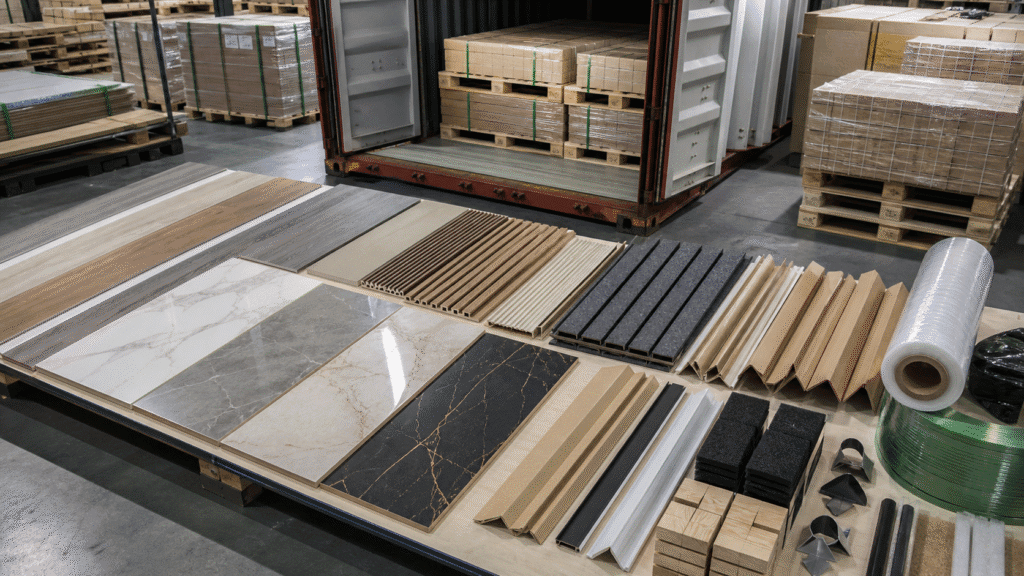
A mixed container may include WPC wall panels, UV marble sheets, bamboo charcoal panels, acoustic panels, SPC flooring, trims, profiles, skirting, underlayment, sample kits, or other decorative building materials. Nevertheless, product compatibility depends on dimensions, weight, packaging, sensitivity, customs requirements, and the supplier’s loading capability.
Buyers should not assume that every combination is efficient. A small quantity of an unusually long product may force a different pallet layout. A heavy flooring order may reach the container’s weight limit before the remaining cubic space is full. Likewise, fragile large sheets may require a protective frame that changes the available loading area.
Witop Decor can discuss mixed product supply, sample evaluation, MOQ, packaging, loading sequence, custom colors, OEM/ODM cartons, and project quotations with importers and wholesale distributors. Final loading quantities should follow actual dimensions, net and gross weights, pallet plans, container limits, destination regulations, and a confirmed loading calculation.
Product Compatibility Comparison
| Product category | Main mixed-loading concern | What the importer should confirm |
|---|---|---|
| WPC wall panels | Long cartons consume linear space and edges can suffer from handling. | Carton length, bundle strength, edge protection, stacking direction, profiles, and unloading plan. |
| UV marble sheets | Large surfaces require flat support, face protection, and controlled movement. | Sheet size, pallet or crate design, corner protection, protective film, stacking, and access. |
| Bamboo charcoal panels | Decorative faces, edges, and color batches need protection and traceability. | Panel size, carton strength, surface protection, batch labels, profile packs, and spare quantity. |
| Acoustic panels | Soft or fiber-based products may face compression, moisture, or surface-mark risk. | Carton compression limit, moisture protection, facing protection, color labels, and storage. |
| SPC flooring | Dense cartons add weight quickly and require stable pallet support. | Gross weight, pallet strength, stacking limit, carton quantity, underlayment, and weight distribution. |
| Trims and accessories | Small items can be lost, mixed, or damaged during loading and unloading. | Separate labels, accessory lists, protected packs, quantities, and branch or SKU references. |
This comparison shows why a mixed container needs product-level data. A supplier cannot produce a reliable loading plan from square meters alone. The importer should provide SKU quantities, dimensions, packaging preferences, delivery priority, and unloading conditions.
Start with Demand, Not Available Container Space
Buyers sometimes begin with a target such as filling one 20-foot or 40-foot container. That approach can encourage unnecessary SKUs or unbalanced quantities. Instead, start with customer demand, historical sales, active quotations, sample feedback, and target inventory coverage.
Classify products into core stock, project stock, test stock, and accessories. Core stock should represent proven colors or formats. Project stock should connect to a confirmed customer requirement. Test stock should remain limited enough to protect cash flow. Accessories should match the main product quantity and installation system.
Next, calculate expected monthly sales, reorder lead time, safety stock, warehouse capacity, and cash conversion. A mixed container can improve variety, but too many low-volume SKUs can slow inventory turnover and reduce channel margin.
Balance Weight, Volume, and Pallet Geometry
Container planning involves three different constraints: weight, cubic volume, and physical geometry. SPC flooring may use weight capacity faster than volume. Long WPC cartons may leave spaces that shorter pallets cannot use efficiently. Large UV marble sheets may require a frame that protects the product but limits stacking.
Ask the supplier for carton dimensions, pieces per carton, net weight, gross weight, pallet dimensions, pallet weight, stacking limit, and proposed loading orientation. Then review the combined plan rather than calculating each product separately. Additionally, consider whether the destination warehouse has a forklift, loading dock, manual unloading team, or limited access.
Buyers should verify container payload and transport limits with their freight forwarder because limits can vary by equipment, route, carrier, road rules, and destination. A theoretical factory calculation does not replace the final logistics approval.
Control Crushing, Surface Damage, and Moisture Risk
Mixed products transfer loads differently. A dense flooring pallet can damage a lighter carton if the loading plan allows contact or movement. Long panels can bend when unsupported. Decorative faces can scratch when cartons shift, while fiber products may suffer from compression or moisture.
Define the protection system before loading. Review corner guards, face protection, pallet caps, straps, stretch wrap, moisture barriers, desiccant strategy where appropriate, timber or frame requirements, and movement prevention. Moreover, confirm which products can stack and which need independent support.
A good plan also considers unloading. Products needed first should remain accessible when practical. Accessories should not sit in an unmarked gap. Branch, project, or SKU labels should face a visible direction so warehouse staff can identify goods without dismantling the full load.
Standardize Labels and Packing Lists
Mixed-container procurement creates more opportunities for quantity and identification errors. Therefore, every carton, bundle, pallet, or crate should carry a clear product code, color, size, batch, quantity, and project reference. Private-label packaging may also include the distributor’s SKU and language requirements.
The commercial packing list should connect to the physical labels. It should separate products, accessories, samples, spare units, and free-of-charge items. Additionally, the buyer should confirm the number of cartons and pallets before loading and compare that figure with container photos and final documents.
For OEM/ODM programs, approve carton artwork, barcode format, product names, and legal markings before production. Buyers should verify labeling and customs requirements for the destination market rather than assume one carton design works everywhere.
Calculate Landed Cost by SKU
A mixed shipment can reduce the need for several separate containers, but it complicates landed-cost allocation. Freight, handling, inspection, documentation, local transport, warehouse labor, and damage risk must be allocated across products.
Importers can allocate costs by weight, volume, pallet space, value, or a hybrid method. No single method fits every business. For example, allocating all freight by product value may understate the cost of a bulky low-value panel. Allocating only by weight may overcharge dense flooring and undercharge large sheets that consume valuable space.
Choose a consistent method and document it. Then compare gross margin, expected selling period, financing cost, warehouse cost, sample demand, and replacement allowance for each SKU. As a result, the distributor can identify products that appear profitable at factory price but perform poorly after full landed cost.
Coordinate MOQ, Lead Time, and Production Sequence
Different product categories may have different MOQ, production cycles, surface availability, color approval steps, and packaging requirements. One slow item can delay the entire container. Therefore, buyers should confirm the critical path before placing deposits.
Ask for a production schedule that shows sample approval, material preparation, manufacturing, inspection, packing, and loading. Define whether completed goods can remain safely in factory storage while another product finishes. Additionally, confirm how storage time may affect cartons, moisture protection, or claim responsibility.
Custom colors and OEM/ODM packaging can strengthen distributor differentiation, but they also add approval and production time. Include those steps in the shipment plan rather than treating them as last-minute additions.
Quality Control and Pre-Shipment Verification
A mixed container needs a category-specific inspection plan. The inspector should not apply one checklist to every product. WPC panels require dimension, profile, and surface checks. UV marble sheets need pattern, surface, flatness, and protective-film checks. Acoustic panels require facing, color, dimensions, and packing checks. SPC flooring needs locking-edge, dimension, surface, and carton checks.
Before loading, verify SKU quantities, accessory packs, batch labels, pallet condition, carton markings, and document references. During loading, record the sequence, separation, bracing, and final door area. Photos and loading records cannot eliminate claims, but they can improve traceability.
Buyers should also agree on claim procedures, evidence requirements, notification periods, warranty terms, and responsibility for concealed damage. Clear rules support faster problem solving after arrival.
Long-Term ROI: Inventory Turnover Before Container Utilization
The ROI of mixed-container procurement includes product cost, packaging, inspection, freight, import handling, customs, local delivery, warehouse labor, financing, samples, damage, slow stock, and markdown risk. Therefore, maximum container utilization does not automatically produce maximum profit.
For example, adding a slow-moving color may improve cubic utilization but lock cash in inventory. Removing one incompatible SKU may reduce packing complexity and damage risk. Ordering more accessories can prevent lost sales when customers need a complete installation system. Meanwhile, a better SKU mix can shorten the reorder cycle and support distributor confidence.
Measure sell-through by SKU, gross margin after landed cost, average inventory age, damage rate, sample-to-order conversion, and stockout frequency. Use the results to improve the next mixed container rather than repeating the first order unchanged.
Mixed-Container Procurement Checklist
- Classify every SKU as core stock, project stock, test stock, accessory, or spare.
- Confirm carton dimensions, net and gross weight, pallet size, stacking limits, and loading orientation.
- Review product compatibility, weight distribution, edge support, face protection, moisture control, and unloading access.
- Verify MOQ, sample approval, production sequence, inspection timing, OEM/ODM artwork, and lead time.
- Match physical labels with the packing list, batch references, project codes, accessories, and final quantities.
- Calculate landed cost, expected turnover, warehouse capacity, financing cost, damage allowance, and reorder timing by SKU.
FAQ: Mixed-Container Procurement for Decorative Materials
1. Can importers combine wall panels and SPC flooring in one container?
They may combine them when weight distribution, dimensions, pallet support, product protection, container limits, unloading access, and supplier capability support the plan. Request a combined loading calculation.
2. Does a mixed container reduce MOQ?
It may reduce the quantity shipped per SKU, but factory MOQ still depends on materials, colors, production setup, packaging, and product category. Confirm MOQ for every SKU before planning the container.
3. How should freight be allocated across mixed products?
Importers may allocate freight by weight, volume, pallet space, value, or a hybrid method. Choose a consistent method that reflects how each SKU uses container and handling resources.
4. What causes the most damage in mixed loading?
Common risks include incompatible stacking, poor weight distribution, unsupported long cartons, insufficient face or edge protection, moisture, movement, and an unloading sequence that forces unnecessary handling.
5. What information should buyers send for a mixed-container quotation?
Send product categories, SKU quantities, dimensions, colors, accessories, packing preferences, destination, container type, unloading conditions, required documents, target date, and any OEM/ODM requirements.
Request a Mixed Decorative Materials Loading Proposal
Mixed-container procurement creates stronger B2B value when importers connect SKU demand with product compatibility, packaging, weight, volume, documentation, landed cost, and inventory turnover. Witop Decor works with wholesale distributors, importers, contractors, and project buyers that need coordinated decorative building material supply.
Contact Witop Decor to discuss product combinations, request samples and technical data sheets, compare MOQ and lead time, review custom colors or OEM/ODM packaging, and prepare a container loading proposal. Include target SKUs, quantities, destination market, warehouse conditions, required documents, and sales priorities so the factory can build a practical quotation.

James is a content creator and decorator with five years of experience designing home decor. In his daily life, james is constantly on the lookout for the latest, great examples of house design and further optimizes his solutions. Additionally, he writes articles related to outdoor design, interior design, and architectural decorating materials to help brands build more engaging relationships with their audiences.