Table of Contents
ToggleQuick Answer: Which Edge Profile Should B2B Buyers Choose?
Choose SPC flooring edges through an assembled sample, an agreed appearance standard and a cleaning trial. Beveled edges deliberately outline individual planks; square edges aim for a less pronounced border. Neither appearance proves joint strength, waterproofing or commercial durability. Therefore, compare edge geometry and finish separately from the locking system, substrate requirements and warranty. An importer should approve the complete floor specification before approving the purchase order.
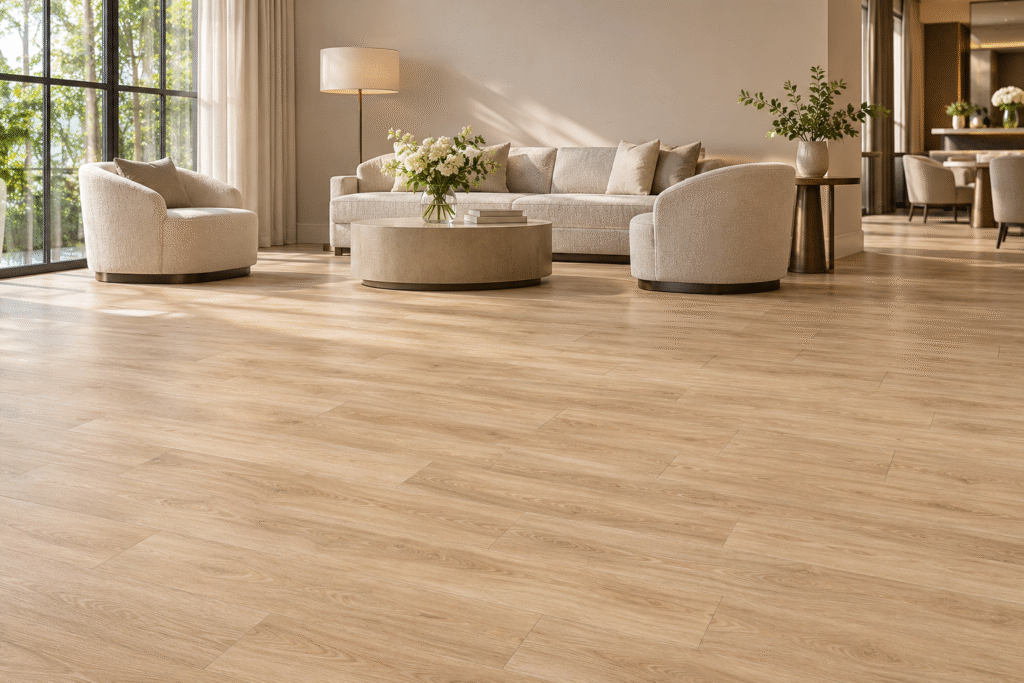
A furnished lounge can make two similar oak designs look surprisingly different. In a serviced apartment’s shared living room, subtle joints may support a calm floor plane. In a boutique hotel lounge, defined plank borders may suit the interior concept. However, project procurement needs more than a preference: buyers must agree what the finished joints should look like and how housekeeping will maintain them.
AI-generated application illustration; not an actual customer project, an approved installation detail or evidence of product performance.
Define the Edge Instead of Relying on a Name
A bevel creates a shaped border at the upper edge of a plank. Suppliers may use labels such as micro bevel, painted bevel or enhanced bevel. However, these names alone do not provide comparable dimensions, coating details or tolerances. Request a section drawing and physical samples showing both long edges and short ends.
For a manufacturer example, Karndean describes bevels among the design details in its rigid-core brochure. This illustrates a visual specification choice, not performance approval for a Witop SKU. Confirm the actual edge options and finish for the proposed product rather than transferring another range’s description.
Also ask how the decorative face meets the edge finish. Record whether the edge follows the surface color, introduces a contrasting line or uses a separate coating. A small swatch of the central wood grain cannot answer these questions. Keep an assembled reference with visible end joints alongside the loose approved plank.
Compare the Attributes That Affect the Finished Room
The following comparison describes purchasing priorities, not guaranteed rankings. Actual results depend on the specific plank, lighting, workmanship and cleaning method.
| Specification dimension | Beveled edge priority | Square edge priority |
|---|---|---|
| Visual effect | Approve the deliberate border and its contrast | Approve the desired continuity without promising invisible joints |
| Geometry | Record width, depth, shape and sides treated | Record top-edge geometry and joint tolerances |
| Surface finish | Inspect color and finish continuity into the bevel | Inspect the face finish up to the meeting edges |
| Cleaning trial | Observe residue along the shaped border | Observe residue and appearance along the meeting line |
| Acceptance | Separate intentional recesses from gaps or chips | Separate normal joints from gaps, chips or height differences |
| Reorders | Match the edge treatment as well as the decor code | Match the edge treatment as well as the decor code |
Consequently, a wholesale distributor should avoid describing either option simply as the premium version. One project may prioritize visible plank character; another may prioritize a quieter visual pattern. The buyer still needs equivalent technical specifications before comparing prices. Different wear layers, backing or locking profiles can otherwise distort an apparent edge-only comparison.
Evaluate Samples Under the Room’s Actual Lighting
Start sample evaluation with several full planks, including long-side joints and staggered end joints. Ask the building contractor to assemble them according to the applicable instructions. Next, review the sample under representative daylight, evening lighting and low-angle light across the floor. Record the conditions so later reviewers can repeat the comparison.
Assess the surface from normal standing and seated positions. Also examine joint details closely for manufacturing or handling damage. These checks serve different purposes: the designer evaluates the room’s appearance, while the contractor checks the physical joint. A dramatic photograph under extreme lighting should not become the sole acceptance reference.
For a serviced apartment lounge, compare how the joints read around the sofa and circulation area. For a hotel lounge, consider the repeated borders across a larger open floor. Neither scenario requires a universally deeper or flatter edge. Instead, approve the visual result with the operator before the importer commits to bulk quantities.
Test the Cleaning Routine Before Estimating Maintenance Cost
Do not assume that every bevel traps unacceptable dirt or that every square edge cleans effortlessly. Run the same practical cleaning trial on representative assembled samples. Use the manufacturer’s permitted cleaner, dilution, equipment and method. Meanwhile, ask the housekeeping team to judge residue, visible streaks and the effort needed around the joints.
Karndean’s official sample and care FAQ illustrates why the reviewer should use suitable physical samples and the manufacturer’s own care guidance. Its product-specific cleaning permissions do not approve the same chemicals or methods for another brand. Obtain the corresponding guide for the exact SPC flooring under review.
Record cleaning time and observations without presenting a short trial as a lifetime durability test. For example, an edge that needs additional attention during the trial may affect housekeeping labor estimates. However, traffic, entrance dirt control and operating practice also influence maintenance cost. Use measured project observations rather than a universal percentage saving.
Separate Decorative Recesses from Joint Defects
An intentional bevel and an unintended opening describe different conditions. Agree how the supplier and contractor will identify each condition before delivery. Also distinguish edge chipping, coating loss and adjacent plank height differences from the approved decorative profile. Photographs should show scale and context, alongside the retained reference sample.
Never accept a bevel as a remedy for a damaged locking joint or an unsuitable subfloor. Request the selected manufacturer’s preparation and installation requirements, and ask the responsible installer to resolve questionable support or joint conditions against those instructions. An attractive edge does not replace the approval of the complete flooring assembly.
Therefore, keep installation cost allowances for substrate correction separate from the edge choice. Review questionable joints before the contractor continues across the room. Early agreement on acceptance can prevent expensive arguments after furniture arrives.
Keep edge appearance records separate from click-profile revision and production-lot compatibility checks. Matching a decorative line does not establish that two locking profiles can be mixed.
Protect Channel Margin with Complete SKU Records
An oak color name cannot identify a replacement plank reliably. Add the edge designation, profile revision and approved sample reference to the SKU record. Also retain plank dimensions, locking system, backing, batch details and packaging identification. Require written approval before the supplier changes any component that could affect appearance or compatibility.
Ask how edge variants affect MOQ, lead time and replacement availability. For container loading, separate cartons by complete SKU rather than grouping visually similar decor names. A mixed edge shipment can disrupt a planned room even when the center grain looks correct.
Additionally, verify test reports, VOC limits, fire rating documents and warranty terms for the exact proposed product and destination. An attractive edge does not establish compliance or suitability for hospitality use. Check commercial-use exclusions and the claim procedure before promising coverage downstream.
B2B Buyer FAQs
Does a deeper bevel prove better quality?
No. It describes a visual and geometric choice. Compare construction, test evidence, finish consistency and joint condition independently. Therefore, approve the edge profile without treating depth as a quality grade.
Are square edges completely seamless?
No. Individual planks still meet at joints. Review a physical assembly under representative lighting and agree acceptable appearance. Avoid selling a plank floor with a promise of invisible seams.
Can we fill the bevel to simplify cleaning?
Do not add fillers, sealers or coatings without the flooring manufacturer’s written approval. A decorative change may conflict with care instructions, movement requirements or warranty terms.
Can the same decor code use different edges?
Supplier coding practices vary. Therefore, include an explicit edge reference in the quotation, order and reorder record. Confirm physical compatibility instead of relying on the decor name alone.
What should accompany a bulk quotation request?
Send the application, destination, quantities, edge preference and cleaning expectations. Also request assembled samples, technical data sheets, packing details and commercial warranty information for review.
Request an Edge-Specific Project Quotation
Contact Witop Decor as your decorative building materials supplier to discuss a bulk order inquiry for SPC flooring. Request samples and technical data sheets, and confirm which edge options are available for the proposed construction. For custom colors or OEM/ODM cooperation, define the edge finish alongside the face design. Include quantities, destination and target delivery dates so the project quotation can address supply and sample approval together.

James is a content creator and decorator with five years of experience designing home decor. In his daily life, james is constantly on the lookout for the latest, great examples of house design and further optimizes his solutions. Additionally, he writes articles related to outdoor design, interior design, and architectural decorating materials to help brands build more engaging relationships with their audiences.