Quick Answer: Should Distributors Add a Wider SPC Plank?
Add a wider plank when it serves a clear customer or project requirement and its supply conditions fit your inventory plan. Plank width changes the visible floor pattern, the number of pieces in a layout and the way a distributor organizes its range. However, width alone does not establish better durability, faster installation or stronger channel margins.
A wider format can make a showroom display look different without adding a genuinely distinct purchasing option. The important question is whether contractors and dealers need that format often enough to support its MOQ, stocking quantity and repeat-order requirements. Therefore, evaluate the product as a new SKU family, not simply a larger version of an existing sample.
This guide addresses wood-look SPC flooring for B2B range planning. Standard and wide are commercial descriptions rather than universal dimensions. Ask each supplier for the actual width and length before comparing labels across catalogs.
Define the Customer Role of Each Format
Start with the enquiries that your channel already receives. Separate general dealer stock from named project requests and design-led orders. Additionally, record whether buyers ask for a wider appearance specifically or merely choose the color shown on a large sample board.
A distributor might use one format for its regular replenishment range and offer another against confirmed projects. That arrangement does not mean one product has lower quality. It simply assigns different stocking roles to options with different demand patterns and commercial conditions.
Next, identify the applications that justify a comparison. A boutique retail space with large open floor areas may present plank proportions differently from a compact consultation room with extensive furniture. Review actual layouts rather than promise that a wider plank makes every room appear larger.
Ask dealers to record the reason for lost or converted enquiries. A request that fails because the color is unavailable should not count as evidence of demand for another width. Clear feedback prevents a range expansion from solving the wrong commercial problem.
Compare Actual Dimensions and Visible Pattern
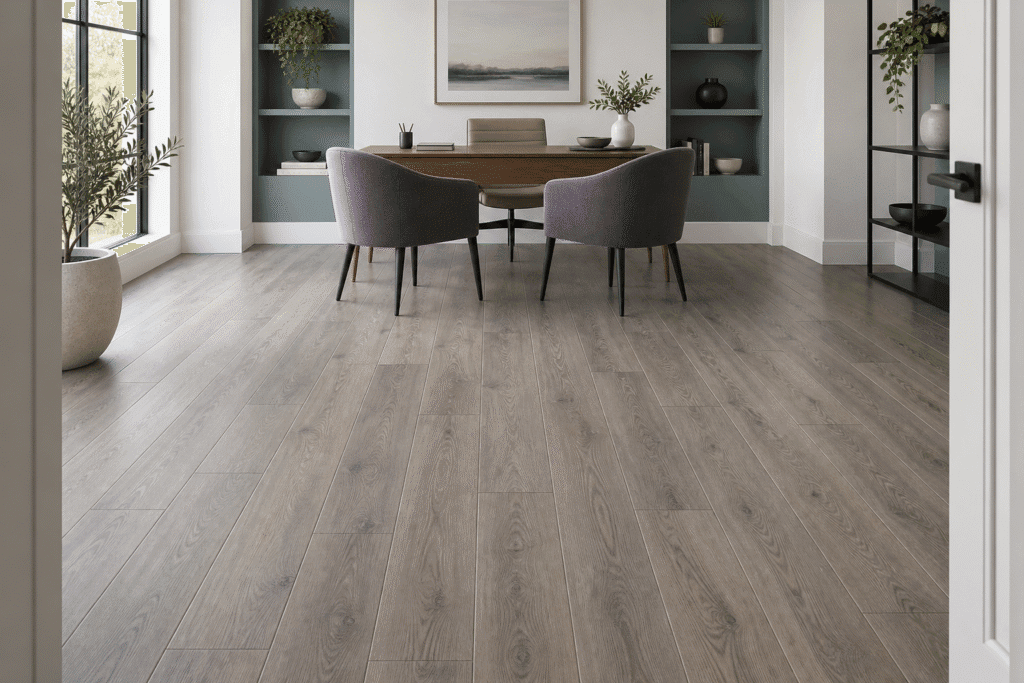
Request the stated plank dimensions, effective coverage, bevel description and decorative pattern information. For example, two suppliers may use the same wide-plank label for different widths and lengths. Those differences affect the appearance of a finished area and the quantity of pieces in a layout.
Compare several assembled rows instead of relying on one plank. Review joint rhythm, pattern repetition and the relationship between printed grain and plank proportions. Moreover, check whether the proposed wider format uses the same decorative design or a separately scaled image.
Do not assume that the same color name produces an exact visual match across formats. Ask for current physical samples from both options. Record which combination the customer approves, particularly when a development includes several unit types or commercial zones.
Keep the format decision separate from performance approval. Confirm total construction, wear-layer information, surface treatment, joint system and relevant test evidence for each model. A familiar appearance and a larger board do not establish equivalent technical specifications.
Use a Range-Planning Comparison, Not a Size Ranking
| Decision factor | Existing standard-format range | Proposed wider-format range | Buyer action |
|---|---|---|---|
| Customer demand | Existing enquiry and reorder history | Evidence of format-specific demand | Record why customers request the option |
| Visual identity | Current joint and grain rhythm | Different proportions and possible pattern scaling | Compare multi-plank layouts |
| Technical construction | Approved model specification | Separate model details to verify | Review data rather than infer equivalence |
| Carton coverage | Current pieces and area per carton | Confirmed pieces and area per carton | Normalize quotations by usable area |
| Stock commitment | Established reorder quantities | MOQ and minimum stocking depth | Calculate commitment across colors |
| Accessories | Existing confirmed references | Compatibility that still needs checking | Match actual profiles and finished heights |
| Reorders | Existing identification system | New width-specific order codes | Keep product references unambiguous |
In contrast to a good-better-best display, this comparison does not automatically put the wider option at the top. A distributor can offer two formats with different roles while requiring both to meet the appropriate project specification. That approach gives sales staff a clearer explanation than size alone.
Translate Cartons into a Real Purchasing Commitment
Compare quotations using a consistent area basis, then check the carton and pallet details. Include pieces per carton, coverage per carton, package dimensions and gross weight. Also, confirm how the supplier handles full-carton ordering and any restrictions on mixed-format shipments.
Consider an illustrative range with six finishes and one format. If a buyer hypothetically holds 40 square meters per SKU, that range requires 240 square meters of opening stock. Adding a second width across all six finishes creates twelve SKUs and 480 square meters at the same stocking depth.
These numbers illustrate inventory arithmetic, not Witop Decor MOQ, recommended stock levels or a forecast of demand. The additional width does not automatically double sales. Therefore, ask whether each new combination deserves regular stock or should remain a project-order option.
Review demand and reorder timing separately for each combination. A fast-selling finish in one width does not prove that the second width will turn at the same rate. Moreover, account for samples, replacement stock and carton rounding when establishing the quantity available for new orders.
Keep Installation Claims Tied to the Actual Job
At the same length and covered area, a wider plank generally requires fewer individual pieces. However, that arithmetic does not establish the total installation time. The contractor still needs to consider room shape, cutting, handling, substrate preparation and the manufacturer’s instructions.
Ask installers to compare representative plans rather than quote a universal time saving. Include narrow perimeter strips, doorways and interrupted floor areas. A layout that looks efficient in a large rectangle may behave differently in a fitted commercial unit.
Also, verify the product-specific installation requirements, including the proposed substrate and any permitted underlayment. Do not transfer an instruction from the existing format simply because the second option shares a brand or color name. Ask the supplier to explain any differences in the complete floor package.
For project tenders, review technical data sheets, applicable test reports, VOC information, fire-rating documents and warranty terms. Neither a width comparison nor a showroom photograph confirms suitability for a particular commercial use. Keep that decision with the responsible project team and the exact product evidence.
Build Width into Codes, Samples and Reorder Conversations
Give each approved combination a clear product reference. Include width and length in the dealer record, quotation and order acknowledgement. Additionally, make sure sales staff can identify the correct format from the sample label instead of relying on a familiar finish name.
Keep discontinued, project-only and regularly stocked options distinct in internal records. A beautiful sample can continue generating enquiries after the corresponding inventory position changes. Review those records before promising availability or a matching replacement.
When a contractor requests additional flooring, confirm the original code, dimensions, quantity and order reference. Ask for the intended location of the new material. Adjacent additions may raise different appearance questions from a separate room or a later project.
Finally, treat private-label packaging as an information system as well as a branding exercise. Discuss the product identification, carton coverage and traceability fields with the factory. Attractive packaging cannot correct an ambiguous order code after the shipment reaches a distributor’s warehouse.
Distributor FAQ
Is there one universal width that counts as wide-plank SPC flooring?
No single marketing label provides a reliable dimension across all suppliers. Request actual width and length. Therefore, compare technical product records instead of grouping products by the word wide alone.
Does a wider plank always provide better durability?
No. Review the complete construction and relevant evidence for the exact model. Width does not replace wear-layer, surface, joint-system or application checks.
Can the same finish code cover both widths?
It can help identify a decorative family, but the order still needs a unique format reference. Also, compare current samples before claiming that different formats will match visually.
Should every stocked color have a wide-plank version?
Only when demand and supply conditions justify that combination. Consider confirmed-project supply for less predictable options. A broader sample range need not become an equally broad warehouse commitment.
What should a wholesale quotation include?
Request exact dimensions, model construction, carton coverage, packing details, MOQ and lead time. Additionally, ask about accessory compatibility, mixed-format loading and private-label requirements where relevant.
Discuss a Focused SPC Flooring Range with Witop Decor
Review the Witop Decor SPC flooring range and share the dimensions and finishes your customers request. Ask which current models can support your proposed range, then request samples, technical specifications and a comparable wholesale quotation.
Explain whether you need dealer replenishment stock, container-based imports or supply for named projects. Witopdecor can review the inquiry against the requested product options and commercial scope. A disciplined format strategy helps the buyer discuss repeat orders without treating every attractive sample as a necessary new inventory line.

James is a content creator and decorator with five years of experience designing home decor. In his daily life, james is constantly on the lookout for the latest, great examples of house design and further optimizes his solutions. Additionally, he writes articles related to outdoor design, interior design, and architectural decorating materials to help brands build more engaging relationships with their audiences.