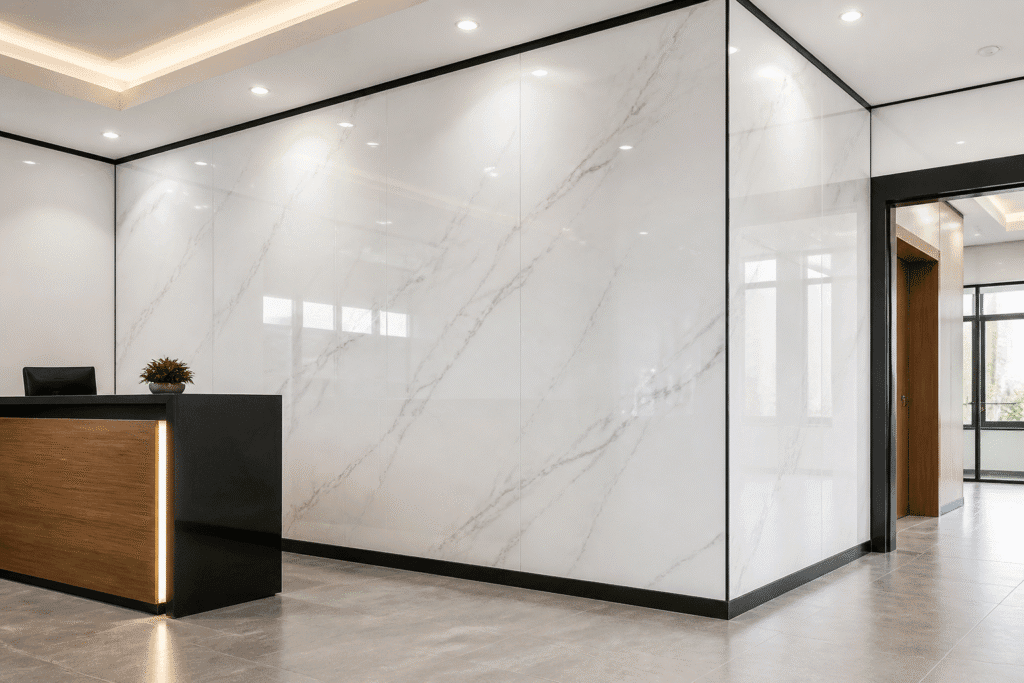
Quick Answer: UV marble sheets can shorten many commercial wall renovation programs because crews handle large, lightweight panels and use dry or low-wet-work installation methods. However, ceramic tile may suit areas that demand proven wet-service details, high heat tolerance, or established local trade practice. Therefore, B2B buyers should compare the complete wall assembly, installation downtime, logistics, compliance evidence, maintenance plan, and lifecycle cost instead of comparing material price per square meter alone.
Why Commercial Buyers Compare UV Marble Sheets and Ceramic Tile
Hotels, offices, retail stores, restaurants, clinics, apartment common areas, and franchise chains often need a marble-look wall without the weight and cost of natural stone. Consequently, project teams frequently compare UV marble sheets with ceramic or porcelain tile. Both options can create durable decorative surfaces, yet they require different substrates, accessories, labor skills, joint strategies, and logistics.
UV marble sheets normally use a printed marble design and a UV-cured decorative surface on a manufactured sheet. However, manufacturers use different cores, surface films, thicknesses, and formulations. Therefore, importers should request the exact product construction and technical data sheet rather than assume that every UV marble sheet has identical properties.
Ceramic tile also varies by body, glaze, size, edge treatment, and intended use. Moreover, the adhesive, grout, waterproofing, movement joints, and substrate form part of the finished system. A useful comparison must evaluate both complete assemblies under the same project conditions.
Direct Specification Comparison
| Decision factor | UV marble sheets | Ceramic or porcelain tile | B2B verification point |
|---|---|---|---|
| Panel or unit size | Large sheets can reduce visible joints | Multiple tile formats create more repeated joints | Confirm dimensions, tolerance, pattern repeat, and handling access |
| Installed weight | Often lower, depending on core and thickness | Usually higher when tile, adhesive, and substrate build-up combine | Compare kilograms per square meter for the full assembly |
| Installation process | Cutting, adhesive or profile fixing, joint finishing | Setting out, adhesive, tile placement, curing, grouting, cleaning | Run a site mockup and record real crew productivity |
| Joint strategy | Fewer joints but more visible large-sheet alignment | More joints with established grout and movement-joint methods | Approve joint width, color, profiles, sealant, and movement locations |
| Wet and heat exposure | Depends strongly on product, adhesive, edges, and detail | Can suit demanding zones when the complete system has approval | Verify the exact use zone and complete assembly evidence |
| Repair method | May require replacement of a large visible module | May allow individual tile replacement if matching stock exists | Define spare quantities, access method, and batch traceability |
This table creates a starting point, not a universal winner. For example, a fast retail refurbishment may value large-sheet installation and reduced grout work. In contrast, a continuously wet or high-heat zone may favor a different tested assembly. Consequently, buyers should connect the material decision to the room, substrate, code, and operating schedule.
Build an Installed-Cost Model
A unit-price comparison rarely captures the real project difference. Therefore, procurement teams should calculate substrate preparation, demolition, disposal, material, adhesive, trims, grout or sealant, labor, access equipment, curing time, protection, cleaning, waste, supervision, and spare stock.
Additionally, commercial downtime has a financial value. A hotel cannot sell rooms during disruptive work, while a retailer may lose trading hours when crews close a customer zone. As a result, an installation method that shortens the program can justify a higher material price.
However, buyers should not use theoretical installation rates. They should build a representative mockup and record crew hours, cutting waste, joint finishing, cleaning, and rework. That evidence produces a more credible cost per completed square meter.
Assess the Existing Substrate Before Removing Finishes
Commercial renovations often start with painted plasterboard, old tile, cement render, plywood, damaged wallcovering, or several historic layers. Therefore, the contractor should survey flatness, strength, moisture, contamination, cracks, loose areas, and movement before selecting either finish.
UV marble sheets may allow crews to retain some sound existing surfaces when the adhesive manufacturer and responsible designer accept the substrate. Nevertheless, covering an unstable wall only hides the problem temporarily. The team must remove loose material and create a clean, flat, compatible base.
Tile usually demands a suitable rigid substrate and controlled setting surface. Moreover, large-format tile can require tighter flatness control. Consequently, the project should assign responsibility for grinding, patching, priming, backing boards, or leveling before the purchase order.
Compare Weight, Handling, and Site Access
Weight affects freight, unloading, floor loading, manual handling, and installation speed. Therefore, buyers should compare the complete assembly in kilograms per square meter. They should also review sheet or tile dimensions, pallet weight, forklift access, elevator capacity, stair turns, and storage space.
Large UV marble sheets may reduce the number of pieces, but their size creates handling risk. Narrow corridors, finished elevators, and low ceilings can make turning difficult. Additionally, crews need clean support surfaces to prevent scratches and edge damage.
Tiles create more individual units and often heavier pallets. However, smaller boxes may move through constrained buildings more easily. As a result, the logistics advantage depends on both weight and the actual route from container to wall.
Measure Installation Speed and Business Downtime
UV marble sheets can reduce repeated tile placement and grout work. Therefore, experienced crews may cover large wall areas quickly after they prepare the substrate. Profiles and preplanned cutouts can also standardize multi-site rollouts.
However, large sheets require accurate measurement. A wrong outlet cutout or corner dimension can waste an entire panel. Consequently, contractors should use verified site templates, elevation drawings, and a controlled cutting area.
Tile installation involves setting, alignment, curing, grouting, and final cleaning. Moreover, wet processes may extend reopening time. Yet local tile contractors often understand the method well, so labor availability can offset part of the program difference. Buyers should compare real local teams, not generic productivity claims.
Plan Pattern Scale, Direction, and Joint Locations
A marble-look wall depends on pattern planning. Therefore, the design team should approve pattern scale, color range, gloss, sheet direction, repeat frequency, and the relationship between adjacent panels. Large sheets make a broad visual statement, but poor pattern sequencing can look artificial.
Moreover, buyers should distinguish bookmatch-style design intent from random installation. If the supplier offers coordinated patterns, the purchase order should identify panel sequence and orientation. Installers also need matching labels and elevation drawings.
Tile can create more frequent pattern interruptions because grout divides the surface. In contrast, those joints can help installers absorb small dimensional differences. Consequently, the mockup should include a full corner, doorway, base, and service cutout rather than one isolated sample.
Coordinate Corners, Cutouts, and Fixtures
Commercial walls contain switches, sockets, access panels, washbasins, counters, shelves, signs, mirrors, handrails, and fire equipment. Therefore, drawings should show each interface and identify independent structural backing for loaded items.
UV marble sheets need accurate cutouts and suitable edge treatment. Additionally, installers should avoid sharp internal corners that concentrate stress when the product guidance requires a different detail. Trims, sealants, and access covers should match the approved color and maintenance plan.
Tile installers can form openings from several pieces, yet small cuts may crack or look untidy. Moreover, fixture penetrations can disturb waterproofing or movement details. A coordinated setting-out drawing helps both systems avoid last-minute cutting.
Define Moisture, Heat, and Wet-Zone Boundaries
A decorative sheet does not replace a waterproofing system. Therefore, project teams should identify splash zones, continuously wet areas, floor-wall junctions, pipe penetrations, drainage, and sealant maintenance. They should confirm whether the exact UV marble sheet, adhesive, joint, and substrate suit the proposed exposure.
Likewise, ceramic tile does not make a wall waterproof by itself. The membrane, joints, penetrations, substrate, and movement strategy control the assembly. Consequently, buyers should compare complete tested or approved details rather than rely on the surface material name.
Heat also matters near cooktops, commercial equipment, lighting, or hot pipes. Therefore, contractors should respect required clearances and manufacturer limits. If the project cannot verify temperature performance, it should choose another approved finish around the heat source.
Review Cleaning Chemicals and Surface Repair
Commercial cleaning teams may use alkaline, acidic, alcohol-based, abrasive, or disinfecting products. Therefore, buyers should test the proposed chemical and cleaning tool on an approved sample. They should also request maintenance guidance for the exact surface.
UV marble sheets can offer a smooth surface with limited grout lines. Consequently, routine cleaning may require fewer joint-specific steps. However, abrasive pads or unsuitable chemicals can change gloss or damage the finish.
Tile surfaces may tolerate a broad range of cleaning conditions, depending on the glaze and product. In contrast, grout can stain or need maintenance. The lifecycle model should include both face cleaning and joint upkeep.
Verify Fire, VOC, and Local Compliance
Commercial interiors may require fire, smoke, VOC, chemical, hygiene, or environmental documents. Therefore, buyers should verify current test reports for the exact UV marble sheet construction, thickness, surface, backing, adhesive, substrate, and mounting condition.
Moreover, one report for a loose sheet may not represent the complete installed wall. Cavities, combustible substrates, adhesives, trims, and existing finishes can change the assessment. The responsible consultant or local authority should review the proposed assembly.
Tile projects also need suitable adhesives, membranes, grout, sealants, and substrate details. Consequently, neither material should receive automatic approval based only on its visible face. Buyers should verify test scope, VOC limits, fire-rating documents, warranty terms, and local acceptance.
Control Packing, Breakage, and Container Loading
Large decorative sheets need face protection, corner guards, rigid support, and suitable pallet dimensions. Therefore, importers should inspect packaging design before bulk loading. They should also confirm gross pallet weight, forklift entry, moisture protection, stacking limits, and unloading sequence.
Tile shipments concentrate weight and may suffer edge or body breakage when pallets move incorrectly. Moreover, mixed sizes and accessory cartons complicate container plans. The buyer should calculate both material utilization and realistic transit loss.
At Witop Decor, B2B customers can request UV marble sheet samples, technical data sheets, pattern options, packing details, and container loading support. Nevertheless, every buyer should approve the product, packaging, inspection standard, and acceptable variation before shipment.
Use a Mockup and Golden Sample to Control Quality
A small swatch cannot show full pattern scale, gloss under lighting, joint quality, corner details, or cutout accuracy. Therefore, the project should build a representative wall bay. It should include the actual substrate, adhesive, trims, sealant, lighting, base, corner, and one service penetration.
Next, the buyer should sign and retain a golden sample. The record should identify SKU, thickness, color, pattern family, surface, edge, protective film, and acceptable visual range. Additionally, the factory should retain a matching reference for production checks.
Finally, pre-shipment inspection should review dimensions, squareness, surface defects, color range, pattern allocation, quantity, labels, packaging, and accessories. As a result, the importer can address variation before the container leaves the factory.
When UV Marble Sheets May Offer Better Project Value
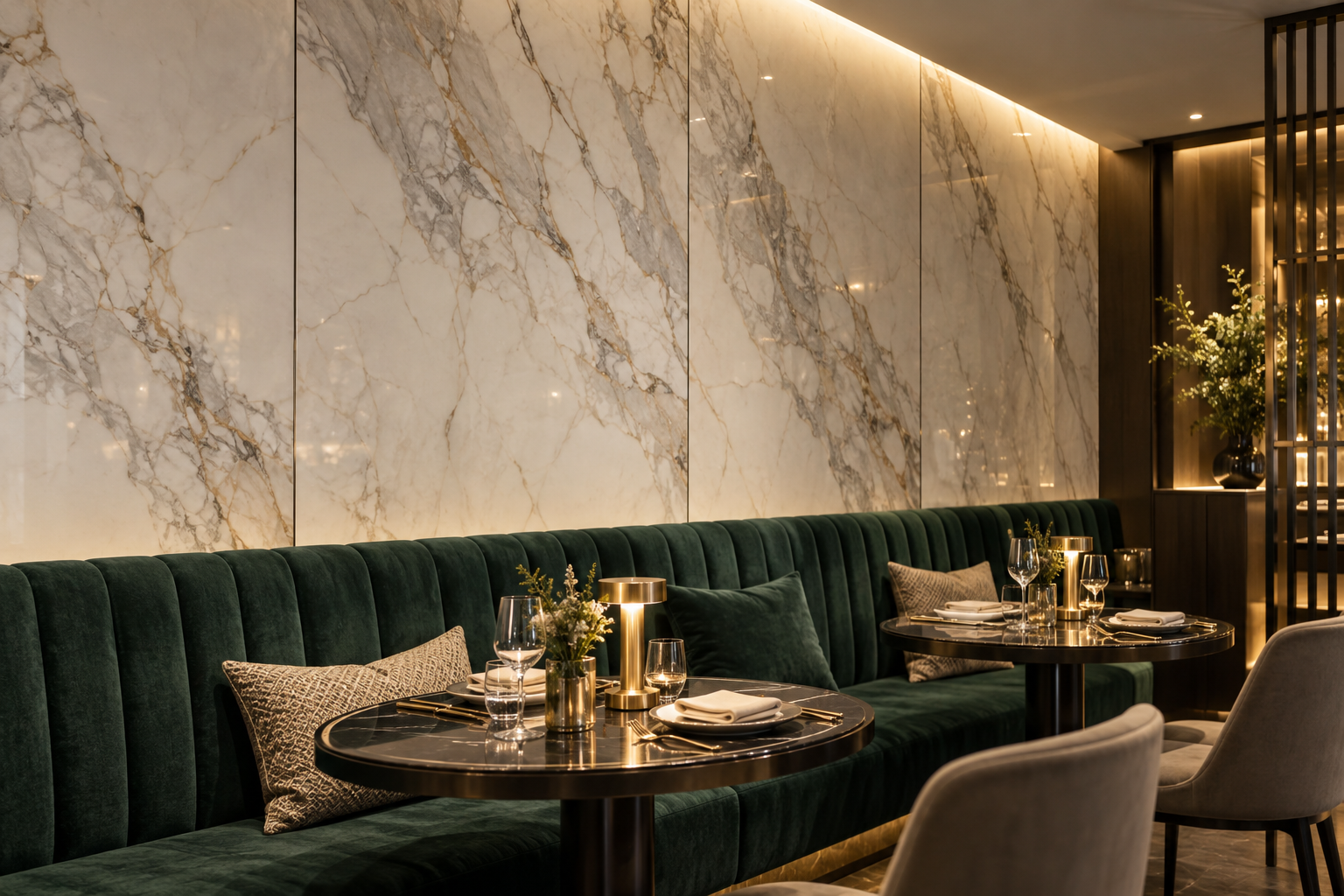
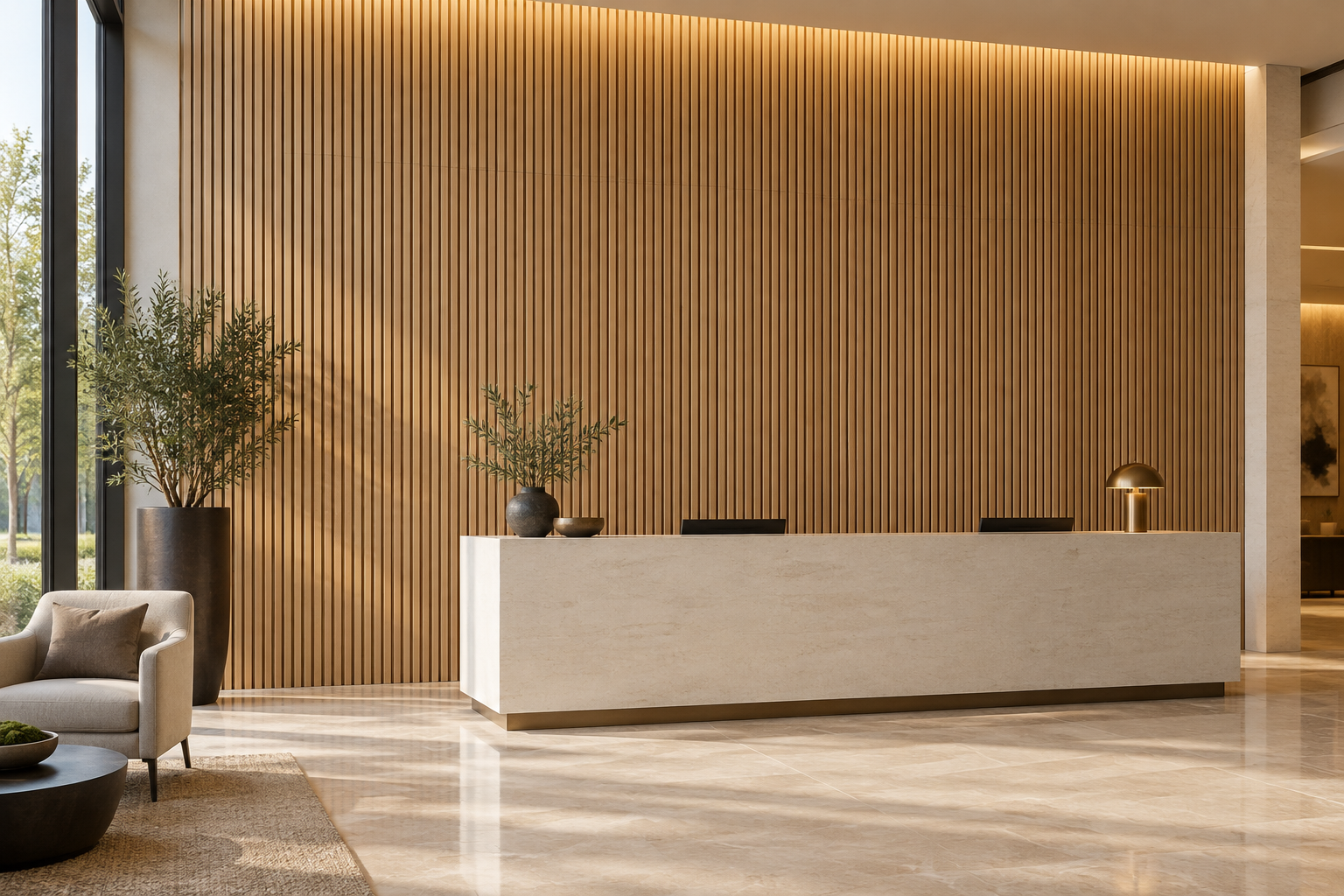
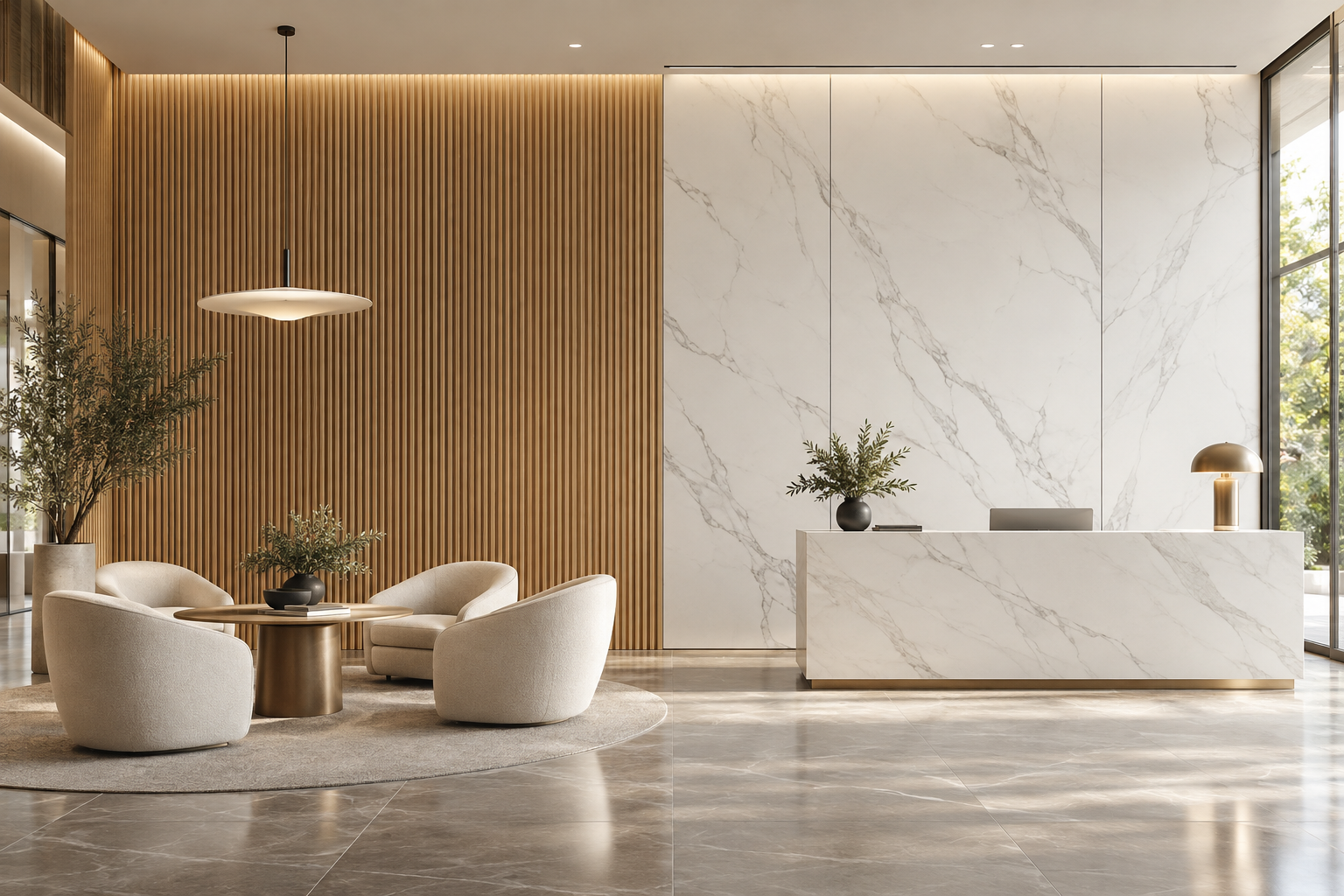
UV marble sheets may suit commercial projects that prioritize rapid visual transformation, lower installed weight, fewer visible joints, dry construction, and repeatable large-format finishes. For example, hotel public areas, office receptions, retail feature walls, apartment lobbies, and selected washroom vanity walls may benefit when the complete assembly meets project requirements.
Additionally, chain projects can use standardized sheet modules, trims, templates, and packing lists across several sites. That coordination can reduce design repetition and installation uncertainty.
However, the buyer must still verify substrate compatibility, fire and VOC evidence, moisture boundaries, heat exposure, cleaning, impact, and repair strategy. A fast installation has little value when the wrong application creates early replacement.
When Ceramic Tile May Remain the Better Choice
Ceramic or porcelain tile may suit projects with established wet-area details, demanding temperature conditions, strong local installer capability, or a preference for modular piece replacement. Moreover, some authorities and consultants may already recognize a proven tile assembly for the intended use.
Tile can also provide textured, slip-related, or specialist technical surfaces that decorative wall sheets do not target. Therefore, the project should retain tile where its verified performance directly answers the operating requirement.
In many buildings, the best result uses both materials. For example, a designer may specify UV marble sheets for dry feature walls and tile for continuously wet zones. This zoning approach connects visual goals with technical risk.
B2B Procurement Checklist
- Define dry, splash, wet, heat, impact, and maintenance zones.
- Survey substrate flatness, strength, moisture, contamination, and existing finishes.
- Compare complete assembly weight and installed cost per square meter.
- Measure site access, panel turning space, pallet weight, and storage capacity.
- Approve pattern scale, direction, joints, trims, corners, and cutouts in a mockup.
- Test cleaning chemicals and define repair or replacement modules.
- Verify fire-rating documents, VOC limits, warranty terms, and local acceptance.
- Lock the golden sample, bill of materials, tolerances, and inspection plan.
- Review packaging, breakage allowance, container loading, and unloading order.
- Reserve matching sheets, profiles, sealants, tiles, or grout for maintenance.
Frequently Asked Questions
1. Are UV marble sheets always cheaper than ceramic tile?
No. Material price tells only part of the story. Buyers should compare substrate preparation, accessories, labor, curing time, waste, protection, downtime, freight, repairs, and spare stock for the complete installation.
2. Can installers apply UV marble sheets over existing tile?
Sometimes a responsible project team may accept installation over a sound, clean, flat, and compatible surface. However, installers must test adhesion and follow the product and adhesive guidance. They should remove loose or unsuitable finishes.
3. Can UV marble sheets replace tile inside every shower?
No universal answer applies. The project must verify the exact sheet, substrate, adhesive, joint, waterproofing, penetrations, and local requirements for continuous wet exposure. Do not treat the decorative face as the waterproofing system.
4. How should importers approve marble patterns?
Review full sheets under project lighting, approve the acceptable color and pattern range, define sequence or random allocation, sign a golden sample, and retain batch references. Small samples alone cannot show full pattern repeat.
5. Which documents should a B2B buyer request?
Request product construction, dimensions, weight, installation guidance, maintenance instructions, packing data, warranty terms, and relevant test reports. Buyers should verify fire, smoke, VOC, chemical, and local compliance evidence for the exact assembly.
Request a Commercial Renovation Comparison
A strong wall-finish decision connects design with substrate, labor, downtime, logistics, compliance, and maintenance. Therefore, share your elevations, use zones, wall condition, target pattern, quantities, destination port, and project schedule with Witop Decor. Our B2B team can discuss UV marble sheet samples, technical data sheets, wholesale pricing, custom patterns, OEM or ODM cooperation, packing plans, container loading, and project quotations.

James is a content creator and decorator with five years of experience designing home decor. In his daily life, james is constantly on the lookout for the latest, great examples of house design and further optimizes his solutions. Additionally, he writes articles related to outdoor design, interior design, and architectural decorating materials to help brands build more engaging relationships with their audiences.