Quick Answer: Which Mounting Approach Costs Less to Maintain?
For acoustic panels, compare the complete approved mounting systems and the cost of replacing one interior panel after the room opens. A demountable system may simplify replacement when staff can reach its release path and obtain compatible fixings. However, mechanical hardware alone does not guarantee independent, damage-free removal. Bonded mounting may suit some projects, but buyers should include substrate repair and adjacent finish protection in the replacement estimate. Neither approach automatically delivers the lowest lifetime cost.
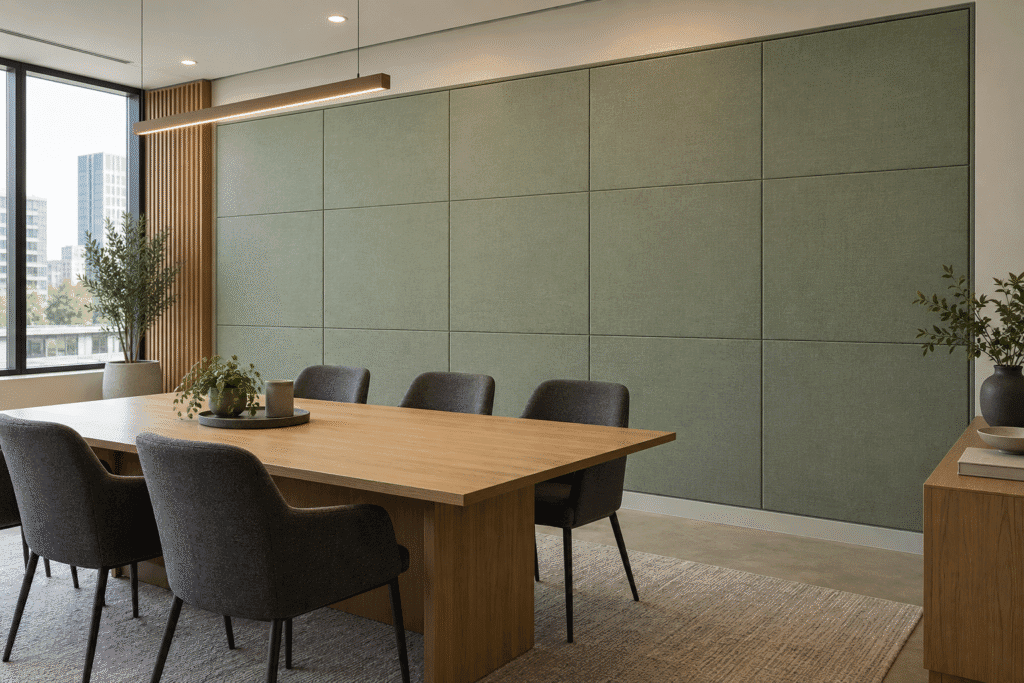
In an office meeting room or hotel business lounge, one stained panel can trigger more work than its purchase price suggests. Therefore, project procurement should define what maintenance teams must remove, protect and restore before comparing quotations.
Define What the Supplier Means by Demountable
Ask whether the system permits removal of the panel, reuse of its fixings, preservation of the wall surface, or all three. These outcomes differ. Also, confirm whether staff can remove a middle panel independently or must first release neighboring modules and trims.
The Armstrong Custom Soundsoak installation guide describes removable applications with Z-clips and specifies release clearance. However, another method in that guide combines impaling clips with adhesive. This distinction matters: the presence of clips does not establish a demountable assembly. These instructions concern Armstrong products; they do not establish a suitable method for Witop Decor panels.
Likewise, the Autex SpinFix product page describes an adhesive-free system with identified compatible product ranges. Buyers should request equally specific compatibility information for their proposed assembly rather than treating a mounting concept as interchangeable hardware.
Compare the Scope of One Replacement
Use the same damaged-panel scenario for both quotations. For example, specify one center module behind a meeting table, with neighboring panels and surrounding finishes remaining acceptable. Then ask the building contractor to describe the complete service route.
| Procurement question | Mechanically demountable system | Adhesively bonded system |
|---|---|---|
| How does the panel release? | Check the documented movement, tool access and clearance | Ask the supplier to define the removal method and expected damage |
| What may need replacement? | Panel, damaged connectors and any single-use components | Panel, adhesive and potentially affected backing or wall finish |
| What blocks access? | Top trims, adjacent modules, furniture or integrated equipment | Furniture, adjacent finishes and the space needed for removal and repair |
| What belongs in the estimate? | Access labor, protection, parts and reinstallation checks | Removal, protection, surface repair, curing time and reinstallation checks |
| What must remain consistent? | Approved panel, fixings, backing and mounting arrangement | Approved panel, adhesive, substrate and mounting arrangement |
These are quotation questions, not universal failure predictions. Actual repair scope depends on the panel, substrate, adhesive or fixing design, and the supplier’s instructions. Therefore, require each bidder to identify assumptions and exclusions beside the price.
Check the Release Path in the Finished Room
A mounting drawing can show adequate clearance before the interior designer adds a ceiling detail, display screen or fixed banquette. However, the finished room determines whether the maintenance team can actually follow that drawing. Review the complete elevation with furniture and equipment in place.
For a hotel lounge, distinguish a movable armchair from a built-in upholstered seat. In a meeting room, check whether the table or screen obstructs safe handling. Also, record any access dependency on neighboring panels. A small replacement can become a larger shutdown when the room lacks working space.
Ask the installer and facility manager to agree on that route before ordering. The supplier should identify required clearances through its technical specifications; buyers should not invent a generic release gap for every clip or rail system.
Furthermore, identify who controls access to integrated screens or furniture. A maintenance contractor may need another trade to disconnect equipment or move a fixed item. Include those dependencies in the service plan, even when the panel itself releases quickly. Otherwise, purchasing may compare two panel removal prices that cover different amounts of work.
Evaluate Removal as Part of the Assembly
During sample evaluation, assess a representative assembled section with the proposed substrate, neighboring panels and edge details. Ask a qualified installer to demonstrate the manufacturer’s removal and reinstatement procedure. Next, document which parts remain serviceable, which parts need replacement, and where the demonstration leaves visible damage.
Evaluate the center module as well as an exposed edge module. Also, inspect the reinstated joint alignment and face condition from the room’s normal viewing positions. A successful demonstration supports the specified combination, but it does not guarantee unlimited cycles or identical outcomes on every site. Agree on acceptable results and record the limits of that evaluation.
Separate Initial Installation Cost from Maintenance Cost
Compare initial installation cost and future maintenance cost on separate lines. The first includes panels, mounting accessories, substrate preparation and installation labor. The second includes access preparation, protection, removal, replacement parts, surface repair, reinstatement and room downtime. Consequently, a lower panel price cannot establish a lower replacement cost.
Use the same number of assumed replacements and the same labor basis for both options. Clearly label these assumptions as a planning scenario, not a durability forecast. Moreover, avoid treating every possible repair as certain. Ask the contractor to price a defined minor replacement and describe what additional damage would trigger extra work.
For occupied premises, also distinguish labor hours from elapsed room closure. Adhesive curing or substrate drying may extend the latter without adding continuous labor. Conversely, a mechanical system may require extra coordination to reach concealed releases. Request a sequence and expected reopening conditions, subject to the approved installation instructions.
Buy Compatible Spares, Not Just Extra Panels
An importer or wholesale distributor should link spare panels to the decor reference, module dimensions and assembly revision. Also, record connector references, approved adhesives where relevant, and any components that the supplier treats as single-use. A spare face panel alone may not complete the repair.
For example, Armstrong’s Workspace kit instructions state that its removable adhesive strips cannot reattach after removal. This product-specific example shows why removability and fastener reuse require separate answers.
Ask a decorative building materials supplier about the MOQ and lead time for both panels and accessories. Additionally, identify small spare kits on packing lists and protect them during container loading. Keep the part schedule with the facility handover documents so later buyers can request compatible replacements.
Store spare panels under the supplier’s stated conditions and retain their batch references. However, do not promise an invisible future color match: exposure, cleaning and production variation can affect the comparison with the existing wall.
Preserve the Mounting Evidence After a Repair
Replacement planning should also preserve the documented assembly. Do not substitute an adhesive, backing layer, mounting gap or fixing arrangement simply because it speeds up the repair. Instead, ask the supplier or relevant specialist to confirm the change and its implications before proceeding.
Buyers should verify test reports, VOC limits, fire-rating documents and warranty terms for the proposed product and installation. Check the scope behind a stated fire rating and confirm which evidence covers any adhesive. Likewise, keep the repair specification with the original technical data sheets; a familiar appearance does not prove equivalent performance.
B2B Buyer FAQs
Does mechanical fixing always mean damage-free removal?
No. Release access, connector design, panel condition and adjacent details influence the result. Therefore, request the documented method and inspect a representative demonstration before accepting that claim.
Can an installer turn a bonded panel into a removable panel?
Only proceed with a supplier-approved compatible arrangement and appropriate evidence. Adding hardware to an existing panel does not establish safe support or equivalent performance.
Should every project choose a demountable system?
No. Compare access needs, appearance, approved assembly options and the actual repair scenario. Some locations may have limited replacement demand, while others need frequent access or refreshes.
How many spare panels should a buyer order?
Base the allowance on module variety, expected replacement needs, procurement timing and storage conditions. Also, include compatible accessories rather than applying one universal spare percentage.
What should accompany a bulk order inquiry?
Send wall elevations, room use, panel references and the desired maintenance route. Request samples, technical data sheets and a project quotation from Witop Decor. Discuss custom colors, container loading and OEM/ODM cooperation alongside documented mounting compatibility.

James is a content creator and decorator with five years of experience designing home decor. In his daily life, james is constantly on the lookout for the latest, great examples of house design and further optimizes his solutions. Additionally, he writes articles related to outdoor design, interior design, and architectural decorating materials to help brands build more engaging relationships with their audiences.