Acoustic Panels for Open-Plan Call Centers: Speech Privacy, Ceiling Coordination, and Bulk Procurement
Direct Answer: Open-plan call centers need more than attractive wall decor. Buyers should evaluate acoustic panels by sound absorption evidence, speech privacy goals, ceiling and MEP coordination, cleanability, fire and VOC documentation, packing, and replacement planning. A procurement-ready acoustic panel program helps importers, contractors, and project suppliers control both room performance and delivery risk.
Why Call Centers Need a Procurement-Grade Acoustic Panel Specification
Call centers create a difficult acoustic environment because many people speak at the same time. In addition, operators often use headsets, managers hold coaching sessions, and customer service teams handle confidential information. Therefore, a buyer cannot select acoustic panels only by color, thickness, or catalog photography. The specification must connect the product to the room, the work pattern, and the project schedule.
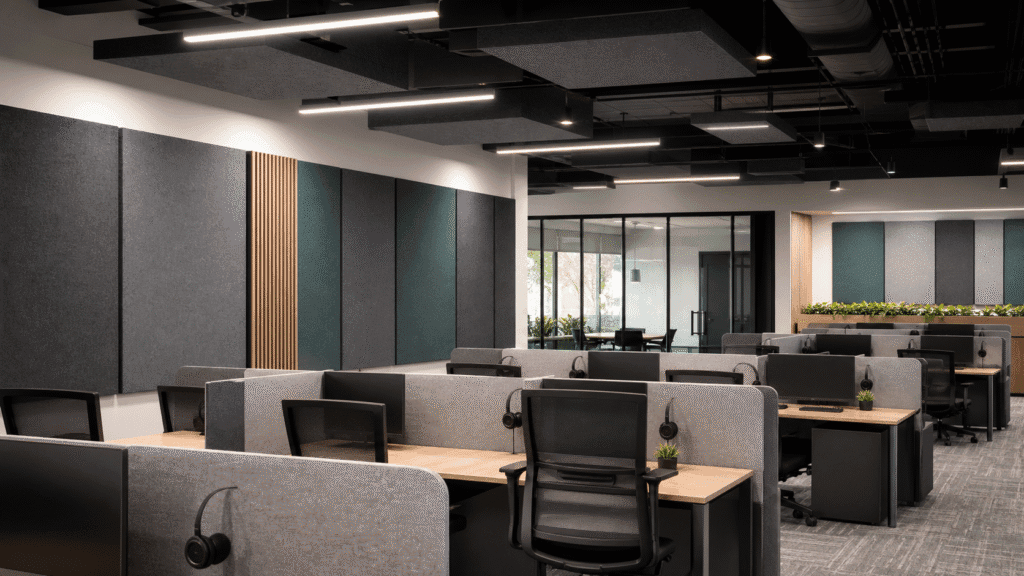
For example, a long open office with hard floors, glass partitions, painted ceilings, and exposed services can produce strong reflections. As a result, employees may hear nearby conversations even when they sit several workstations apart. However, adding random decorative panels does not automatically solve speech privacy. The project team needs a coverage plan that considers wall position, ceiling height, workstation density, call volume, and the location of meeting rooms.
For a B2B buyer, this distinction matters. A wholesale distributor may need a repeatable product line for several fit-out contractors. An importer may need technical data sheets and consistent colors across containers. Meanwhile, a contractor needs predictable dimensions, mounting details, accessory availability, and a lead time that matches phased installation. Consequently, the best acoustic panel supplier supports a complete specification instead of selling isolated panels.
What Are Acoustic Panels in an Open-Plan Call Center?
Acoustic panels are interior products that help absorb reflected sound when the room uses suitable coverage and placement. They may use PET, polyester, fabric, slatted construction, mineral-based cores, or other engineered assemblies, depending on the product range. Each construction has different values for appearance, weight, cleanability, edge treatment, mounting, and acoustic testing.
Witop Decor can support B2B buyers who need to compare panel formats for wall, ceiling, workstation, corridor, meeting, or reception areas. Nevertheless, the buyer should match each product to the installation environment. A wall panel for a supervisor room may not provide the same value as a suspended baffle above a dense operator zone. Additionally, a fabric face for a low-contact meeting room may require a different cleaning plan from a high-traffic circulation area.
Key Specifications Buyers Should Compare
The following dimensions help a project team convert a design idea into a purchase specification:
| Specification dimension | Why it matters in a call center | What buyers should request |
|---|---|---|
| Sound absorption evidence | Product-level performance supports room modeling and coverage decisions. | Test report, test method, frequency data, and any stated NRC or equivalent value. |
| Panel format and thickness | Size affects visual rhythm, coverage, storage, handling, and installation speed. | Exact dimensions, tolerance, weight per unit, edge detail, and available formats. |
| Mounting system | Weak or unclear mounting increases installation delays and service problems. | Clips, adhesive guidance, rails, suspension parts, substrate requirements, and drawings. |
| Facing and cleanability | Operators and maintenance teams need a practical surface care routine. | Face material, stain guidance, cleaning limits, color reference, and replacement process. |
| Fire and VOC documents | Commercial projects may require documentation for local code and indoor air review. | Current reports or declarations that buyers can compare with project requirements. |
| Packaging and loading | Large panels can suffer edge damage when packaging ignores long-distance transport. | Carton design, corner protection, pallet plan, container loading photos, and spare policy. |
In contrast, a simple catalog may show only color and size. Those details help design selection, but they do not prove room performance or delivery readiness. Therefore, importers should ask for a sample kit plus the supporting technical file before they approve a wholesale SKU.
Speech Privacy: Connect Product Data to Room Planning
Call center buyers often use the phrase speech privacy, yet the project team should define the phrase clearly. Sound absorption can reduce reflected energy and shorten reverberation. It can therefore improve comfort and reduce the buildup of competing voices. However, sound absorption alone does not guarantee confidential conversations. Distance, workstation screens, background sound, room geometry, and operating policy also affect privacy.
A practical procurement process starts with a room map. Mark operator rows, supervisor points, quiet rooms, training zones, glass walls, hard surfaces, and high-noise equipment. Next, ask an acoustic consultant or qualified project professional to estimate the treatment area and identify priority surfaces. Then, compare acoustic panels by the way they fit that plan. For example, a ceiling cloud may treat reflections above operator rows, while a wall panel may control a hard side wall near a training area.
Moreover, buyers should avoid using one unverified number as a guarantee for the complete room. A product test result describes the tested assembly and method. The finished room may use different spacing, air gaps, ceiling conditions, or furniture. As a result, the specification should state both the product evidence and the room-level design responsibility.
Ceiling, Lighting, HVAC, and Fire System Coordination
Open-plan call centers often contain a dense ceiling package. Lights, diffusers, sprinklers, cable trays, cameras, smoke detectors, and access panels compete for the same visual field. Acoustic panels add another layer of coordination. Consequently, contractors should review reflected ceiling plans, mounting clearances, service access, and maintenance paths before finalizing the order.
Wall-mounted panels create similar questions. The team should check door swings, skirting, electrical outlets, monitor arms, signage, and cleaning equipment. For suspended products, the installer should confirm suspension points and the structural or ceiling system requirements. For adhesive or clip systems, the substrate needs a suitable condition and a clear preparation method.
These details also affect the B2B quotation. A supplier quotation should identify the panel, accessory set, color, quantity, carton count, spare allowance, and packing method. Additionally, it should separate standard items from custom components. That structure helps an importer protect margin and helps a contractor avoid a late accessory shortage.
How Importers Can Build a Repeatable Acoustic Panel Program
A distributor can turn a call center opportunity into a wider commercial product line by creating a small, disciplined SKU architecture. Start with two or three neutral colors, one or two standard formats, and a mounting system that installers can understand. Next, add custom colors or patterns only when a project or channel forecast justifies them. This approach reduces slow-moving inventory while still giving designers useful choice.
Sample evaluation should follow a written checklist. Inspect color consistency, edge quality, face adhesion, thickness, flatness, mounting fit, and carton protection. Ask the factory for batch control information and a clear process for handling shade or dimensional questions. In addition, compare the sample with the final pre-production approval, because a showroom sample alone does not control every future batch.
For OEM or ODM cooperation, define the artwork, color reference, label, carton mark, accessory identification, and approval process early. A factory-direct partner such as Witopdecor can discuss custom colors, private label packing, container loading, technical data sheets, and project quotation requirements. Nevertheless, buyers should confirm MOQ, lead time, payment terms, inspection scope, warranty terms, and export documents before placing a purchase order.
Maintenance and Long-Term Procurement ROI
Acoustic panel ROI includes more than the initial unit price. A project team should consider installation labor, ceiling coordination, damaged-unit replacement, cleaning time, sample approval, spare stock, and the cost of reordering a discontinued color. Therefore, a slightly higher specification can make commercial sense when it reduces installation confusion or supports repeat projects.
For example, a distributor may earn better long-term value from a panel system with stable colors, clear mounting parts, and documented packing than from a lower-priced item that produces frequent claims. Likewise, a contractor may reduce schedule risk when the supplier provides a coordinated accessory list and pre-shipment quality photos. In addition, a project owner may value a replaceable panel format because maintenance teams can service one zone without redesigning the entire wall.
Buyers should calculate the total delivered cost: product, packaging, ocean freight, import charges, local handling, installation, spare units, and expected maintenance. They should also record assumptions. This method creates a more reliable comparison between suppliers and protects the channel from price-only decisions.
Supplier Checklist for a Call Center Acoustic Panel Order
- Confirm the exact product construction, panel size, thickness, weight, color, and edge finish.
- Request acoustic test information and clarify whether values apply to the product or a complete room assembly.
- Ask for fire-rating, VOC, cleaning, and warranty documents relevant to the destination market.
- Review mounting drawings, accessory quantities, substrate conditions, and installation responsibility.
- Confirm MOQ, sample approval, production lead time, inspection plan, carton protection, and container loading.
- Discuss OEM/ODM labels, custom colors, spare units, reorder rules, and distributor support.
FAQ: Acoustic Panels for Open-Plan Call Centers
1. What acoustic panels work best for a call center?
The right panel depends on room geometry, coverage, target comfort, cleaning needs, and the project specification. Buyers should compare tested absorption data, panel placement, mounting, and facing rather than choose by appearance alone.
2. Does a higher NRC guarantee speech privacy?
No. A product-level absorption value can support room planning, but speech privacy also depends on distance, screens, background sound, furniture, and room layout. Ask the project acoustic professional to connect product data with room-level objectives.
3. Can an importer order custom acoustic panel colors?
Many factories can discuss custom colors or private label programs, subject to MOQ, material availability, color approval, and lead time. Request a physical sample and define the reference before mass production.
4. Which documents should a contractor request?
Request technical data sheets, acoustic test information, fire-rating documents where required, VOC or indoor-air information, installation guidance, cleaning limits, packing details, and warranty terms. Buyers should verify each document against local project requirements.
5. How can buyers reduce damage during international shipping?
Review corner protection, face protection, carton strength, pallet stability, container loading, moisture control, and spare-unit planning. Pre-shipment photos and an agreed inspection process can also reduce uncertainty.
Plan a Call Center Acoustic Panel Purchase with Witop Decor
Acoustic panels create stronger commercial value when the supplier understands the full B2B workflow: technical comparison, sample evaluation, accessory planning, container loading, phased delivery, and repeat ordering. Witop Decor works with importers, wholesale distributors, contractors, and project buyers who need a clear specification and dependable communication.
Contact Witop Decor to request samples, compare acoustic panel technical data, discuss custom colors or OEM/ODM packing, and prepare a project quotation for your market. A detailed brief with room type, estimated quantity, destination, target schedule, and documentation needs will help the factory build a more accurate supply proposal.

James is a content creator and decorator with five years of experience designing home decor. In his daily life, james is constantly on the lookout for the latest, great examples of house design and further optimizes his solutions. Additionally, he writes articles related to outdoor design, interior design, and architectural decorating materials to help brands build more engaging relationships with their audiences.