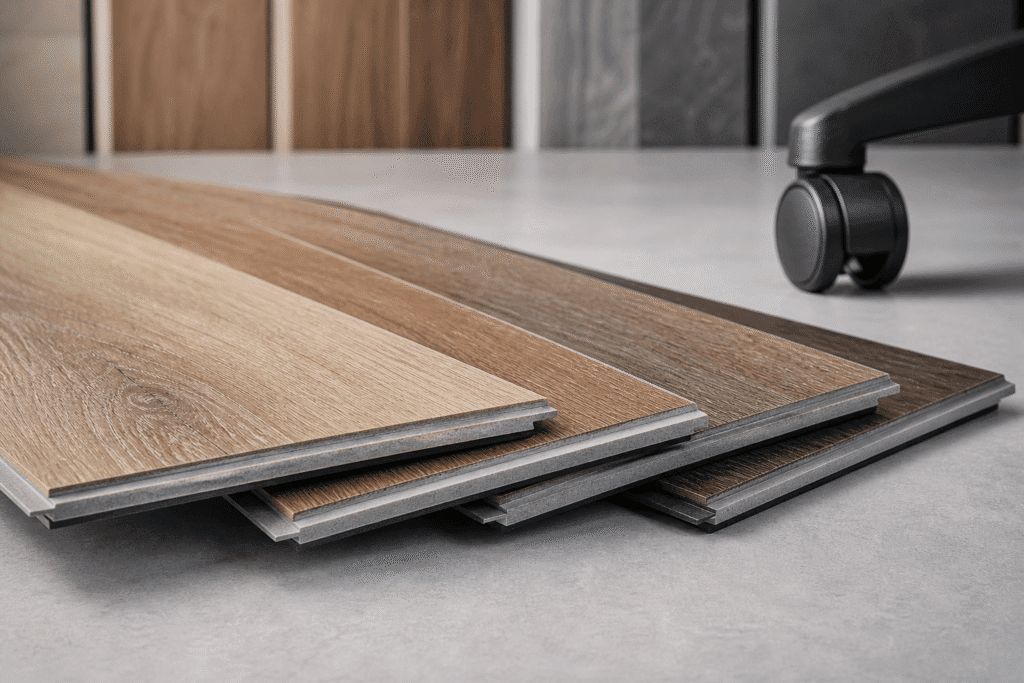
Quick Answer: The wear layer matters when B2B buyers specify SPC flooring, but thickness alone does not predict commercial durability. Importers should compare the measured wear layer, surface coating, abrasion test method, embossing, core construction, locking strength, installation conditions, cleaning plan, warranty scope, and batch control. Therefore, a 0.5 mm wear layer can support a strong specification only when the complete product and its evidence match the intended project.
Why the SPC Flooring Wear Layer Needs Its Own RFQ Line
Many quotations compress an SPC flooring specification into total thickness, wear layer, and price. However, that shortcut hides several variables that affect service life, installation, claims, and distributor returns. Two planks can show the same nominal wear layer while using different coatings, films, embossing depths, core formulations, locking profiles, and quality tolerances.
Consequently, wholesalers, importers, agents, contractors, and project procurement teams should treat the wear layer as one part of a complete flooring system. The RFQ should identify the intended traffic, furniture movement, entrance exposure, cleaning routine, expected maintenance, and replacement strategy. Moreover, buyers should request evidence for the exact offered construction rather than a similar catalog sample.
At the same time, distributors need a specification that their sales teams can explain without making unsupported promises. Therefore, a disciplined comparison protects both project performance and channel reputation.
SPC Flooring Wear Layer Comparison
| Specification dimension | What the buyer should request | Why it matters | Common procurement risk |
|---|---|---|---|
| Wear layer thickness | Nominal value, tolerance, measurement method, and batch records | Defines the transparent protective film available above the decor layer | Buyer compares nominal claims without checking actual tolerance |
| Surface coating | Coating type, application process, finish, and relevant test data | Affects stain response, gloss, scratch appearance, and cleaning | Marketing names replace measurable evidence |
| Abrasion test | Test method, specimen construction, conditions, result, and report | Supports comparison when suppliers use the same method | Buyer compares cycle counts from different methods |
| Embossing | Texture depth, visual standard, cleaning check, and approved sample | Changes appearance, soil retention, and perceived wear | Deep texture looks attractive but conflicts with maintenance |
| Core and locking system | Core composition, density range, profile drawing, fit, and strength data | Controls dimensional behavior and joint performance | Strong surface claim distracts from weak joints or unstable planks |
| Warranty scope | Application, traffic limits, exclusions, maintenance, and claim process | Shows how the supplier connects specification to use | A long headline warranty excludes the actual project condition |
This table prevents a single number from controlling the purchase decision. Additionally, it gives suppliers a consistent response format. As a result, procurement teams can compare complete offers rather than isolated wear layer claims.
Understand What the Wear Layer Does
An SPC plank normally places a transparent wear layer above the printed decor film and below or within the surface coating system. The wear layer helps protect the visual design from routine traffic and cleaning. However, the final surface response also depends on the coating, texture, contamination, maintenance tools, and contact loads.
Therefore, buyers should not describe the wear layer as the only protective component. A chair leg, metal trolley wheel, trapped grit, abrasive pad, or harsh chemical can create damage that a thickness number cannot explain. Moreover, scratches, scuffs, gloss changes, stains, and complete wear-through represent different failure modes.
A useful RFQ asks the supplier to describe the layer structure in sequence. It should also request a cross-section sample or clear construction diagram. Consequently, sales teams and inspectors can identify the offered product without relying on a product name alone.
Compare 0.3 mm, 0.5 mm, and 0.7 mm Carefully
Buyers often use 0.3 mm, 0.5 mm, and 0.7 mm as quick sourcing categories. In approximate imperial terms, these values correspond to about 12 mil, 20 mil, and 28 mil. Nevertheless, buyers should use the supplier’s measured metric value as the controlled specification and treat conversions only as communication aids.
A thicker wear layer provides more protective material above the decor film, all other factors being equal. However, all other factors rarely remain equal across factories or product ranges. A poorly controlled coating, excessive embossing, unstable core, weak lock, or unsuitable maintenance plan can outweigh the benefit of extra thickness.
Therefore, importers should avoid universal statements such as “0.5 mm always suits commercial use.” Instead, they should connect the construction to a defined application and supporting evidence. For example, a quiet apartment bedroom, a fashion store, a grocery aisle, and an airport retail zone create different loads even when all four projects request SPC flooring.
Check Nominal Thickness and Manufacturing Tolerance
A quotation usually lists a nominal wear layer. Therefore, the buyer should ask how the factory measures it, how many samples it checks, and what tolerance it controls. The purchase order should state the agreed nominal value and acceptance method.
Moreover, total plank thickness does not equal wear layer thickness. A 6 mm plank can combine different core, backing, decor, and wear layer structures. Buyers should record each component separately so suppliers cannot compensate for one layer by changing another.
During pre-shipment inspection, the inspector can review traceable production records and conduct agreed measurements with suitable equipment. However, the parties should define the method before production. Otherwise, a late inspection argument may delay shipment without creating a fair decision rule.
Evaluate UV Coating and Surface Additives
Suppliers may describe UV coatings, ceramic additives, enhanced scratch resistance, stain protection, or matte finishes. These features can add value, yet marketing language does not create a comparable specification. Therefore, buyers should ask for the coating description, application control, relevant test method, and exact specimen construction.
Additionally, gloss level affects how users perceive scratches and cleaning marks. Very dark or low-gloss surfaces may reveal certain scuffs differently from lighter wood designs. The buyer should review several colors under side lighting rather than approve only one small sample under office light.
Cleaning trials also matter. A distributor can test the approved cleaner, diluted chemical, microfiber pad, and maintenance machine on full planks. As a result, the maintenance recommendation reflects the actual surface rather than a generic flooring instruction.
Do Not Compare Abrasion Numbers Without the Test Method
Abrasion results only support comparison when suppliers use the same test method, conditions, specimen preparation, endpoint, and reporting basis. Therefore, a cycle count from one method may not equal a cycle count from another method.
Buyers should request the full report or relevant pages, not a number copied into a brochure. They should check the laboratory, date, product identification, layer construction, conditioning, equipment, load, abrasive medium, endpoint, and result. Moreover, they should confirm whether the report covers the exact finish and wear layer in the quotation.
If a project specification names a standard, the supplier should state compliance or deviation clearly. If the market does not require a specific method, procurement teams should choose one comparison basis for all shortlisted suppliers. Consequently, the team reduces false precision and improves technical scoring.
Separate Abrasion, Scratch, Scuff, and Stain Performance
Abrasion removes material through repeated rubbing. In contrast, a sharp object may create a scratch through concentrated force, while rubber wheels or shoe soles may leave scuff marks. Stains involve another interaction between the surface and a contaminant.
Therefore, one abrasion result cannot answer every maintenance question. B2B buyers should create a project-specific sample evaluation. For example, they can test chair feet, trolley wheels, common spills, cleaning chemicals, entrance grit, and rubber marks under controlled conditions.
Moreover, the team should define an acceptable visual change. A barely visible gloss shift differs from a deep cut through the decor. As a result, the sample review becomes a practical decision tool instead of an informal opinion.
Match Surface Texture to Cleaning Capability
Embossing can strengthen the wood or stone appearance of SPC flooring. However, deeper texture can hold soil in certain environments. Therefore, buyers should connect texture selection to cleaning equipment, staff routines, and contamination type.
A hospitality guestroom may accept one texture, while a clinic corridor or food-service area may need another cleaning response. Additionally, registered embossing and broad matte textures can change visual consistency between production lots.
Importers should approve full planks from the proposed production route. They should also keep a golden sample that records color, gloss, embossing, bevel, and coating. Consequently, the factory can compare later batches against a controlled reference.
Review Core Construction and Dimensional Stability
The surface may remain intact while the plank develops joint, flatness, or dimensional problems. Therefore, buyers must evaluate the SPC core as carefully as the wear layer. The RFQ should request core composition, density range where relevant, dimensional tolerance, flatness, and applicable stability test data.
Sunlight, heat, substrate conditions, room dimensions, expansion planning, and installation quality can affect the floor. Moreover, dark finishes near large glazed areas may experience different surface temperatures from shaded zones. The project should follow verified product limits and local installation requirements.
Buyers should avoid assuming that a heavier or denser plank always performs better. Instead, they should compare the complete construction, test evidence, locking geometry, and factory consistency.
Inspect Locking Strength and Joint Fit
A durable surface cannot compensate for open joints or damaged locking profiles. Therefore, importers should request profile drawings, fit samples, locking test data where relevant, and installation instructions.
Next, the sample team should assemble planks from several cartons. It should check engagement force, joint flatness, edge chipping, end-joint behavior, and disassembly damage. Additionally, installers should test the product with the intended underlay and subfloor condition.
Profile consistency matters during repeat orders. Consequently, buyers should require change notification before the factory modifies tooling, formulation, or locking geometry. Otherwise, replacement stock may not connect reliably with an earlier batch.
Consider Total Thickness, Backing, and Acoustic Claims
Total thickness affects handling, transitions, doors, skirting, and interface levels. Meanwhile, an attached backing can change comfort, acoustic response, installation instructions, and packing volume. Therefore, buyers should list the core and backing separately.
Acoustic claims require a defined test assembly. A result may depend on the slab, ceiling, room, underlay, and plank construction. Moreover, one laboratory result may not predict every building. Buyers should verify report scope and ask the responsible consultant to review project requirements.
When a supplier offers several backings, the quotation should show material, thickness, density where relevant, adhesion, and packing impact. As a result, importers can compare usable value and container quantity.
Control Subfloor and Installation Conditions
SPC flooring needs a suitable substrate even though the plank uses a rigid core. Therefore, contractors should check flatness, strength, cleanliness, moisture conditions, cracks, level changes, and existing finishes before installation.
Uneven substrates can stress joints and create movement or sound. Grit below the floor can create point pressure. Moreover, incorrect expansion details can affect large rooms, fixed furniture, doorways, and temperature zones.
The procurement package should include current installation guidance and project-specific shop drawings where needed. Additionally, contractors should record substrate checks and acclimation or conditioning requirements. This evidence helps separate material issues from site conditions if a claim arises.
Plan Furniture, Castors, Entrances, and Maintenance
Commercial interiors expose flooring to more than foot traffic. Office chairs, display racks, rolling carts, luggage, movable partitions, and maintenance machines create concentrated or repeated loads. Therefore, the use survey should identify wheel type, load, route, turning points, and protective accessories.
Entrance zones can bring grit and water onto the floor. Consequently, a suitable entrance matting and cleaning plan may protect the surface more effectively than simply increasing wear layer thickness. The project should also define mat compatibility and avoid backing materials that can discolor or react with the floor.
Moreover, the buyer should review cleaning chemicals, dilution, pad type, machine weight, and frequency. A clear maintenance guide supports end users, protects warranty eligibility, and reduces avoidable complaints.
Balance MOQ, SKU Range, and Distributor Inventory
A distributor may want several wear layers, total thicknesses, colors, surfaces, and backings. However, every additional construction creates another MOQ, sample set, technical file, spare-stock requirement, and reorder risk. Therefore, importers should build a compact product architecture.
For example, one core commercial range may use a controlled wear layer and backing across the best-selling colors, while project-only options follow separate MOQ and lead-time rules. Additionally, the supplier should explain which colors can share one production run and which require independent setup.
Channel margin depends on inventory turnover as well as unit price. Consequently, buyers should compare landed cost, stock days, sample expense, breakage, claims, markdown risk, and sales support before expanding the range.
Lock Batch, Color, and Reorder References
SPC flooring reorders can show color, gloss, embossing, bevel, or locking differences if production inputs change. Therefore, purchase orders should record the approved SKU, decor code, film, wear layer, coating, embossing, core, backing, profile, dimensions, and golden sample.
Moreover, project teams should zone batches logically and retain spare cartons from the installed lot. They should record where each batch goes, especially across large multi-phase projects.
Distributors should request written change notification before material, tooling, coating, or process changes. As a result, they can test the new version before mixing it with existing stock.
Protect Locks and Surfaces During Container Shipping
Heavy flooring cartons can crush edges or overload weak pallets. Therefore, buyers should approve carton strength, corner protection, pallet dimensions, stacking pattern, wrapping, moisture protection, gross weight, and forklift access.
Additionally, the supplier should calculate cartons per pallet, pallets per container, net and gross weight, and unloading sequence. Mixed colors need clear, accurate labels, yet the physical packing plan should also separate SKUs in a way that warehouse teams can count.
Container loading must control movement while respecting weight distribution and local limits. Consequently, a slightly higher packaging cost can reduce damage, claims, and warehouse labor.
Calculate Lifecycle Cost Instead of Price per Square Meter Alone
The buying price represents only one part of total cost. Therefore, procurement teams should include freight, duty, local transport, waste, underlay, transitions, installation, floor preparation, maintenance, downtime, repairs, spare stock, claims, and future replacement.
A thicker wear layer may create value in a demanding application. However, it may add unnecessary cost in a controlled low-traffic zone. In contrast, a lower-priced construction may increase risk if it lacks consistent locks, suitable packing, technical evidence, or reorder control.
Buyers can model several scenarios over the planned service period. Moreover, they should assign realistic probabilities to damage, partial replacement, business interruption, and stock obsolescence. As a result, the team can choose the construction that supports the best risk-adjusted return.
Build a Factory Quality Control Plan
A useful control plan starts with approved raw materials and a signed golden sample. Therefore, the factory should identify the decor film, wear layer, coating, core formula, backing, and locking profile for the order.
During production, quality teams can check dimensions, thickness, flatness, color, gloss, embossing, bevel, surface defects, profile fit, and packing according to agreed methods. Additionally, they should keep batch and inspection records that link finished cartons to production.
Before shipment, the buyer or inspector should sample finished cartons and review quantity, SKU accuracy, joint assembly, appearance, packaging, and documents. Buyers should verify test reports, VOC limits, warranty terms, and destination-market requirements for the exact offered product.
B2B SPC Flooring Procurement Checklist
- Define traffic, castors, furniture, entrances, spills, cleaning, and replacement expectations.
- Specify nominal wear layer, tolerance, measurement method, coating, gloss, and embossing.
- Request comparable abrasion, scratch, stain, and chemical evidence where relevant.
- Record total thickness, core construction, backing, dimensions, flatness, and locking profile.
- Test full planks under project lighting with actual cleaners, wheels, and contact loads.
- Approve a golden sample and require production change notification.
- Define subfloor checks, installation method, expansion details, and interface levels.
- Confirm MOQ by construction and color, mixed-order rules, lead time, and spare stock.
- Approve cartons, pallets, loading quantity, weight distribution, and unloading plan.
- Compare landed cost, maintenance, claims, downtime, and replacement over the lifecycle.
Frequently Asked Questions
1. Is a 0.5 mm wear layer always suitable for commercial SPC flooring?
No single thickness guarantees suitability. Buyers should connect the wear layer, coating, core, locking system, test evidence, installation conditions, traffic, cleaning, and warranty to the exact commercial application.
2. What is the difference between mil and millimeter wear layer values?
A mil equals one-thousandth of an inch, while a millimeter uses the metric system. For reference, 0.3 mm is about 12 mil, 0.5 mm is about 20 mil, and 0.7 mm is about 28 mil. Use the controlled metric specification and agreed tolerance on the purchase order.
3. Can buyers compare abrasion cycle numbers from different suppliers?
Only when the suppliers use the same test method, conditions, specimen construction, load, abrasive medium, and endpoint. Otherwise, the cycle numbers may not support a fair comparison.
4. Which samples should an importer approve before a bulk order?
Approve full planks, assembled joint samples, the exact color and texture, a cross-section, backing, packaging, and a signed golden sample. For projects, also build a representative floor mockup.
5. What information should an SPC flooring warranty include?
The warranty should identify the product, approved application, duration, traffic and installation conditions, maintenance rules, exclusions, evidence, claim deadline, and remedy. Buyers should review the complete terms rather than rely on the headline period.
Request an SPC Flooring Specification Comparison
A reliable SPC flooring decision connects the wear layer to the complete plank, project conditions, factory controls, logistics, and lifecycle cost. Therefore, share your target market, application, traffic, dimensions, wear layer, colors, backing, quantities, destination port, and document requirements with Witop Decor. Our B2B team can discuss SPC flooring samples, technical data sheets, custom colors, OEM or ODM cooperation, MOQ, lead time, packing, container loading, wholesale pricing, distributor support, and project quotations.

James is a content creator and decorator with five years of experience designing home decor. In his daily life, james is constantly on the lookout for the latest, great examples of house design and further optimizes his solutions. Additionally, he writes articles related to outdoor design, interior design, and architectural decorating materials to help brands build more engaging relationships with their audiences.