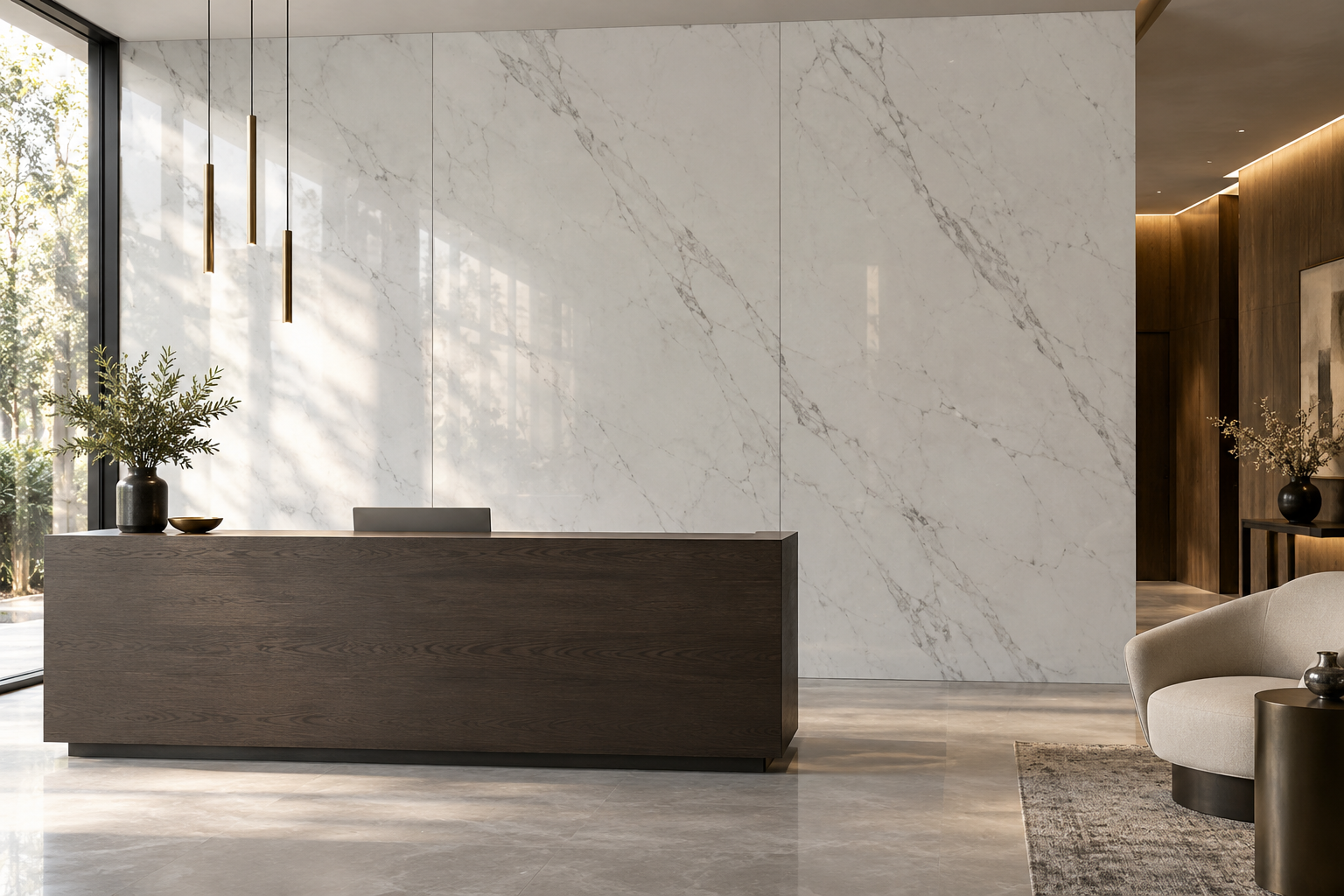
Bamboo Charcoal Panels for Commercial Reception Areas: Surface Consistency, Compliance Documents, and SKU Planning
Direct Answer: Bamboo charcoal panels can help importers and contractors create a consistent commercial reception program when buyers control surface samples, batch variation, substrate preparation, documents, packaging, and reorder rules. The right purchase decision connects the panel finish to the reception environment, maintenance plan, local compliance review, and distributor SKU strategy. Buyers should evaluate technical evidence and delivered project cost rather than rely on a decorative photo or a low unit price.
Why Commercial Reception Areas Need a Different Panel Specification
A reception area introduces a building to visitors, employees, tenants, and business partners. It often combines a feature wall, brand background, waiting zone, lift lobby, directional signage, lighting, and a reception desk. Therefore, the wall finish must deliver visual consistency while also working with electrical outlets, access panels, furniture, signage, and cleaning routines.
In addition, reception walls receive more attention than ordinary back-of-house surfaces. Visitors notice joint alignment, color changes, edge details, and transitions around doors. As a result, a small inconsistency can create a larger commercial concern than the same issue in a storage room. However, the buyer should not treat appearance as the only quality measure. The panel must also arrive safely, install predictably, and remain available for future repairs or additional locations.
For a wholesale distributor, reception projects can create repeat demand from offices, hotels, clinics, showrooms, restaurants, and commercial buildings. An importer may need a manageable SKU program that offers several finishes without creating slow-moving inventory. Meanwhile, a contractor needs clear dimensions, cutting guidance, accessory availability, packing details, and a lead time that matches the fit-out schedule. Consequently, supplier selection should cover both the visible wall and the complete B2B supply process.
What Are Bamboo Charcoal Panels in Commercial Interior Supply?
Bamboo charcoal panels are decorative interior panels that may combine a bamboo-charcoal-based core or board structure with a decorative surface, depending on the specific factory model. Product constructions, thicknesses, surface films, laminations, edge profiles, and installation systems can vary. Therefore, buyers should request the exact technical data sheet for the selected SKU instead of treating every bamboo charcoal panel as identical.
Witop Decor can support importers, distributors, interior contractors, and project procurement teams who need to compare finishes for feature walls, reception backgrounds, corridors, office areas, and commercial display spaces. Nevertheless, the product must match the environment. A textured finish may create a strong visual focal point, while a smoother surface may simplify cleaning around a busy front desk. Additionally, the design team should test the physical sample under the final lighting because showroom lights can change how color and texture appear.
Specification Comparison for Reception Wall Panels
A structured comparison helps the project team choose the right material for the right surface:
| Decision dimension | Why it matters in a reception area | What B2B buyers should request |
|---|---|---|
| Surface consistency | Feature walls make shade, texture, gloss, and joint changes easy to notice. | Control sample, finish reference, batch tolerance, and pre-production approval process. |
| Panel construction | Core and surface structure affect weight, cutting, handling, and fixing. | Exact thickness, dimensions, density or construction details, edge profile, and tolerances. |
| VOC and indoor-air information | Commercial interiors may require product information for indoor-environment review. | Current VOC or indoor-air documents and a clear scope for the tested product. |
| Fire documentation | Project requirements may apply different rules to wall finishes and public spaces. | Fire-rating reports or declarations that buyers can verify against local requirements. |
| Installation method | Reception walls often include corners, outlets, signage, and detailed cuts. | Adhesive or clip guidance, substrate requirements, cutting notes, and accessory list. |
| Maintenance and repair | Front-of-house surfaces need a repeatable cleaning and replacement routine. | Cleaning limits, stain guidance, spare-unit policy, and reorder reference. |
| Packing and logistics | Large decorative surfaces can suffer edge, corner, or face damage in transit. | Carton protection, pallet plan, container loading, moisture control, and inspection process. |
In contrast, a decorative catalog usually emphasizes patterns and room photography. Those assets support marketing, but they do not answer the buyer’s technical and logistics questions. Therefore, an importer should request samples, technical data sheets, packing photos, and a commercial quotation before adding a reception finish to the wholesale line.
Surface Consistency: The First Quality Check for a Feature Wall
Reception projects require a clear visual approval process. Start by selecting a physical reference panel that represents the approved color, texture, gloss, and edge. Next, define how the factory will record the approved reference and how the buyer will review the pre-production sample. This step creates a practical control point for custom colors, private label projects, and repeat orders.
Buyers should inspect the sample for flatness, edge straightness, surface adhesion, decorative film or coating, texture depth, and visible defects. Additionally, they should check how the finish reacts to the project’s lighting angle. A surface that appears uniform in a small sample may show a different visual rhythm across a long wall. For that reason, project teams should request multiple samples or a larger mock-up when the reception design uses repeated panels.
Batch management also affects distributor confidence. If an importer sells the same panel to several contractors, the factory should provide a clear batch or production reference. The distributor can then record the reference with the customer order and keep a small spare allowance. As a result, future repairs or extensions have a better chance of matching the original installation.
Compliance Documents: Build a Verifiable Technical File
Commercial buyers often ask whether a bamboo charcoal panel is eco-friendly, low-VOC, fire-rated, waterproof, or suitable for a particular public building. A responsible supplier should answer with product-specific evidence and clear limits. Buyers should verify VOC limits, fire-rating documents, test reports, warranty terms, and any environmental claims against the destination market and project specification.
The technical file should identify the product construction, size, thickness, surface finish, installation method, cleaning limits, packaging, and available test information. Moreover, the document should state the scope of any test. A report for one thickness, surface, or assembly may not cover every version in the product family. Therefore, the importer should avoid applying a document to a different SKU without confirmation.
This discipline supports E-E-A-T and protects the channel. A distributor can explain what the product does, what evidence supports it, and what the buyer must confirm locally. In addition, accurate documentation reduces the risk of a contractor discovering a missing requirement after the material reaches the jobsite.
Installation Planning for Reception Counters, Corners, and Services
Reception walls rarely form a simple uninterrupted rectangle. They may include a counter, logo panel, monitor, power outlet, access door, fire equipment, lighting detail, or a junction with another finish. Consequently, the installer needs accurate measurements and a coordinated cutting plan before the factory confirms the final quantity.
Ask the supplier to clarify substrate conditions, fixing method, adhesive compatibility, corner treatment, joint approach, and the recommended sequence. For a clip system, review accessory quantities and service access. For adhesive installation, confirm surface preparation and curing guidance. The contractor should also plan expansion or movement details where the project environment requires them.
These details influence the quotation. A project-ready offer should separate panel quantity, accessory quantity, sample cost, custom-color charge, packaging, and spare allowance. This structure helps the importer calculate landed cost and gives the building contractor a clearer installation budget. Additionally, it reduces the chance that a visually important wall stops because of a missing trim or corner component.
How Importers Can Plan a Profitable Bamboo Charcoal Panel SKU Line
A distributor does not need dozens of reception finishes to create a useful product program. Start with a small palette that covers neutral, wood-inspired, stone-inspired, and textured options. Next, group the products by installation method and project use. This organization helps sales staff recommend a suitable finish without confusing the customer with overlapping SKUs.
For stock products, compare demand forecasts, carton volume, container loading, MOQ, local storage, and expected reorder frequency. For custom colors or OEM/ODM packaging, confirm the minimum order and approval timeline before presenting the offer to the market. Moreover, the importer should decide which accessories belong in stock and which items the factory will supply only with a project order.
Witopdecor can discuss sample kits, custom colors, private label packing, technical data sheets, container loading, lead time, and project quotation requirements. Buyers should also confirm payment terms, inspection scope, warranty terms, export documents, and the process for handling shade or dimensional claims.
Long-Term ROI: Compare Delivered Project Value
The commercial value of a reception wall depends on more than the factory unit price. Buyers should calculate material, accessory, freight, import handling, installation labor, substrate preparation, spare panels, cleaning, replacement, and future reorder costs. Therefore, a panel with clearer documentation and more reliable packing may provide better long-term value than a cheaper product that creates repeated claims.
For example, a contractor can protect schedule performance when the supplier provides an accurate accessory list and clear cutting guidance. A distributor can protect margin when the factory maintains consistent packing and supports repeat colors. Meanwhile, a building owner may reduce future disruption when the supplier can identify the original batch and provide matching or compatible replacement material.
This ROI logic also supports better customer conversations. Instead of presenting bamboo charcoal panels as a purely decorative purchase, the distributor can explain the full cost and risk profile. As a result, the channel competes on specification quality, service, and project support rather than only on price.
Supplier Checklist for Commercial Reception Orders
- Confirm the exact bamboo charcoal panel construction, thickness, size, surface, edge, and tolerance.
- Approve a physical control sample and define the process for color, texture, and batch review.
- Request technical data sheets, VOC information, fire documents, cleaning guidance, and warranty terms.
- Review substrate, fixing, corner, trim, cutting, service access, and installation requirements.
- Confirm MOQ, sample approval, custom color rules, OEM/ODM packing, lead time, and container loading.
- Discuss spare panels, reorder references, inspection scope, and the process for handling claims.
FAQ: Bamboo Charcoal Panels for Commercial Receptions
1. Are bamboo charcoal panels suitable for reception feature walls?
They can suit reception feature walls when the selected construction, finish, installation method, maintenance plan, and project documentation meet the design and local requirements. Buyers should evaluate physical samples and technical data before approval.
2. What documents should an importer request?
Request product construction details, dimensions, installation guidance, cleaning limits, VOC or indoor-air information, fire-rating documents where required, test reports, packing details, and warranty terms. Verify the scope of each document for the selected SKU.
3. Can a factory produce custom colors or private label packaging?
Many factories can discuss custom colors and OEM/ODM packaging subject to MOQ, material availability, approval samples, artwork, and lead time. Confirm the commercial terms before marketing the custom program.
4. How can contractors avoid visible shade variation?
Use a physical control sample, approve a larger mock-up when necessary, organize cartons by batch, plan panel mixing, and keep spare material from the same order. Record the batch reference for future repairs.
5. How should buyers compare bamboo charcoal panels with WPC wall panels?
Compare construction, surface finish, weight, cutting, accessories, cleaning, documents, MOQ, lead time, packing, and total installed cost. The best material depends on the reception design and project requirements.
Request a Commercial Reception Panel Proposal
Bamboo charcoal panels create stronger B2B value when buyers manage surface consistency, documents, installation details, SKU planning, and future replacement. Witop Decor works with importers, wholesale distributors, contractors, interior designers, and project procurement teams that need factory-direct communication and dependable supply coordination.
Contact Witop Decor to request a sample kit, compare technical data sheets, discuss custom colors or OEM/ODM cooperation, review container loading, and prepare a project quotation. Include the destination market, estimated wall area, preferred finish, target schedule, required documents, and delivery plan so the factory can build a more accurate proposal.

James is a content creator and decorator with five years of experience designing home decor. In his daily life, james is constantly on the lookout for the latest, great examples of house design and further optimizes his solutions. Additionally, he writes articles related to outdoor design, interior design, and architectural decorating materials to help brands build more engaging relationships with their audiences.