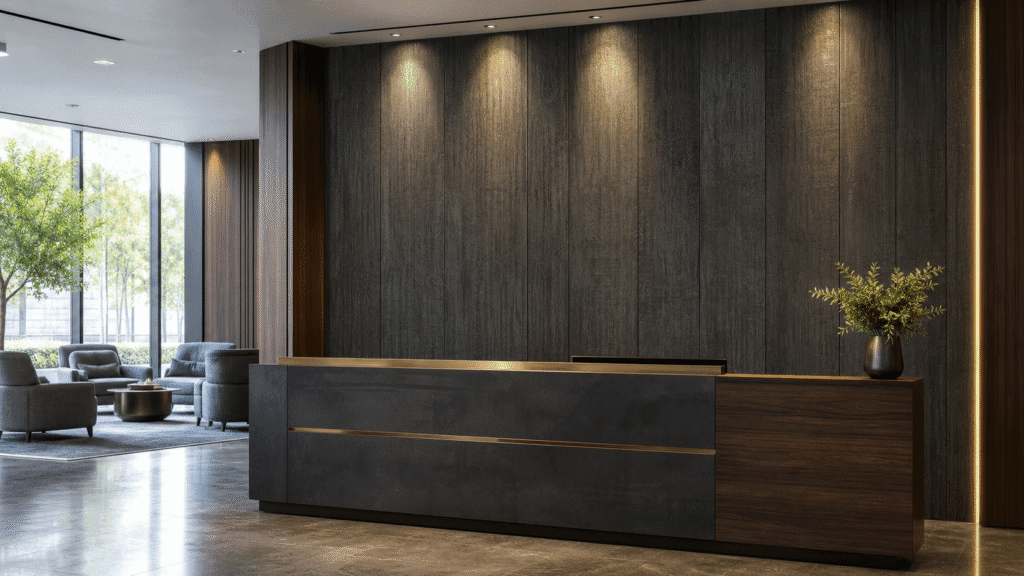
Bamboo Charcoal Panels for Education Campus Common Areas: Surface Durability, Compliance, and Phased Supply
Direct Answer: Bamboo charcoal panels can support education campus common areas when buyers match the panel construction and finish to student traffic, cleaning routines, impact zones, moisture conditions, and project documentation. Importers, school contractors, and project procurement teams should compare surface durability, module dimensions, fixing, edge protection, VOC and fire documents, maintenance guidance, packing, MOQ, lead time, and phased delivery. A factory-direct supply program can help contractors complete renovation zones while keeping future replacement manageable.
Why Education Common Areas Need a Practical Wall-Finish Strategy
Schools, universities, training centers, and campus facilities contain corridors, waiting areas, student lounges, library approaches, reception zones, stair landings, and collaboration spaces. These areas experience repeated movement, bags, furniture, cleaning equipment, signage changes, and occasional wall contact. Therefore, the wall finish must support everyday facility operations rather than only create a decorative backdrop.
Education projects also work around academic calendars. A contractor may receive a short holiday shutdown, a phased handover, or a sequence that keeps part of the building open. As a result, the supplier must coordinate panel quantities, color batches, packing, accessories, and lead time with the construction schedule. However, a visually attractive sample does not automatically satisfy local fire, VOC, maintenance, or warranty requirements.
For a wholesale distributor, education projects create repeat opportunities with school builders, university contractors, facility managers, public procurement teams, and interior design companies. A useful product line needs dependable neutral colors, clear technical files, protected edges, spare support, and reorder references. Meanwhile, the building contractor needs accurate dimensions, fixing guidance, and a delivery plan that fits around students and staff.
What Are Bamboo Charcoal Panels in Campus Interiors?
Bamboo charcoal panels are decorative interior wall panels that use a bamboo-charcoal-related material construction with a finished surface layer. Exact core composition, density, thickness, surface treatment, backing, edge profile, and accessory system vary by factory and model. Therefore, buyers should request a product-specific technical data sheet and sample.
Campus common areas may use wood-look, linear, fluted, solid-color, or stone-inspired finishes. Nevertheless, surface depth and texture affect cleaning, touch points, edge handling, and visual maintenance. A smooth panel may simplify routine wiping, while a textured surface may support a stronger design concept but require additional cleaning attention. In addition, the design team should review samples under the building’s lighting and alongside doors, benches, notice boards, and handrails.
Witop Decor can support importers, wholesale distributors, school contractors, university projects, and procurement teams with bamboo charcoal panel samples, color comparisons, technical data, bulk supply, custom colors, OEM/ODM packing, and project quotations. Buyers should verify VOC limits, fire-rating documents, cleaning guidance, moisture information, warranty terms, and any environmental claims for the selected SKU.
Specification Comparison for Education Campus Wall Panels
| Specification dimension | Why it matters in campus common areas | What B2B buyers should confirm |
|---|---|---|
| Panel construction | Core and surface structure affect weight, cutting, fixing, and handling. | Exact construction, thickness, density, backing, edge, tolerance, and recommended use. |
| Surface durability | Students, bags, furniture, and daily movement create repeated contact. | Surface guidance, impact locations, edge protection, cleaning limits, and replacement method. |
| Module dimensions | Repeatable modules simplify corridors, waiting areas, and phased renovation. | Panel size, usable coverage, joint design, cutting tolerance, and layout orientation. |
| Cleaning and moisture | Schools need repeatable maintenance across many rooms and operators. | Approved cleaning methods, chemical limits, moisture guidance, storage, and care sheet. |
| Fixture coordination | Handrails, signs, notice boards, doors, outlets, and benches interrupt the wall. | Backing, cutting guidance, interface drawings, access details, and load assumptions. |
| Substrate and fixing | Existing campus buildings may have mixed walls and renovation layers. | Substrate requirements, clip or adhesive guidance, preparation, and sequence. |
| VOC and fire information | Education and public projects may require documentation for interior finishes. | Current VOC data, fire documents where required, test reports, and scope. |
| Packing and phased supply | Academic schedules require protected cartons and zone-based delivery. | Carton protection, batch labels, spare policy, MOQ, lead time, and delivery sequence. |
In contrast, a residential design image may not show student traffic, cleaning teams, notice boards, or holiday installation windows. Therefore, importers should request a complete technical and commercial file before creating an education-sector product line.
Surface Durability at Bags, Benches, and High-Contact Routes
Students and staff place bags against walls, move chairs, carry equipment, and gather near doors and notice boards. A wall finish may also receive contact from cleaning carts, delivery trolleys, and furniture during room changes. Consequently, the project team should map lower-wall contact, corners, door returns, stair landings, and waiting areas before selecting the surface.
Ask the supplier to show internal corners, external corners, panel endings, skirting, top caps, handrail interfaces, notice-board edges, and transitions to paint or tile. The installer should understand how to replace one damaged module without dismantling an entire wall. Moreover, the quotation should separate panels, trims, protective accessories, spare pieces, and installation assumptions.
This structure helps the contractor prepare a realistic project cost and helps the facility plan future repairs. A small spare allowance can reduce disruption during the academic term. However, the spare must match the original color, surface, profile, and dimension, so the importer should keep a master sample and batch record.
Cleaning, Maintenance, and Multi-Operator Use
Education facilities often use standardized cleaning teams, but different campuses may use different products and schedules. Before approval, the buyer should request clear instructions for routine cleaning, marks, stains, storage, and repair. Buyers should not assume that every commercial cleaner suits every bamboo charcoal panel surface.
Surface texture influences cleaning time. A smooth finish may simplify wiping in a busy corridor, while a deeper profile may require more attention near seating, food areas, or entrance routes. Therefore, the project team should compare a larger sample with the actual maintenance tools and cleaning process.
A distributor can add value by providing a short facility care sheet with approved cleaning methods, chemical limits, moisture guidance, replacement steps, and the original product reference. Additionally, the importer can keep records by campus, building, room, color, batch, and profile so future orders remain traceable.
Compliance Documents and Responsible Product Claims
Education projects may require documentation for interior wall finishes. The exact requirement depends on the destination market, building type, project specification, and local authority. Therefore, buyers should request current VOC information, fire-rating documents where required, relevant test reports, installation guidance, cleaning limitations, and warranty terms.
Buyers should also separate verified product properties from broad marketing language. A material name alone does not prove low emissions, fire performance, moisture resistance, or environmental compliance. As a result, the technical file should identify the exact construction, surface, thickness, assembly, test scope, and applicable limitations.
For a wholesale distributor, a complete compliance folder can support contractor confidence and reduce repeated questions during tendering. Nevertheless, the importer remains responsible for checking whether the available documents meet the destination market and customer project requirements.
Coordinating Handrails, Doors, Signs, and Campus Services
Campus common areas include handrails, exit signs, room signs, notice boards, electrical outlets, access panels, cameras, fire equipment, doors, and protective rails. These interfaces affect the panel layout and the cutting plan. As a result, the contractor should coordinate elevations before production.
Confirm whether the selected panel system needs backing boards, clips, adhesives, rails, mechanical fixing, or a combination. Define who measures each opening, who cuts the panel, who supplies trims, and who approves changes after installation begins. In addition, protect access to equipment that facility staff must inspect later.
For campus networks, an importer may request custom colors, coordinated profiles, private-label cartons, or a standard common-area kit. Nevertheless, buyers should confirm MOQ, sample approval, development costs, artwork, lead time, spare stock, and repeat-order rules before launching the program.
Quality Control, Packing, and Holiday-Period Installation
A reliable bamboo charcoal panel program uses several quality gates. The factory should control incoming materials, panel dimensions, surface appearance, color, profile accuracy, edge quality, carton condition, accessory quantities, and loading sequence. The buyer can support this process with an inspection plan that defines acceptable visual variation, measurement tolerance, labels, packing, and claim handling.
Campus projects often move material through factory handling, container loading, warehouse storage, school loading areas, and active renovation zones. Review corner protection, face protection, pallet stability, moisture control, carton strength, and container loading photos. Additionally, separate buildings, floors, rooms, colors, batches, and delivery phases clearly so the contractor can locate the correct material.
For phased renovation, confirm what the installer should receive first, what can remain in storage, and how spare material will be protected until the next holiday period. Clear labels can reduce searching and help the contractor complete each zone within the approved closure window.
How Importers Can Build an Education Campus Program
A wholesale distributor can organize a focused line around light wood, warm wood, neutral grey, solid colors, and one or two accent finishes. Next, group each product by surface, profile, accessory system, recommended location, carton quantity, MOQ, and lead time.
For school contractors, confirm building type, room function, wall length, handrail and sign interfaces, corners, substrate, holiday schedule, and required documents. For university projects, confirm campus standards, building phases, maintenance responsibility, sample approval, and reorder process. Moreover, compare custom colors, OEM/ODM packing, container loading, inspection, phased delivery, and project quotation before the distributor commits to inventory.
Witopdecor can support sample evaluation, technical data comparison, bulk orders, custom colors, private-label packing, phased supply, and distributor communication. Buyers should confirm payment terms, export documents, warranty terms, and the process for handling shade, dimensional, or transit-damage claims.
Long-Term ROI: Compare Maintenance and Disruption Cost
The ROI of bamboo charcoal panels in education common areas includes panel cost, trims, protection accessories, packaging, freight, installation, substrate preparation, cleaning, repair, spare stock, storage, and building disruption. Therefore, the lowest factory unit price may not create the lowest total project cost.
For example, coordinated accessories can reduce rework around handrails and doors. Clear compliance documents can reduce tender delays. A traceable batch can simplify future replacement. Meanwhile, a standardized distributor line can support several buildings while keeping inventory manageable.
Record the assumptions behind the quotation, including impact zones, waste, spare quantity, storage period, delivery phase, labor, cleaning, and the academic schedule. This approach helps project procurement teams compare suppliers on delivered value and helps importers protect channel margin.
Supplier Checklist for Education Campus Bamboo Charcoal Panels
- Confirm construction, thickness, surface, profile, tolerance, flatness, weight, and recommended locations.
- Approve a physical sample and record color, gloss, texture, direction, profile, and batch reference.
- Map handrails, signs, notice boards, doors, outlets, cameras, access panels, corners, and lower-wall contact.
- Request technical data sheets, cleaning guidance, moisture information, VOC data, fire documents, test reports, and warranty terms.
- Confirm MOQ, sample approval, custom colors, OEM/ODM packing, container loading, inspection, and lead time.
- Discuss building-zone labels, spare profiles, reorder availability, holiday delivery, distributor support, and claims handling.
FAQ: Bamboo Charcoal Panels for Education Common Areas
1. Can bamboo charcoal panels work in school and university common areas?
They may suit selected campus areas when the construction, surface, fixing method, cleaning plan, impact protection, and project documents match the environment. Buyers should evaluate corridors, waiting areas, stair zones, and other locations separately.
2. How can contractors protect panels from student traffic?
Map bags, benches, door openings, handrails, furniture routes, and lower-wall contact. Then coordinate panels with corner trims, wall guards, skirting, and replaceable modules.
3. Which compliance documents should an importer request?
Request technical data sheets, VOC information, fire-rating documents where required, test reports, cleaning and moisture guidance, installation information, packing details, and warranty terms.
4. How should suppliers support holiday-period installation?
Confirm building zones, delivery phases, carton labels, accessory packs, storage conditions, inspection timing, spare quantity, and the installation sequence before production.
5. Can factories provide a private-label campus wall program?
Factories may discuss custom colors, coordinated profiles, OEM/ODM cartons, campus kits, and phased supply subject to MOQ, approval samples, development requirements, artwork, and lead time.
Request an Education Campus Bamboo Charcoal Panel Proposal
Bamboo charcoal panels create stronger B2B value in education common areas when buyers connect surface selection with student traffic, cleaning, compliance documents, fixtures, packing, phased delivery, and future replacement. Witop Decor works with importers, wholesale distributors, school contractors, university projects, and procurement teams that need factory-direct supply coordination.
Contact Witop Decor to request samples, compare bamboo charcoal panel technical data, discuss custom colors or OEM/ODM cooperation, review container loading, and prepare a project quotation. Include building type, common-area locations, wall dimensions, handrail and sign interfaces, destination market, academic schedule, required documents, and delivery phases so the factory can build a practical proposal.

James is a content creator and decorator with five years of experience designing home decor. In his daily life, james is constantly on the lookout for the latest, great examples of house design and further optimizes his solutions. Additionally, he writes articles related to outdoor design, interior design, and architectural decorating materials to help brands build more engaging relationships with their audiences.