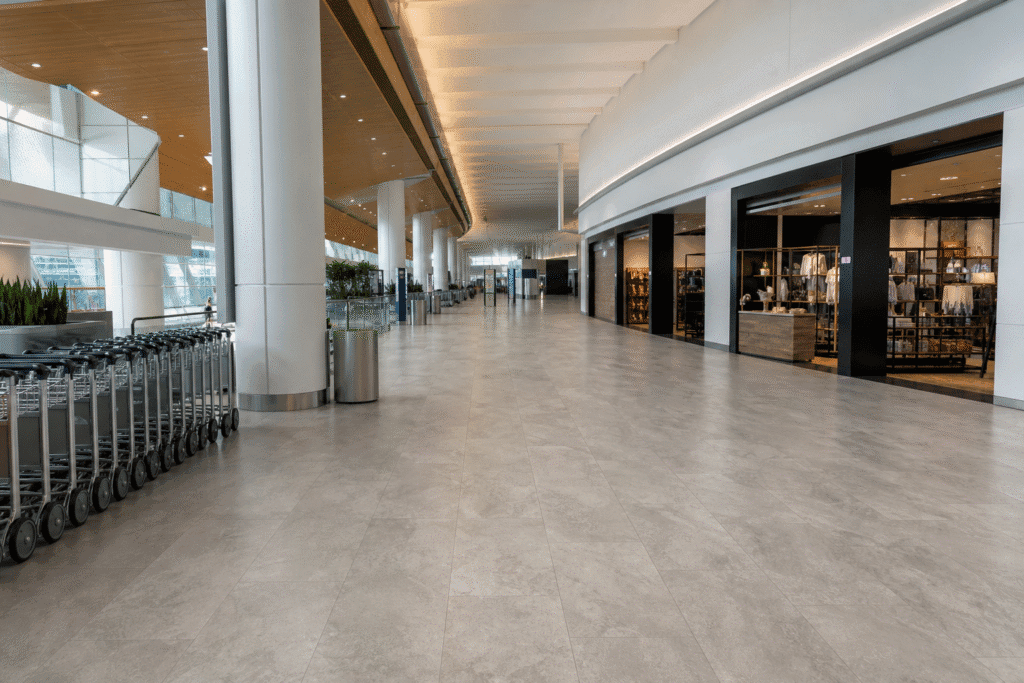
SPC Flooring for Airport Retail and Transit Terminals: Rolling Loads, Seam Control, and Phased Delivery
Direct Answer: SPC flooring can support airport retail and transit terminal projects when buyers match the product construction to rolling loads, foot traffic, cleaning routines, subfloor conditions, and restricted installation windows. Importers and contractors should compare the wear layer, rigid core, joint design, slip-resistance evidence, fire and VOC documents, color strategy, packing, and phased delivery plan. A reliable B2B supplier helps the project team control both installed cost and schedule risk.
Why Transit Flooring Requires a Different Procurement Logic
Airport retail units, railway terminals, coach stations, and ferry facilities operate under continuous movement. Travelers pull luggage, staff push carts, cleaners move equipment, and service teams transport stock through the same routes. Therefore, the flooring specification must consider rolling loads and repeated traffic rather than only a showroom appearance.
Transit projects also work under strict access and schedule conditions. A contractor may receive a short night installation window, a phased handover, or a zone that must open while another area remains under construction. As a result, flooring must arrive in clearly identified batches with predictable carton quantities, suitable accessories, and a documented installation method. However, a durable-looking product does not automatically meet every airport or terminal requirement. Buyers should match the selected SKU to the project specification and local approvals.
For a wholesale distributor, transport projects create opportunities across retail units, lounges, ticketing areas, staff corridors, and commercial concessions. An importer may need a compact product line with several stone and wood visuals, while a building contractor needs stable supply, fast technical responses, and accurate container loading information. Consequently, the supplier evaluation should include product data, logistics, project documentation, and reorder support.
What Is SPC Flooring in an Airport Retail Project?
SPC flooring uses a rigid core construction that combines mineral filler and polymer components with a decorative layer and protective wear layer. Exact formulas, densities, thicknesses, locking profiles, underlayment options, and surface finishes vary by factory. Therefore, buyers should compare the selected product’s technical data sheet rather than rely on the general term SPC flooring.
SPC flooring can provide a defined plank or tile format for retail interiors, commercial corridors, lounges, offices, and other project spaces. Nevertheless, the floor must work with the actual substrate, transition details, cleaning process, and movement pattern. A retail concession may need different performance evidence from a back-of-house route used by stock carts. Additionally, the design team should inspect samples under the terminal’s lighting because large public spaces can reveal shade and texture differences.
Witop Decor can support importers, wholesale distributors, retail contractors, interior companies, and project procurement teams with samples, technical comparisons, packing discussions, and bulk quotations. Buyers should still verify fire-rating documents, VOC limits, slip-resistance information, warranty terms, and local project approvals.
Technical Comparison for Airport and Transit SPC Flooring
| Specification dimension | Why it matters in a terminal | What B2B buyers should request |
|---|---|---|
| Wear-layer thickness | Foot traffic, grit, luggage wheels, and cart routes can affect surface life. | Available wear layers, test information, surface finish, and proposed-use guidance. |
| Rigid core and overall thickness | Thickness affects transitions, dimensional behavior, handling, and joint performance. | Exact construction, tolerance, density information, flatness, and edge details. |
| Rolling-load suitability | Retail stock carts and maintenance equipment create repeated concentrated loads. | Applicable load guidance, test data where available, and installation conditions. |
| Joint and locking system | Busy public floors need a clear installation sequence and controlled joints. | Click profile, approved installation method, expansion guidance, and accessories. |
| Slip-resistance evidence | Entrances and cleaning operations may introduce wet conditions. | Current test report and comparison with local project requirements. |
| Cleaning and chemical guidance | Terminals often use frequent cleaning and spill response. | Approved cleaning methods, chemical limits, and care instructions. |
| Packing and phasing | Night work and zone handovers require accurate cartons and batch control. | Carton quantity, pallet plan, container loading, batch labels, and delivery sequence. |
In contrast, a basic product listing often shows only the plank size and decorative pattern. Those details help initial selection, but they do not show how the floor will handle rolling traffic or restricted installation. Therefore, importers should request samples, technical data sheets, installation guidance, packing details, MOQ, and lead time before approving the product.
Rolling Loads, Luggage Wheels, and Surface Planning
Transit flooring faces many small repeated actions rather than one single heavy event. Luggage wheels cross thresholds, stock carts turn near retail counters, cleaning machines pass through service routes, and furniture moves during concession changes. Consequently, the project team should map the traffic pattern before selecting the wear layer and installation system.
Ask the contractor to identify high-turn areas, queue lines, retail entrances, cashier zones, storage routes, lift approaches, and transitions to other finishes. Next, compare the selected SPC flooring with the expected traffic and maintenance method. Buyers should not use a general durability statement as a substitute for product-specific evidence. Instead, request test data, warranty terms, and the conditions that support the proposed application.
Joint control also matters. A rigid floor can perform differently when the substrate, expansion gap, temperature, underlayment, or installation direction changes. Therefore, the contractor should confirm substrate flatness, moisture, movement, transition strips, door clearances, and expansion requirements before production. A controlled installation plan can reduce rework when the terminal must reopen a zone quickly.
Subfloor Preparation and Night-Shift Installation
Airports and terminals often schedule work outside peak passenger periods. That arrangement reduces disruption, but it creates pressure on the installation team. The floor must reach the site in the right batch, the substrate must be ready, and the accessories must arrive with the main cartons. Otherwise, a short work window can disappear before the crew completes the zone.
The project specification should define the required flatness, moisture condition, surface preparation, underlayment, adhesive or click method, and transition details. These requirements vary by product and local practice, so buyers should follow the supplier’s installation guidance and the responsible contractor’s approved method. In addition, the team should plan temporary protection for completed floors and define when the surface can accept traffic.
For phased delivery, label cartons by terminal zone, shop, color, batch, and installation sequence. Keep a small spare allowance for later repairs. Moreover, separate different project phases during container loading so the contractor can locate the right product without opening unrelated cartons. This approach supports faster handover and better inventory control.
Slip, Cleaning, Fire, and VOC Documentation
Transit buyers often ask whether SPC flooring is slip resistant, waterproof, fire rated, or suitable for public use. A responsible answer depends on the exact product, test method, installation, and local requirement. Buyers should verify slip-resistance test reports, fire-rating documents, VOC limits, warranty terms, and cleaning guidance against the destination market and project specification.
Cleaning teams may use damp mopping, spot cleaning, automatic machines, or approved chemical products. The supplier should identify cleaning limits and practices that could damage the surface, edge, or joint. As a result, the operator can prepare a realistic maintenance plan rather than assume that every cleaner suits every floor.
The technical file should identify construction, dimensions, wear layer, surface, installation, cleaning, documents, packaging, and warranty. Furthermore, a document for one thickness or assembly may not cover another version. Importers should keep the document linked to the SKU, batch, and customer project.
How Importers Can Build a Transit SPC Flooring Program
A wholesale distributor can build a focused line around several practical visuals: light stone, dark stone, warm oak, cool grey, and a controlled accent. Next, organize each product by wear layer, format, installation method, carton quantity, and recommended project use. This structure helps contractors compare products without creating an oversized slow-moving inventory.
For airport retail chains, confirm store format, brand colors, pilot location, rollout schedule, spare stock, and reorder rules. For terminal contractors, confirm zone quantity, night-work sequence, loading plan, access restrictions, and document requirements. Additionally, discuss MOQ, lead time, custom colors, OEM/ODM packing, container loading, inspection scope, and project quotation before the importer commits to the channel program.
Witopdecor can support sample evaluation, technical data comparison, bulk orders, custom colors, private label packing, phased delivery, and distributor communication. Buyers should confirm payment terms, export documents, warranty terms, and the process for handling shade, quantity, or damage claims.
Long-Term ROI: Calculate Total Installed Terminal Cost
The ROI of SPC flooring in a terminal includes product, accessories, packaging, freight, import handling, substrate preparation, installation labor, night-shift work, protection, spare cartons, cleaning, replacement, and downtime. Therefore, buyers should compare total installed cost rather than factory unit price alone.
For example, accurate cartons and clear batch labels can reduce time spent searching for material during a night shift. A suitable joint system can reduce adjustment work when the contractor follows the approved substrate and installation method. A spare-stock plan can shorten future repair preparation. Moreover, a consistent distributor SKU program can support several retail units without carrying every possible design.
Record the assumptions behind the quotation. Include expected waste, phase quantity, local storage, container loading, delivery sequence, and maintenance. This method gives the project procurement team a more reliable comparison between suppliers and helps the importer protect channel margin.
Supplier Checklist for Airport Retail SPC Flooring
- Confirm construction, wear layer, thickness, format, surface, edge profile, tolerance, and rolling-load guidance.
- Request a physical sample and approve color under the terminal’s lighting conditions.
- Verify installation, subfloor, cleaning, slip, VOC, fire, test, and warranty information.
- Review transition details, expansion, doors, lifts, retail fixtures, temporary protection, and night-work sequence.
- Confirm MOQ, sample approval, custom colors, OEM/ODM packing, container loading, inspection, and lead time.
- Discuss batch labels, zone packaging, spare cartons, reorder availability, and claim handling.
FAQ: SPC Flooring for Airport Retail and Transit Terminals
1. Can SPC flooring handle airport retail traffic?
It may suit airport retail when the selected construction, wear layer, joint system, substrate, cleaning plan, and project documents match the traffic and local requirements. Buyers should compare product-specific evidence rather than rely on a general label.
2. What should buyers check for luggage wheels and carts?
Map cart routes, turning zones, retail entries, stock paths, and transitions. Then request applicable load guidance, test information, wear-layer options, installation requirements, and warranty conditions.
3. How can contractors manage night-shift installation?
Prepare the substrate early, confirm the installation method, label cartons by zone and batch, coordinate accessories, protect completed areas, and plan the delivery sequence around the available work window.
4. Which documents should an importer request?
Request technical data sheets, wear-layer details, installation guidance, cleaning limits, slip-resistance information, VOC information, fire-rating documents where required, test reports, packing details, and warranty terms.
5. Can distributors supply custom SPC flooring colors for retail chains?
Factories may discuss custom colors and OEM/ODM packing subject to MOQ, material availability, approval samples, artwork, and lead time. Confirm repeat-order rules before launching a chain program.
Request a Transit Terminal SPC Flooring Proposal
SPC flooring creates stronger B2B value in airport retail and transit terminals when buyers manage rolling traffic, joints, subfloors, documents, cleaning, packing, and phased delivery together. Witop Decor works with importers, wholesale distributors, retail contractors, and project procurement teams that need factory-direct supply coordination.
Contact Witop Decor to request SPC flooring samples, compare wear-layer and installation options, discuss custom colors or OEM/ODM cooperation, review container loading, and prepare a project quotation. Include the terminal zone, estimated area, traffic pattern, installation window, destination market, document requirements, and delivery phases so the factory can build a practical proposal.

James is a content creator and decorator with five years of experience designing home decor. In his daily life, james is constantly on the lookout for the latest, great examples of house design and further optimizes his solutions. Additionally, he writes articles related to outdoor design, interior design, and architectural decorating materials to help brands build more engaging relationships with their audiences.