Quick Answer: Can a Display Bracket Attach Through a Decorative Sheet?
A decorative sheet should not automatically be treated as structural backing for a display, sign or shelf. Before project procurement, identify the fixture load, fixing path, backing construction and panel cutout. Then have the responsible designer or contractor approve the complete assembly for the intended use. Ask the supplier for the exact product instructions and confirm who provides backing and who installs the fixture.
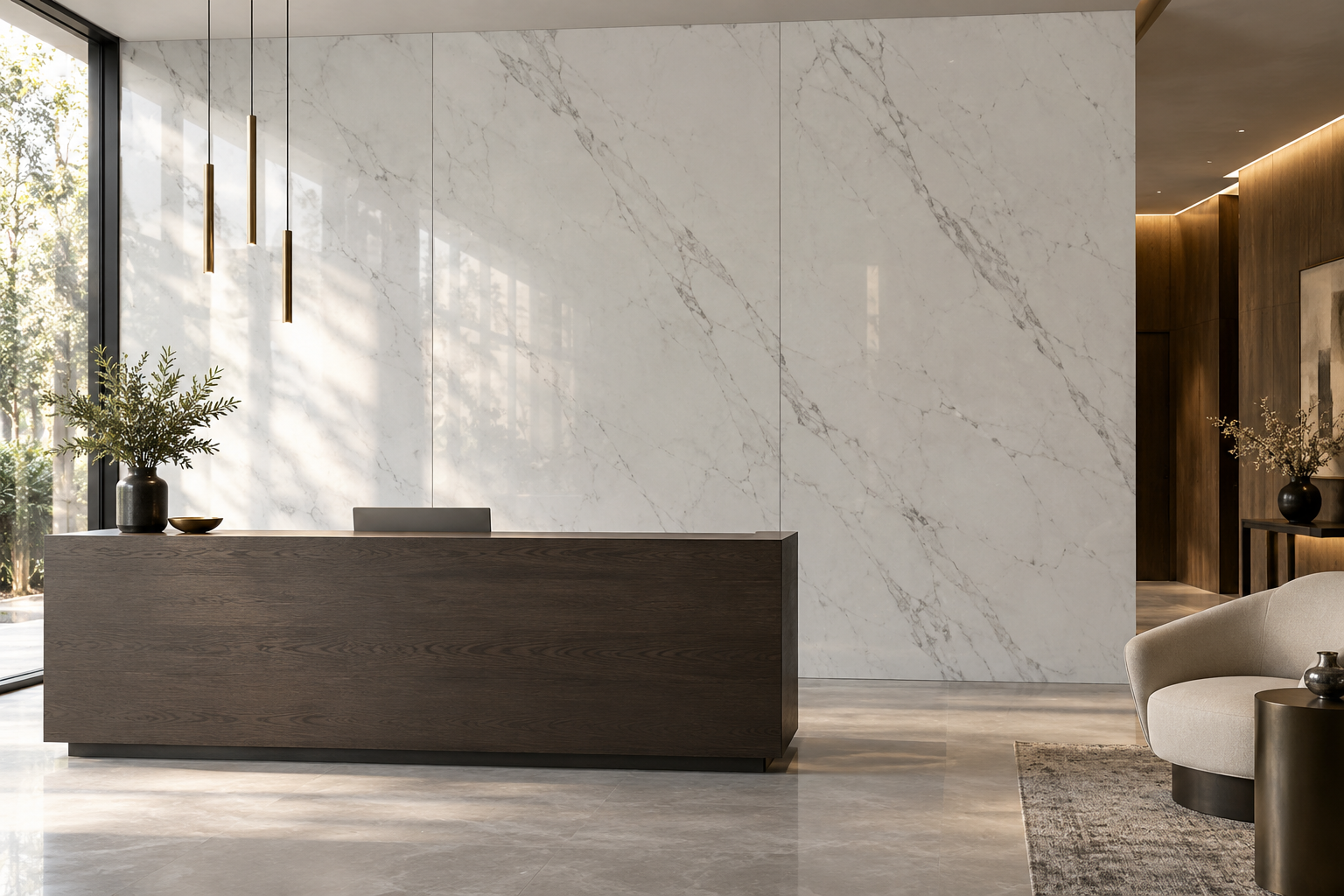
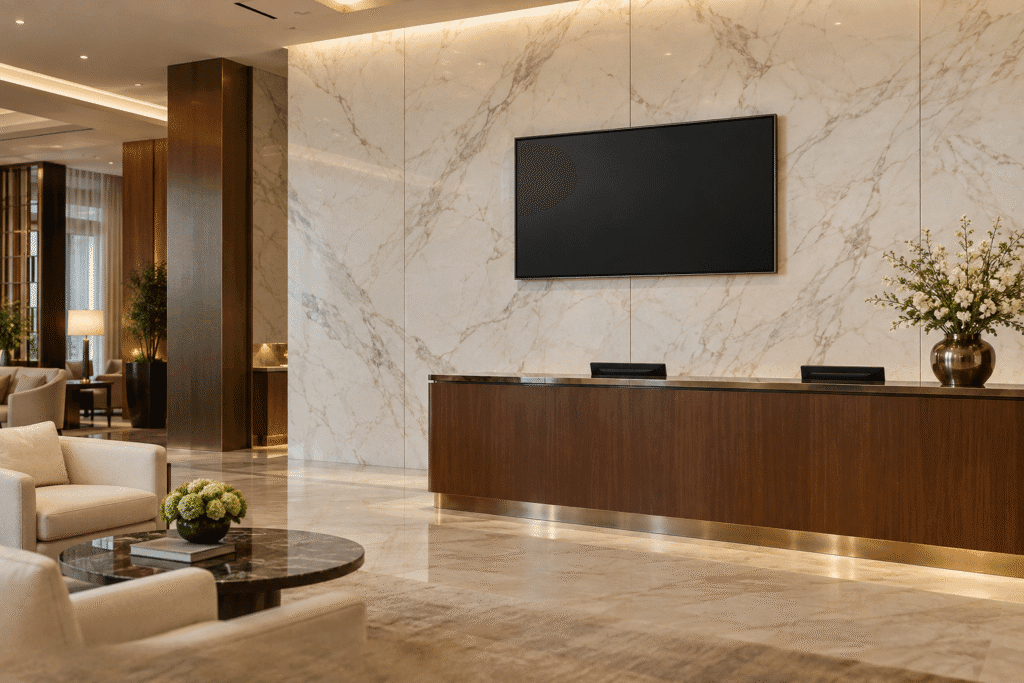
A completed hotel reception may feature ivory marble-look UV sheets behind a digital directory, artwork or brand sign. The visible sheet creates the decorative background, while the project team coordinates how each mounted item attaches. This is a design scenario, not proof that a Witop panel supports any load or a representation of an actual customer installation.
Put Fixtures on the Elevation Before Ordering
Start with a dimensioned wall elevation. Mark display screens, directory signs, shelves, wall lights, artwork, receptacles and access panels. Include the mounting plate dimensions, cable route and service clearance requested by the equipment supplier. A note that simply says “feature wall” gives an importer too little information to plan cuts, backing or finished edges.
Next, assign a wall ID and drawing revision. This lets the building contractor locate each fixture and gives the decorative building materials supplier one version to review. If the screen moves after sample approval, update the elevation and quantity schedule before issuing a production release. Otherwise, a cutout can land behind a bracket or interfere with the intended joint layout.
Separate the Decorative Surface from the Fixing Structure
Ask the project team to state which layer carries each fixture. The decorative sheet may cover a separate support or backing, but the actual load path depends on the designed assembly. Confirm the backing type, fixing method, fixture weight and any service access requirement with the responsible parties. Do not assume that adhesive attachment of a decorative sheet makes it suitable to retain a mounted item.
Request the technical specifications and installation guidance for the exact UV marble sheet SKU. Ask which cutting, edge finishing and attachment details the supplier documents. Separately, the fixture supplier and project designer should confirm their mounting requirements. Keep these documents together so no one treats a decorative finish sheet as a universal anchor board.
| Coordination item | Information to show | Approval question |
|---|---|---|
| Display or sign | Size, weight, mounting plate and location | Which backing carries the fixture? |
| Cable route | Entry point, exit point and service loop | Does the route conflict with a panel joint? |
| Panel layout | Sheet direction, joints, corners and finish | Where should the cutout fall? |
| Access panel | Opening size and removal direction | Can technicians reach the connection later? |
| Edge finish | Trim, return, reveal or frame | Who supplies and installs each visible edge? |
| Responsibility | Supplier, contractor, fixture team and designer | Who approves the complete assembly? |
This schedule organizes a review. It does not supply engineering calculations or establish permitted loads for any product.
Coordinate Cutouts and Service Access
A screen or illuminated sign often needs a cable opening. Mark the center and size of that opening on the same drawing as the UV sheet joints. Ask the installer to confirm the proposed cut does not leave an unsupported or visibly narrow edge. Also determine whether the equipment requires periodic removal. In that case, design service access before closing the decorative wall.
For example, a hotel directory may use a wall bracket with concealed cables. The decorative panel can surround the fixture, but the designer should decide whether the bracket passes through a finished opening, a trim frame or a removable panel zone. Each option affects the visible seam and future maintenance cost. Therefore, get an approved detail instead of asking the installer to improvise at the site.
Compare Three Fixture-Interface Approaches
A project team may evaluate three broad approaches: mount through a planned opening to separate backing; align the fixture with a framed access zone; or keep equipment off the decorative wall using a floor-standing or joinery-supported unit. The choice depends on the equipment and approved wall design.
The first approach may give the cleanest appearance, but it requires coordinated backing and precise openings. A framed access zone can make service work clearer, while adding trim and a visible perimeter. A separate support can reduce penetrations in the decorative surface, but it changes furniture and circulation planning. Compare installation cost using the same fixture, finish area and service requirement rather than comparing panel price alone.
During sample evaluation, review a finish sample beside the proposed frame, metal trim and screen. A small sample does not validate the actual cutout or fixture attachment; use a marked elevation or mockup to evaluate the interface. Moreover, record which visual attributes the sample approves: color, gloss, texture or pattern.
Price Scope, Accessories and Reorder Conditions
The importer should separate UV sheets, backing material, trims, cutout work, cable access and fixture installation in the quotation. Confirm MOQ and lead time for the main sheets and any custom profile. If the project combines multiple wall codes in one container loading plan, keep the finish and accessory references identifiable on the packing list.
For a wholesale distributor, a clear schedule helps explain what belongs to the panel supply and what remains in the contractor’s scope. It also supports repeat orders when the hotel adds another reception or lobby. Retain the approved finish reference, fixture drawing, panel layout and revision date. If the contractor changes the display size, review the interface again rather than reusing the old cutout dimensions.
Estimate maintenance cost from the service procedure and approved care instructions. Buyers should verify test reports, VOC limits, fire-rating documents and warranty terms for the exact product construction and intended location. A fixture detail does not establish any of those product properties. If custom colors or OEM/ODM cooperation changes the sheet surface, ask for updated documents and a new sample evaluation.
Lock the Schedule and Change-Control Point
List the fixture reference beside each wall code in the purchase schedule. Also note which party supplies brackets, backing and any access frame. This prevents the panel quotation from quietly absorbing hardware that the equipment supplier expects the contractor to provide. Meanwhile, the contractor can price openings and edge finishing against one coordinated elevation.
Before production, agree when the design becomes fixed. If the owner moves a sign or changes a display, send a revised drawing and ask which panel quantities or cut details change. Additionally, confirm the new access position. In addition, confirm whether a revised cut schedule affects lead time. Keep the previous revision on file so the purchasing team can trace which version supported each quotation. Moreover, mark the superseded plan clearly. Therefore, a later reorder can start from the correct reference instead of an email description of the feature wall. Likewise, retain the approved sample code.
B2B Buyer FAQs
Can a UV marble sheet hold a wall-mounted display?
Do not assume so. Identify the assembly and ask the responsible designer or contractor to approve the backing and fixing path for that fixture.
Should cable openings follow the sheet joints?
The drawing should coordinate both, but the appropriate placement depends on the panel layout, edge details and equipment requirements. Obtain an approved cutout plan.
Who supplies the backing and fixture hardware?
Name each party in the scope schedule. The panel quotation alone may not include structural backing, brackets or installation labor.
How can buyers plan future maintenance?
Mark the cable route and access panel on the elevation. Confirm how technicians remove the display and reach connections without damaging the decorative finish.
What should an importer include in a project quotation request?
Send marked elevations, fixture dimensions, approximate quantities, destination and finish reference. Request samples, technical data sheets, MOQ, lead time and a complete project quotation from Witopdecor.

James is a content creator and decorator with five years of experience designing home decor. In his daily life, james is constantly on the lookout for the latest, great examples of house design and further optimizes his solutions. Additionally, he writes articles related to outdoor design, interior design, and architectural decorating materials to help brands build more engaging relationships with their audiences.