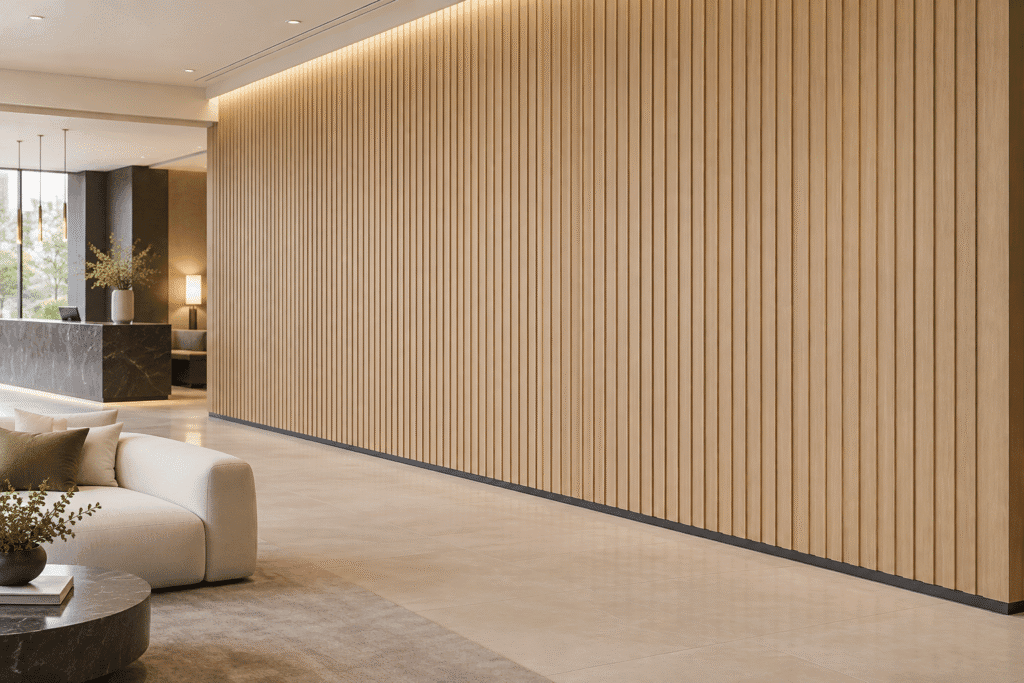
Quick Answer: Which Fluted Profile Should a Hotel Buyer Choose?
Choose WPC wall panels by comparing the complete groove shape, surface finish and cleaning access in a representative lobby wall sample. A shallow profile may simplify access, while a deeper profile can create a stronger shadow pattern. However, depth alone cannot predict cleaning time or durability. Ask housekeeping staff to evaluate the proposed finish and record their actual routine before project procurement approves the bulk order.
A hotel wall remains in service long after the opening photographs. Therefore, the importer, wholesale distributor and building contractor should treat recurring wall care as a specification issue. A low panel price can lose its advantage when staff need extra passes, special access equipment or frequent local repairs. The useful question is how the selected profile supports the operator’s working day.
Define the Wall’s Exposure Before Comparing Profiles
Separate the lobby into arrival routes, reception backdrops, seating areas and quieter upper wall sections. Guests, luggage, housekeeping carts and furniture create different contact conditions. Moreover, air movement and nearby doors can change where visible dust collects. Record these conditions on elevations instead of assuming that every square meter needs the same maintenance routine.
Next, identify what staff can actually reach. A narrow gap behind a fixed cabinet may matter more than the difference between two groove depths. Confirm the intended access method for high areas, adjacent lighting and panel terminations. Ask the facilities team to accept the layout before the designer freezes the finish selection.
Witopdecor lists fluted WPC wall panel options and decorative trims in its product range. Use those categories to start a sample request; obtain model-specific drawings and technical specifications before assigning any cleaning or performance advantage to a profile.
Compare Groove Geometry as a Complete System
The visible face width, groove opening, recess depth and corner shape work together. Consequently, a single dimension such as total panel thickness tells the buyer little about maintenance access. Request a cross-section and a physical sample that includes several repeats, one joint and the proposed edge trim.
| Specification dimension | Question for sample evaluation | Purchasing implication |
|---|---|---|
| Groove opening | Can the approved cloth or soft attachment reach the recess? | Determines practical cleaning access |
| Recess depth | How many passes does the trial require? | Informs labor assumptions |
| Internal corner shape | Does residue remain after the approved routine? | Identifies a detail that needs review |
| Surface texture | Does wiping change the visible appearance? | Supports finish acceptance |
| Joint and trim | Can staff clean the junction without catching an edge? | Coordinates the complete wall system |
| Installed height | Can staff reach every approved cleaning zone? | Adds access time to the cost model |
Avoid declaring one profile universally easier to maintain. For example, a wider, deeper groove may offer better tool access than a very narrow shallow groove. Likewise, two panels with similar geometry may use different surface constructions. Compare the actual offered SKUs under the same conditions.
Run a Repeatable Cleaning Trial Before Bulk Approval
Ask the supplier for written care instructions first. Then agree a trial with the hotel operator using only compatible materials and methods. Do not invent a universal cleaner concentration, abrasive treatment or steam-cleaning allowance for the product category. The selected finish, adhesive, joints and trims need their own review.
Build a representative wall bay and keep an untouched control sample. Record the finish code, batch reference, orientation, lighting, cleaning material and method. Additionally, document the type and location of ordinary marks that the operator wants to assess. Obtain supplier agreement before applying any potentially damaging substance to a sample.
Time the whole task: preparing equipment, reaching the wall, cleaning the face, reaching the recesses, checking the result and putting equipment away. Repeat the agreed routine enough times to compare operators and methods fairly. However, describe the results as a project screening exercise; a short trial cannot establish the wall’s full service life.
Inspect the dry surface from normal guest viewpoints as well as close range. Look for remaining soil, gloss changes, scratches, lifted edges and visible differences from the control. Record photographs under consistent lighting. If the team changes the cleaner or attachment, give that trial a new revision rather than combining incompatible results.
Translate Cleaning Time into an Honest Cost Comparison
Use a transparent model: annual routine labor equals wall area multiplied by minutes per square meter per cleaning event, multiplied by events per year, divided by sixty, multiplied by the hourly labor rate. Next, add access preparation, consumables and any separate periodic work. Keep repair allowances outside routine cleaning so the buyer can see each assumption.
For illustration only, assume a 100-square-meter wall, twelve cleaning events annually and labor at USD 18 per hour. A trial difference of one minute per square meter per event creates twenty additional labor hours, or USD 360 annually. These figures are hypothetical, not measured Witopdecor performance, a recommended cleaning frequency or a savings promise.
Therefore, compare any purchase premium with the operator’s own trial results. Also include installation cost, trim quantities, replacement access and maintenance cost. If access preparation dominates the calculation, redesigning a furniture junction may offer more value than changing the entire panel range.
Keep Finish Durability Separate from Appearance Preference
A dramatic shadow line can support the design concept without proving scratch resistance. Similarly, a surface that looks clean in a photograph may retain marks under the hotel’s actual lighting. Ask for relevant durability evidence and evaluate the proposed finish against the project’s exposure conditions.
Moreover, buyers should verify test reports, VOC limits, fire-rating documents and warranty terms for the exact product and intended assembly. Check the product identity, report scope and mounting conditions. A decorative groove pattern does not establish acoustic performance, and an attractive wood appearance does not identify the material’s fire rating.
Ask who authorizes a change in the surface film, coating, profile or compatible care products. A substitution can alter the approved cleaning routine even when the color name stays the same. Consequently, the purchase order should reference the accepted sample and require written review of relevant changes.
Build the Bulk Order Around the Approved Wall Bay
Give the decorative building materials supplier a schedule that connects each wall zone to a profile, finish, trim and care instruction. Confirm MOQ by finish and profile, production lead time, packing protection and container loading assumptions. Do not quote nominal panel width as finished coverage without checking the joint arrangement.
Additionally, plan spares by repair zone and reorder risk. A small quantity of the wrong trim cannot complete a local repair. Keep matching finish references and clarify how the operator can replace a damaged section without unnecessarily disturbing neighboring panels. Record responsibility for the substrate and installation details separately from the panel warranty.
B2B Buyer FAQ
Are shallow grooves always easier to clean?
No. Opening width, corner geometry, finish and access all matter. Compare representative samples with the operator’s approved method. A product photograph cannot establish cleaning time.
Can the buyer use any general-purpose cleaner?
No. Request written compatibility guidance for the exact finish and assembly. Furthermore, review the proposed concentration and method before the operator adopts a cleaner.
Should distributors stock only one flute depth?
Let customer applications and reorder demand guide the range. A focused selection can simplify inventory, but one profile may not satisfy every visual brief or maintenance condition.
What should a sample request include?
Request the profile section, several connected repeats, the actual finish, a joint, an edge trim and care instructions. Include the hotel’s wall height and exposure description so the supplier can respond accurately.
How should the project judge long-term ROI?
Combine verified installed cost with realistic cleaning, access, repair and spare-stock assumptions. Use trial data and sensitivity ranges; avoid presenting a single unverified saving as a guaranteed result.
Request a Specification-Based Project Quotation
Send Witop Decor your lobby elevations, preferred flute effect, cleaning routine and order quantities. Request samples, technical data sheets and a project quotation covering profiles, trims, custom colors, packing and container loading. For wholesale programs or OEM/ODM cooperation, align the approved care instructions with the distributor’s product information before placing a bulk order inquiry.

James is a content creator and decorator with five years of experience designing home decor. In his daily life, james is constantly on the lookout for the latest, great examples of house design and further optimizes his solutions. Additionally, he writes articles related to outdoor design, interior design, and architectural decorating materials to help brands build more engaging relationships with their audiences.