Quick Answer: When Does a Custom Length Make Sense?
Choose custom lengths for WPC wall panels when a confirmed dimension schedule creates enough repeat demand to justify the supplier’s production conditions. Compare usable output, order minimums, remaining inventory and later replenishment against available standard lengths. However, do not equate a shorter offcut with a lower total cost. A custom order can improve cutting yield while leaving costly surplus pieces or a difficult small reorder. Ask for both options against the same approved specification.
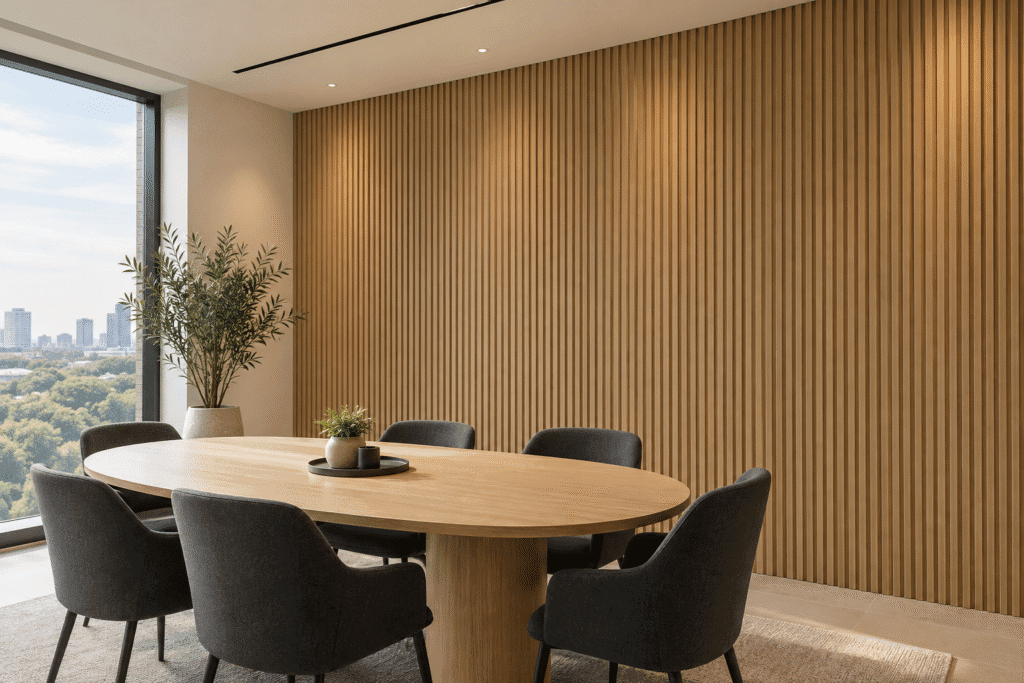
A finished meeting room may use full-height light-oak-look panels, while a hotel lounge uses walnut-look panels beneath a lower ceiling and along shorter wall sections. Therefore, project procurement should group actual required panel lengths before choosing a supply format. Total wall area alone cannot explain that distribution.
Distinguish Catalogue Length from Available Stock
Ask whether a standard length means a regular manufacturing size or inventory ready for allocation. These are different supply conditions. Also confirm the profile, finish, quantity and location behind any availability statement. An importer cannot build a reliable schedule around a stock description that refers to another color or product revision.
Witop Decor lists a custom-size WPC panel product, providing an inquiry route for project-specific requirements. However, buyers should confirm available lengths and commercial conditions for their selected profile in the quotation. The page does not establish a universal stock program or a custom length that every order can obtain.
Turn Wall Elevations into a Length Schedule
Have the building contractor identify required cut lengths from approved elevations and site dimensions. Account for the specified installation clearances, trims and finishing details. Then group identical or compatible lengths with their quantities, keeping different profiles and finishes separate. Do not substitute an average room height for this schedule.
For example, a meeting-room wall and a hotel lounge may share a panel profile but require different finished heights. Also separate short returns or wall sections that can accept compatible remaining material. Identify these uses before assigning value to an offcut. A leftover piece without a confirmed destination is potential inventory, not an immediate saving.
Confirm who approves dimensions and the deadline for changes. Additionally, ask what happens if the final site survey arrives after a custom production commitment. A small change in the required length can invalidate a carefully planned order, even when the total wall area barely changes.
Compare Yield with Explicit Assumptions
Consider a hypothetical order requiring 100 pieces, each 2.65 m long. Assume the proposed production plan has already allowed for trimming and cutting losses, and each supplied panel yields one acceptable piece. Compare a 3.00 m supply length with a 2.70 m alternative. These numbers illustrate purchasing arithmetic; they are not Witop specifications or recommended installation allowances.
The required output totals 265 linear meters. Buying 100 pieces at 3.00 m supplies 300 linear meters, giving an output-to-input ratio of about 88.3%. Buying 100 pieces at 2.70 m supplies 270 linear meters, raising that ratio to about 98.1%. Nevertheless, the ratio alone does not show the custom production charge or order minimum.
If the hypothetical custom minimum requires 120 pieces, the buyer purchases 324 linear meters. Against the original 265-meter requirement, immediate project utilization becomes about 81.8%, with 20 complete surplus pieces. This does not make custom supply inherently worse. Instead, it shows why buyers should compare the full purchase quantity and realistic reuse demand, rather than only the yield of one cut.
For a schedule with several shorter sections, also test whether one longer panel can produce multiple required pieces. Include the actual cutting allowance and check face direction, finish continuity and acceptable end condition. Then compare that cutting plan with separate short-length orders. A longer supply length may offer useful combinations that a single-height calculation overlooks. Have the contractor validate the plan before treating its expected output as available material.
Compare Three Supply Strategies
Request a quotation for each feasible approach and keep its assumptions visible. A mixed order may combine common lengths for uncertain areas with custom lengths for repeated confirmed sections. However, additional length references can create handling and allocation work, so assess that effort alongside material utilization.
| Decision point | Standard lengths | Custom lengths | Mixed length order |
|---|---|---|---|
| Demand basis | Several changing requirements | Repeated confirmed dimensions | Separate stable and uncertain zones |
| Quantity check | Available packs and allocations | Minimum per length and finish | Minimum for each order line |
| Yield review | Approved cutting combinations | Output after agreed end preparation | Separate plans for each length |
| Residual stock | Possible use across projects | Possible narrow reuse market | More references to track |
| Reorder question | Actual availability at reorder | Repeat production conditions | Which route covers small quantities? |
Ask whether the MOQ applies per profile, color, length or total order. Also confirm how pack quantities affect the final purchase. Combining several room types on one spreadsheet does not mean the supplier can combine them under one production minimum.
Calculate Cost per Accepted Project Quantity
Compare total quoted supply, relevant logistics, allocation work and installation cost against the accepted project requirement. State any expected value for surplus inventory separately. Otherwise, a wholesale distributor may assume that a project-specific length will sell quickly even when its other customers need different dimensions.
Request the lead time for initial supply and a smaller repeat order. Also ask about cancellation or amendment terms before committing to custom production. A lower theoretical cutting loss offers limited benefit if a late design change leaves the business holding panels it cannot readily redeploy.
For container loading, confirm the actual packaged dimensions and mixed-length handling plan with the supplier. Keep this check specific to the offered order; do not assume that fewer linear meters always reduces freight charges or creates usable loading space.
Plan Reorders Before Approving a Special Length
Ask the decorative building materials supplier how it would supply a small later requirement. Can a compatible standard length serve the repair after approved cutting, or would the buyer need another custom run? Obtain a written response with its limitations, including finish availability and any revised commercial conditions.
Retain the profile drawing, finish reference and agreed length specification with the purchasing record. Moreover, distinguish compatible replacement material from an exact visual match after the original wall has aged. Reorder flexibility can influence maintenance cost, but it does not guarantee invisible repairs or continued availability indefinitely.
Keep Length Optimization within the Approved Specification
During sample evaluation, confirm the appearance and relevant technical specifications for the proposed product. Length optimization does not justify changing its construction, finish or installation system. Likewise, assess durability against the intended room use rather than assuming a longer or shorter panel performs better.
Buyers should verify test reports, VOC limits, fire-rating documents and warranty terms for the selected product and assembly. Ask which evidence supports any stated fire rating, and review relevant VOC information for accompanying materials. These checks remain necessary regardless of the supply length.
B2B Buyer FAQs
Are standard lengths always ready to ship?
No. Confirm actual allocated quantity, finish and shipping readiness. A standard manufacturing size can still require production, especially when the selected color is unavailable.
Does custom length mean no site cutting?
Not necessarily. The approved installation details, site variation and end preparation may still require cutting. Define the delivered length and expected site work in the order.
Can we combine different custom lengths under one MOQ?
Ask the supplier explicitly. Minimums may depend on individual length, color or profile combinations. Record the answer for every quoted order line.
Should buyers credit every offcut as reusable?
Only assign practical value when a confirmed compatible use exists. Consider handling, identification and storage as well. Unassigned leftovers should not automatically offset the purchase cost.
What information supports a useful quotation?
Send the profile, finish, length schedule, quantities and delivery phases. Request samples and technical data sheets from Witopdecor, then discuss custom colors and OEM/ODM cooperation. For a bulk order inquiry, ask for a project quotation comparing feasible length options and their reorder conditions.

James is a content creator and decorator with five years of experience designing home decor. In his daily life, james is constantly on the lookout for the latest, great examples of house design and further optimizes his solutions. Additionally, he writes articles related to outdoor design, interior design, and architectural decorating materials to help brands build more engaging relationships with their audiences.